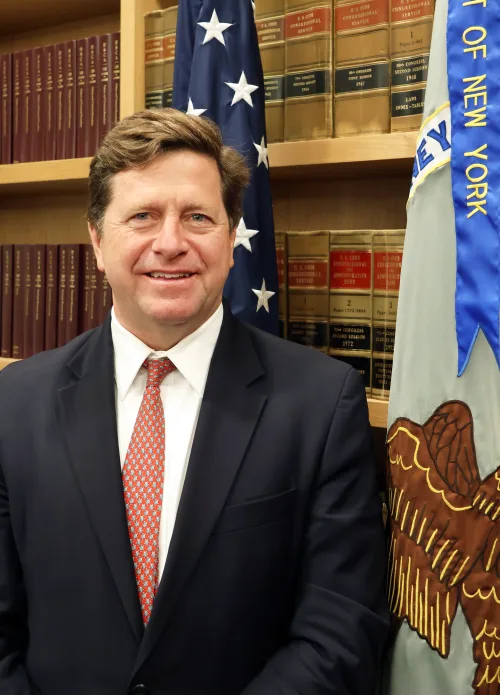
America's most important counter-terrorism surveillance program has gone dark for the first time in its history, the guy tapped to run it couldn't say who won the 2020 election to the satisfaction of a Senate committee, and the man briefly put in charge of 18 intelligence agencies in the interim was also running the Federal Housing Finance Agency. But sure, everything's fine. The Senate voted 51-43 Monday night to advance Jay Clayton toward becoming the next Director of National Intelligence, which Fox News reports puts the country one step closer to reviving Section 702 of the Foreign Intelligence Surveillance Act, a program that has literally stopped mass-casualty terror attacks.
So Who Is Jay Clayton, Exactly?
Clayton ran the Securities and Exchange Commission during Trump's first term. He is not, by any traditional measure, a spy. He's a finance regulator turned U.S. Attorney for the Southern District of New York, and now Trump wants him overseeing the entire American intelligence apparatus.
He cleared the Senate Intelligence Committee on a 9-to-8 vote. That's not a ringing endorsement. That's a squeaker. That's winning a game of musical chairs because someone tripped.
Before Clayton's committee vote, Senate Democrats had a list of concerns. According to Fox News, they pressed him on who won the 2020 election, his awareness of former DNI Tulsi Gabbard's raid on Fulton County, Georgia election offices, and subpoenas he issued against New York Times reporters while serving as a federal prosecutor. Clayton apparently didn't give answers satisfying enough for a single Democratic vote. Only Republicans moved him out of committee.
The Subpoena Thing Is Worth a Full Stop
Let's sit with that for a second. Clayton, while serving as the top federal prosecutor in the Southern District of New York, issued subpoenas against journalists at the New York Times. As Fox News notes, those subpoenas were voluntarily withdrawn by the Department of Justice last week, two days after Clayton was confirmed out of committee.
The timing on that withdrawal is not subtle. It has the energy of someone frantically clearing their browser history right before a job interview.
And yet, here we are. The Senate's majority voted to move him forward anyway, because that is where we are as a country in the summer of 2026.
How We Got a Housing Finance Guy Running Intelligence
To understand the current chaos, you have to go back to Tulsi Gabbard's exit. The former DNI left her post to care for her husband, who is battling cancer. That is genuinely a sympathetic reason to leave a job, and this article will not editorialize on it.
What followed, however, is fair game. Trump's response to losing his intelligence director was to install Bill Pulte, the Director of the Federal Housing Finance Agency, as acting DNI. Pulte is now temporarily running 18 intelligence agencies while also, presumably, still running the FHFA. As Fox News reports, Pulte announced on X that he had just completed his fourth round of layoffs at the Office of the Director of National Intelligence, calling them "thoughtful" and "measured" in a social media post that ended with "Thank you!"
Democrats, who had been close to a bipartisan deal to reauthorize Section 702, walked away from the table after Trump torched Clayton's previously scheduled confirmation hearing, according to Fox News. They refused to cut any deal that would hand Pulte, a man they called an unqualified loyalist, expanded surveillance powers. That standoff is directly why the program went dark.
Section 702 and the Taylor Swift Attack That Didn't Happen
Section 702 of FISA is the program the government uses to surveil foreign targets on foreign soil, including communications that may pass through American networks. It is not a small thing. Fox News reports that it was used to thwart a mass-casualty terror plot targeting a Taylor Swift concert in Vienna, Austria. That attack did not happen because of this program.
It has now lapsed. New authorizations are sitting in a legal void, Fox News reports, because Congress couldn't get its act together before skipping town while the World Cup was happening. That sentence sounds made up. It is not made up.
The program is described by both parties as the nation's most important counter-terrorism tool, and it went dark anyway, because of a chain of events that started with a partisan fight over a housing regulator being handed the keys to the intelligence community. The stakes of bureaucratic chaos are not always abstract.
Where Things Stand Now
The final Senate confirmation vote on Clayton is scheduled for Tuesday. Senate Majority Leader John Thune took the floor to chide Democrats for not supporting Clayton, framing their opposition as pure partisanship. "Democrats have made no secret of their disdain for the current acting Director of National Intelligence," Thune said, per Fox News, essentially acknowledging that the entire crisis was accelerated by Trump's decision to install Pulte, which drove Democrats away from the FISA deal.
It was a remarkable thing to say out loud. Thune was criticizing Democrats for refusing to work with a man their opposition to was, by his own framing, entirely predictable and preventable.
If Clayton is confirmed Tuesday, Congress will presumably return to hammering out a Section 702 reauthorization deal. How long that takes, and how much operational damage has been done in the interim, remains an open question.
The Dingo Take
The through-line of the entire Jay Clayton saga is that almost every problem in it was self-inflicted. Trump torched Clayton's original hearing date, which blew up a bipartisan FISA deal that was nearly done, which let the program go dark, which is now a national security crisis that Clayton will be handed to fix the moment he's confirmed. The chaos wasn't inevitable. Someone chose it.
And the subpoena thing. We have to keep coming back to the subpoena thing. The incoming Director of National Intelligence, a man who will oversee the surveillance powers of the United States government, spent part of his recent career issuing subpoenas against journalists. Those subpoenas got dropped two days after he cleared committee, in a move that has absolutely no political calculation behind it whatsoever. He'll now be confirmed to run the agencies that decide who gets surveilled and how. Sleep well.
The people who will tell you this is all fine are the same people who thought installing the Federal Housing Finance Agency director as acting spy chief was a reasonable stopgap. At some point, the parade of decisions starts to look less like stumbling and more like a policy. What that policy is, exactly, and who it serves, is the question reporters should be asking every single day.


Comments