Trump launched an anti-crime task force in Memphis last fall, loudly promising to crack down on 'dangerous career criminals.' Nobody mentioned immigration. That's because if you said the quiet part out loud, the whole thing falls apart.
Crime Was Already Down. That Wasn't Really the Point.
Trump rolled out the Memphis Safe Task Force alongside Tennessee Republican Gov. Bill Lee last fall, deploying over a dozen federal agencies and hundreds of National Guard members to a city where crime had already hit a 25-year low. NPR reports that federal and local officials, at every public announcement, framed this entirely as an anti-crime initiative. Dangerous career criminals. Violent offenders. The whole pitch.
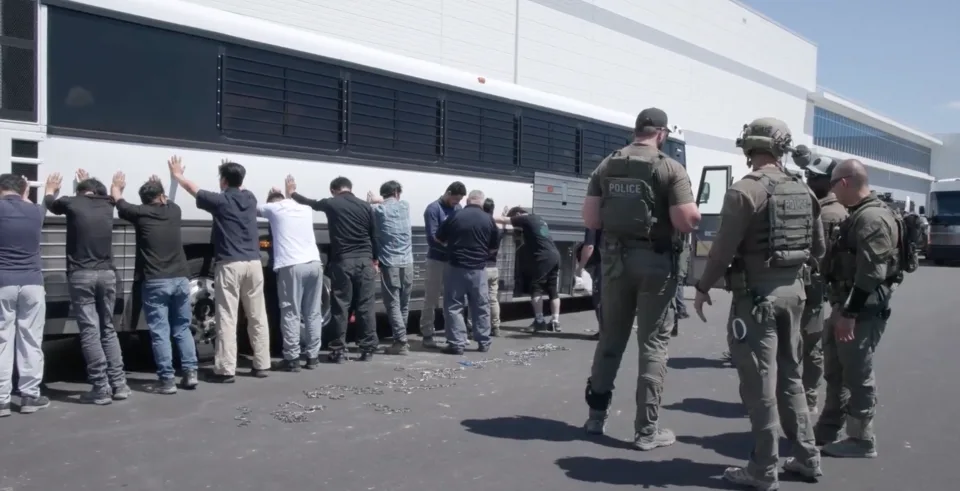
What followed, according to NPR's review of arrest data and interviews with lawyers, immigrants, and community advocates, was a sustained immigration enforcement operation that has left Memphis's immigrant neighborhoods paralyzed with fear. A majority of the immigration arrests made by the task force involved people with no criminal convictions, according to a data analysis by the Institute for Public Service Reporting.
The city's own data shows that the vast majority of all arrests made by the task force, whether immigration-related or not, were for nonviolent offenses. So to recap: a violent crime task force, deployed to a city where violent crime was already falling, has spent ten months mostly arresting people for nonviolent things, a large portion of whom had no criminal record at all.
Stephen Miller Said the Quiet Part Out Loud on Day One
Community organizer Maria Oceja, co-founder of rapid-response network Vecindarios 901, says she saw this coming the moment the task force was announced. She started making the rounds to local officials, asking directly whether this was going to be an immigration operation dressed up as crime enforcement. The officials apparently did not have great answers for her.
"I was like, they're not coming to Memphis for just crime. I'm pretty sure this is going to be an ICE operation," she told NPR. She felt her suspicions confirmed when members of the Trump administration showed up in October to formally launch the task force. Stephen Miller, the White House's chief immigration architect, stood in front of the assembled law enforcement and told them: "You are unleashed."
That first evening, the hotline Oceja's organization runs received so many calls from panicked immigrants that they had to put four people on the phones at once. Which is, as far as soft launches go, fairly telling.
The Playbook: Use Crime, Get Immigration
Chioma Chukwu, executive director of American Oversight, a nonpartisan watchdog that has been tracking the administration's use of multi-agency task forces, has a name for what happened in Memphis: mission creep. And she says it is entirely deliberate.
"This administration has used crime as a pretext for furthering and advancing its immigration enforcement agenda because they understand that immigration may not be top of mind in maybe non-border states in the way that it is in border states," Chukwu told NPR. The formula is pretty simple. Anti-crime rhetoric plays better in cities with real public safety concerns. You brand it as a crime crackdown, you get local and state buy-in, you deploy the federal machinery, and then the actual work looks a lot more like immigration enforcement than anyone said it would.
American Oversight has also been tracking the same pattern in the D.C. task force, which Trump himself called a "replica" of the Memphis operation. Trump has publicly stated he plans to expand these task forces to other cities, specifically mentioning Republican-led states where political cooperation will be easier to secure. The pattern is not accidental. It is the product.
Local Lawyers and Advocates Knew. Locals Officials Looked Away.
Casey Bryant, executive director of Advocates for Immigrant Rights in Memphis, told NPR that when the task force announcement dropped, she was immediately clear-eyed about what was coming. She watched the media coverage focus almost entirely on the dramatic optics of hundreds of National Guard troops deploying to the city, and found that framing frustrating. "It was really going to be about the federal agencies that were riding the coattails of the National Guard," she said.
NPR reports that Memphis's immigrant community is roughly 10% of the city's population, primarily Hispanic and Haitian, and is the fastest-growing demographic in the city according to Census data. Aid networks have ramped up operations significantly over the past ten months. Hotlines rang constantly. Routine traffic stops became immigration arrests. Neighborhoods went quiet in the particular way that neighborhoods go quiet when people are afraid to leave their homes.
All of this has unfolded without significant political backlash, NPR notes, largely because local and state leaders have cooperated with federal authorities rather than pushed back. When there is no one in power willing to make noise, it is much easier to run a quiet operation.
The White House Response Was Exactly What You'd Expect
When NPR asked the White House directly about the immigration dimension of the Memphis task force, spokesperson Abigail Jackson sent a statement praising the task force's results for local communities and listing impacts without providing supporting evidence. That is, in the parlance of journalism, not a denial.
The U.S. Marshals Service, which leads the Memphis task force, sent its own statement through spokesperson Emily Williams. "Our primary focus is violent offenders. We arrest anyone who is breaking the law," Williams wrote. "If you are in the country illegally, you are committing a crime." That last sentence is doing a lot of heavy lifting, and it is worth understanding exactly what it reveals: in this framing, being undocumented is itself sufficient justification for arrest under a task force whose stated, public purpose was targeting violent career criminals. The bait-and-switch is not even hidden at this point.
The Dingo Take
Here is the thing about calling something an anti-crime task force when you deploy it to a city where crime is already at a 25-year low: you have to already know what it is actually for. Nobody accidentally sends a dozen federal agencies and the National Guard to solve a problem that does not exist. The "crime" framing was always marketing. The product was always mass immigration enforcement, sold with enough law-and-order packaging that local politicians could nod along without having to answer for it directly.
What makes Memphis worth watching closely is that it is explicitly a template. Trump said so himself. This is how you run immigration sweeps in non-border cities that do not have the political appetite for open ICE operations: you call it something else, you get the governor on board, you let Stephen Miller tell the cops they are unleashed, and then you let the quiet machinery run while the cameras point at the National Guard troops on Beale Street. The immigrant community panics, the hotlines flood, the neighborhoods go silent, and the press releases keep talking about violent criminals.
There will be more of these. That is not speculation. Trump announced it. The only question is which city gets the "anti-crime task force" treatment next, and whether anyone in that city's government will bother to ask what, exactly, is actually being enforced.




Comments