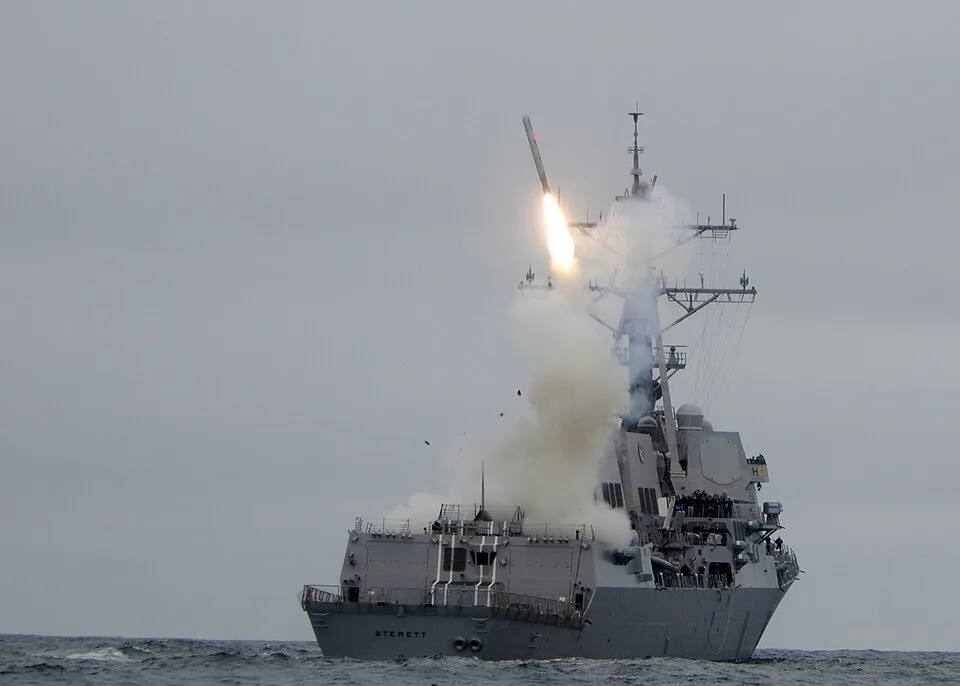
The United States military has fired over a thousand Tomahawk cruise missiles since a war with Iran started in February. The Pentagon bought 38 of them in the last fiscal year. Thirty-eight. Sit with that number for a second.
The Math Is Terrifying and Nobody Is Hiding It
According to reporting cited by the New York Post, US forces have expended more than 1,000 ship- and submarine-launched Tomahawk cruise missiles since hostilities with Iran began. Pentagon documents show it purchased only 38 of those missiles in Fiscal Year 2025. That is not a typo. That is a procurement gap you could drive a carrier strike group through.
On top of the Tomahawks, the Post reports that US forces burned through more than 1,100 Joint Air-to-Surface Standoff Missile-Extended Range cruise missiles, leaving roughly 1,500 in Pentagon stocks as of late April. That's a substantial chunk of a finite stockpile, gone in a matter of months, against a regional power that is not China.
Think about that last part carefully. Iran is a serious adversary. Iran is not Beijing. If the US arsenal is getting this hollowed out fighting a conflict in the Middle East, what exactly is the plan if the Taiwan Strait goes hot?
How Did We Get Here
This didn't happen overnight. Defense analysts and military officials have been sounding alarms for years about what chronic underfunding does to industrial capacity. The New York Post piece, written by Bradley Bowman and Rear Admiral Mark Montgomery of the Foundation for Defense of Democracies, makes the case plainly: years of insufficient defense budgets gutted the production base and left stockpiles at dangerously low levels.
The dirty secret of American military power is that the US got very good at making extraordinarily expensive, extraordinarily precise weapons, and very bad at making large quantities of anything. That worked fine in the post-Cold War era of counterinsurgency and drone strikes against groups that couldn't shoot back meaningfully. It is not working fine now.
Chairman of the Joint Chiefs General Dan Caine has been warning Congress about this explicitly. He told the Senate Appropriations Committee this week, reiterating earlier testimony, that China, Russia, Iran, and North Korea are cooperating at unprecedented levels. The threat picture is not getting simpler. The arsenal is not getting deeper. Something has to give.
The Pentagon Is Actually Trying to Fix This
Credit where it's due: the Defense Department is not sleepwalking through the problem. The Post reports that this month the Pentagon announced framework agreements with defense companies Anduril, CoAspire, and Zone 5 to produce a new family of low-cost air-launched cruise missiles. The five-year plan targets 28,000 missiles, ramping from 1,000 next year to over 5,000 annually by 2028. Some of these missiles may cost less than ten to twenty percent of a Tomahawk.
The Pentagon also signed a deal with Castelion to manufacture its Blackbeard hypersonic strike missile at a minimum of 500 units per year, with the military seeking funding for more than 12,000 over five years at under $300,000 each at full production scale. The engineering philosophy, as the Post describes it, borrows directly from SpaceX: design for mass production and continuous iteration from the start.
That's a genuinely significant cultural shift for a procurement system that has historically moved at the speed of congressional committee schedules and defense contractor lobbying calendars. Whether the Pentagon can actually execute it is a different question.
Congress Is the Chokepoint Now
Here's where things get politically ugly. Congress authorized multiyear procurement for these new programs last year. Authorization is not the same as appropriation. Authorizing spending is like writing something on a grocery list. Appropriating the money is like actually going to the store. Lawmakers have so far done the easy part.
The New York Post piece is direct about the stakes: delaying or cutting defense appropriations for munitions doesn't hurt the contractors or the Pentagon bureaucrats. It penalizes the service members who will be fighting with whatever's left in the magazine when the next conflict starts. That's not a rhetorical flourish. That's a straightforward description of consequences.
Some members of Congress have been raising questions about the administration's broader strategy in the Iran war, which is entirely legitimate. But holding munitions funding hostage to those debates is a separate and genuinely dangerous game. You can oppose a war and still believe the people fighting it shouldn't run out of ammunition.
The Axis Problem Nobody Wants to Talk About
Bowman and Montgomery, along with their colleague Elaine Dezenski, have a new book out called Axis of Aggressors, which examines the deepening cooperation between China, Russia, Iran, and North Korea. General Caine's warning to the Senate Appropriations Committee this week underscores that this cooperation is not hypothetical or theoretical. It is happening right now, and it changes the strategic calculus considerably.
A US military sized and stocked to handle one regional conflict at a time is not a US military prepared for a world where adversaries are coordinating and potentially planning to stretch American resources across multiple theaters simultaneously. The munitions shortage isn't just a logistics problem. It's a strategic vulnerability that any serious adversary has already noticed and is almost certainly accounting for.
The Dingo Take
Let's be honest about what we're looking at. The richest, most powerful military in human history got into a shooting war and burned through a year's worth of its primary cruise missile procurement in a matter of months. That's not a failure of the soldiers or the weapons. That's a failure of the political system to take seriously, for years, the boring and expensive and unglamorous work of buying enough ammunition. Procurement briefings don't win primaries. Ribbon-cutting ceremonies at missile factories don't trend on social media. So Congress kicked the can, and here we are.
The new production agreements are promising, genuinely. Mass-producible low-cost missiles built on a SpaceX-style manufacturing philosophy sounds like exactly the kind of rethink the system needed. But a framework agreement signed in July 2026 does not put missiles in launch tubes today. The gap between where production is and where it needs to be is not closeable in weeks or months. The US is going to be operating with constrained arsenals for a while, and the people who let it get this way should have to say so out loud.
Congress needs to appropriate the money, and it needs to do it without attaching it to unrelated political fights or using it as leverage in debates about war strategy. The people carrying out these missions don't get to call a timeout because Capitol Hill is having a procedural argument. The least the legislature can do is make sure they have enough weapons to do the job they were sent to do.





Comments