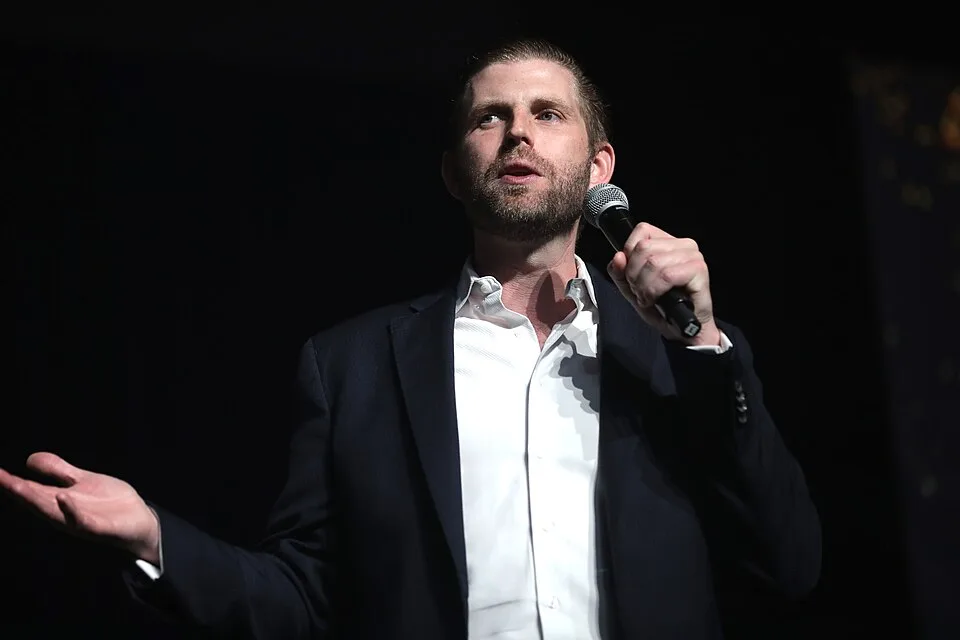
Donald Trump Jr. and Eric Trump quietly purchased a stake in a construction company that has since merged its way into a $1.6 billion U.S. government-backed tungsten mining deal in Kazakhstan. The Trump Organization says the brothers had no idea any of this was coming. Sure. Totally normal investment behavior from totally normal private citizens who just happen to be the president's sons.
Here Is the Chain of Events You Are Being Asked to Ignore
Let's just lay this out in sequence, because the sequence is the whole story. Between 2023 and 2024, a U.S. investment company called Cove Capital negotiated a deal with the Kazakh government to take a 70% share in Kazakhstan's state-owned tungsten mining deposits, according to Fox News. Tungsten, for the uninitiated, is a critical mineral used in missiles and fighter jets, and the vast majority of the world's supply currently sits in the hands of China and Russia.
In August 2025, the Trump brothers purchased a minority interest in a publicly traded construction company called Skyline Builders, using an investment vehicle created by Dominari Securities, which operates out of Trump Tower in New York. Fox News reports that at roughly the same time, Cantor Fitzgerald, the firm founded by Commerce Secretary Howard Lutnick, underwrote a $46.8 million loan to a company called ASP Isotopes. ASP Isotopes, it turns out, had already acquired voting control of Skyline Builders.
Then, in November 2025, Kazakhstan's president flew to Washington, met with Trump, and announced the country was awarding its tungsten mining contract to the United States. The Export-Import Bank and the U.S. International Development Finance Corporation issued letters of interest for up to $1.6 billion in government financing for the deal. Cove Capital's mining affiliate was selected to do the majority of the mining work.
This spring, Skyline Builders completed a reverse merger with Cove Capital's mining arm, creating a new NASDAQ-listed company called Kaz Resources. Skyline Builders now owns 20% of Kaz Resources after a $20 million investment. The company the Trump brothers bought into now has a 20% stake in the entity at the center of a $1.6 billion U.S. government deal. Timeline complete.
The 'We Didn't Know' Defense, Examined
The Trump Organization's official position is that the brothers' investment in Skyline Builders was passive, made before the Kazakhstan deal was announced, and made without any foreknowledge that the U.S. would land the contract. Fox News reports the organization has pushed back vehemently against any suggestion the brothers knew what was coming.
Securities and investment fraud attorney Andrew Stoltmann, speaking to Fox News Digital, gave critics what he called a "proof problem." His argument is straightforward: Don Jr. and Eric are private citizens, not government employees, and private investors have no legal obligation to disclose their holdings. Whether the president knew about his sons' investment would depend entirely on whether the sons told him. Which, naturally, would be impossible to prove either way.
"The optics are bad," Stoltmann acknowledged. "You have the president's sons investing in a company that is eventually awarded a very large contract." He then immediately walked that back, calling the outrage "more thunder, more noise, a tempest in a teapot." Which is a fun thing to say about $1.6 billion in U.S. government financing flowing toward a company partially owned by the president's family.
Howard Lutnick Is Also Somehow in This
Because this story did not already have enough characters, Commerce Secretary Howard Lutnick's name is threaded through the middle of it. Cantor Fitzgerald, the firm Lutnick founded, underwrote the $46.8 million loan to ASP Isotopes, the company that had acquired control of Skyline Builders right around the time the Trump brothers were buying in, Fox News reports.
Lutnick himself is now a government official, so Cantor Fitzgerald is currently run by his sons, Brandon and Kyle Lutnick. So to recap: the president's sons invested in a company, through an investment vehicle based in Trump Tower, connected to a firm linked to a loan underwritten by the company of the current Commerce Secretary, whose sons now run that company while their father sits in the cabinet. This is the kind of sentence that, if you wrote it in a political thriller, your editor would ask you to tone it down for believability.
What the Government Is Actually Financing Here
The U.S. government's financial interest in Kazakh tungsten is not, by itself, unreasonable. Trump has made securing rare earth minerals a stated national security priority, and tungsten specifically matters because China and Russia control most of the global supply. Fox News notes the deal is still under standard SEC review and has not been formally finalized.
But the government vehicles involved are not small players. The Export-Import Bank and the U.S. International Development Finance Corporation are public institutions that exist to finance international projects on behalf of American taxpayers. Letters of interest totaling up to $1.6 billion from those two institutions represent serious federal firepower being aimed at a deal that now benefits, however indirectly, a company with a Trump family investment in it. Whether that is illegal, unethical, or both is apparently a very complicated question. Whether it looks terrible is not complicated at all.
The 'Private Citizen' Shield and Its Limits
The legal argument being floated here, that Don Jr. and Eric are private investors with no disclosure obligations, is technically accurate and almost entirely beside the point. The question was never whether the brothers violated securities law by failing to disclose a private investment. The question is whether the president of the United States was influenced, consciously or not, by the financial interests of his immediate family when his administration pushed a $1.6 billion government financing package toward a deal.
That question has no clean legal answer. It does not need one. The entire architecture of conflict-of-interest rules in American government exists precisely because proving corrupt intent is almost impossible, so we instead build structural firewalls to prevent the situations from arising in the first place. The Trump administration dismantled most of those firewalls on its first week back in office. Now we are surprised that there is fire.
The Dingo Take
You are supposed to believe that Donald Trump Jr. and Eric Trump happened to buy into a small NASDAQ-listed construction company, which happened to be connected to a firm that had just received a $46.8 million loan underwritten by the current Commerce Secretary's old firm, which then happened to merge with a mining company that happened to win a $1.6 billion U.S. government-backed tungsten deal in Kazakhstan after the Kazakh president happened to fly to Washington and announce the whole thing to the elder Trump in person. Every single one of those steps is a coincidence, stacked on top of other coincidences, in a tower of coincidences so tall you'd need a tungsten-reinforced scaffold to inspect the top floor.
The "proof problem" Stoltmann describes is real, and it is also a feature, not a bug. This is how modern influence and self-dealing actually works. Nobody sends the email that says "invest here before we hand them the government contract." The whole system runs on proximity, relationships, and plausible deniability. The Trump family has been running this particular playbook since 2017, and they have gotten considerably better at it. No fingerprints. Just money moving in convenient directions.
The Fox News article, to its credit, actually reported this story rather than spiking it. But the framing, that critics have a "proof problem" and this is probably just a tempest in a teapot, misses the larger issue entirely. A billion and a half dollars in U.S. government financing is heading toward a deal in which the president's sons have a financial stake. That is the story. Whether a prosecutor could build a criminal case around it is a completely separate question, and not a particularly interesting one compared to the one right in front of us: who exactly is this government working for?


Comments