At least 52 people have died in ICE custody since Trump's second term began. More than 65,000 are currently confined in facilities where oversight has been gutted, members of Congress have been turned away, and one woman in Arizona has reportedly lost 70 pounds and is vomiting blood after 16 months without proper cancer treatment. Call them whatever you want. Journalist John Washington, writing in The Guardian, has a word for what they actually are.
What the Word 'Camp' Actually Means
Washington has spent a decade reporting on immigration enforcement, and in The Guardian he makes the case plainly: calling these facilities 'detention centers' is a sanitizing lie. 'Alligator Alcatraz' and 'Cornhole Clink,' the nicknames the Trump administration has been happily branding its facilities with, are something worse: they make atrocity sound like a bit.
The word Washington uses instead is camp. Not as a rhetorical grenade, not as a partisan provocation, but as an accurate description of what a camp is and does. A concentration camp, in its most basic historical definition, is a place where a targeted civilian population, not accused of a crime, is detained and stripped of at least some basic rights. That is a description, not an analogy. It fits.
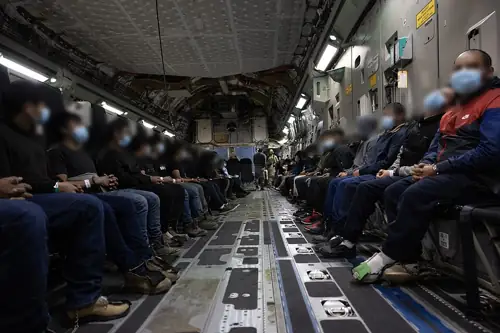
The people inside these facilities have not been convicted of anything. They are detained for a civil infraction, the administrative offense of being on the wrong side of a border. They are ripped from their homes, their families, their jobs, and shipped hundreds of miles away to languish in facilities that are, by documented account, squalid, freezing, and increasingly deadly. That is not editorializing. That is the reported record.
The Conditions That Forced the Word
The Guardian details what has been leaking out of these facilities despite aggressive efforts to stop it. A woman in Arizona, detained for 16 months, has reportedly lost more than 70 pounds while battling leukemia without proper medical care. She is regularly vomiting blood. At a now-shuttered camp in Florida, detainees were allegedly subjected to a two-by-two-foot outdoor punishment cage.
Tens of thousands of people have been held in solitary confinement. Oversight mechanisms have been systematically dismantled. Members of Congress attempting to inspect facilities have been turned away. ICE has stopped reporting the basic, legally mandated data about who is inside and what is happening to them. The agency has essentially dared anyone to find out.
Fifty-two people have died in ICE custody since January 2025. That number is not a projection or an estimate. It is the documented death toll, compiled despite the administration's hostility to transparency, during a period when the system has been rapidly expanding and the conditions inside have been getting demonstrably worse.
This Is Not New, Which Is the Whole Problem
Washington traces the historical lineage carefully, and The Guardian publishes it without flinching. The concentration camp model was not invented by the Nazis. It was developed by the Spanish in Cuba and the British in South Africa at the end of the 19th century. The United States used it on more than 120,000 Japanese Americans during World War II, a program FDR was calling for before the war even started.
In a 1981 internal memo unearthed from the Reagan era, an immigration task force explicitly worried that the 'appearance of concentration camps,' which at that point would have been filled largely with Black Cuban and Haitian refugees, 'may be publicly unacceptable.' They used scare quotes around the term. They were worried about the optics, not the reality. Every administration since has expanded the system anyway.
Philosopher Giorgio Agamben describes the various forms camps take throughout history as a 'progression,' with a slippage between them. Scholar Dan Stone writes that people held in immigration camps sit very close to what Hannah Arendt called the category of the superfluous stateless person, someone from whom the right to have rights has been removed. These are not abstract philosophical concerns. They describe something that is happening right now, at scale, in this country.
The Legal Architecture Being Built Around Indefinite Detention
Last fall, the Board of Immigration Appeals ruled that no undocumented migrants who entered without inspection would be eligible for release on bond. Read that again slowly. Mandatory indefinite detention, without trial by jury, for a civil infraction. The camp, as Washington writes, became compulsory.
A recent Fifth Circuit ruling clawed back a small amount of ground, according to The Guardian, requiring that people held under mandatory detention get a bond hearing within 90 days instead of never. That sounds like progress until you understand what it actually means: nobody gets released because of the ruling. They just get to make their case for freedom every 90 days instead of having no case at all. The government is expected to appeal even that.
Meanwhile, immigration arrests are at record highs. More people than ever before are being picked up off American streets and fed into a detention system that is simultaneously expanding its capacity and making its conditions more punishing. The administration is not trying to hide that this is the point. They are spending billions to make the system bigger, faster, and more painful. That is a policy choice, not an operational necessity.
The Naming Problem Is a Power Problem
Language matters in ways that are not merely semantic. 'Detention center' implies a temporary, regulated, administratively neutral holding space. That framing makes the whole enterprise sound boring and procedural, which is exactly what the people running it want. Boring and procedural does not generate outrage. Boring and procedural lets 52 people die without a national reckoning.
The Trump administration's own branding instinct, the 'Alligator Alcatraz' cheerfulness, goes in the opposite direction. It makes the cruelty sound like a joke, a tough-guy punchline for the base. That framing is also dangerous, because cruelty dressed up as comedy is still cruelty, and it still kills people.
Washington's argument, published in The Guardian, is that 'camp' is the word that strips both the bureaucratic neutrality and the performative toughness away and leaves just the reality. A place where civilians, guilty of nothing beyond geography, are concentrated, immobilized, stripped of legal personhood, and held indefinitely. That is what a camp is. That is what this is.
The Dingo Take
Fifty-two people dead. Sixty-five thousand detained. A woman vomiting blood in an Arizona facility for a year and a half while her leukemia goes untreated. A two-by-two-foot outdoor punishment cage in Florida. Congressional oversight turned away at the door. The government refusing to report its own legally required data. At what point does the United States have to look at what it is actually doing?
The people defending this system will say 'these are illegal immigrants' as if that phrase is a full argument, as if civil administrative status is a justification for any of this. It is not. It has never been. The Reagan administration knew it wasn't, which is why they were worried in 1981 about what it would look like. They were not worried it was wrong. They were worried it was unpopular. That distinction tells you everything about how this country has talked itself into this place over forty-plus years.
John Washington is not calling these camps to be provocative. He is calling them camps because that is what they are, and because every softer word is doing the political work of the people running them. The question for everyone watching this unfold is a simple one: if not now, when does the word start to fit? Because 52 bodies in is a strange time to still be arguing about terminology.




Comments