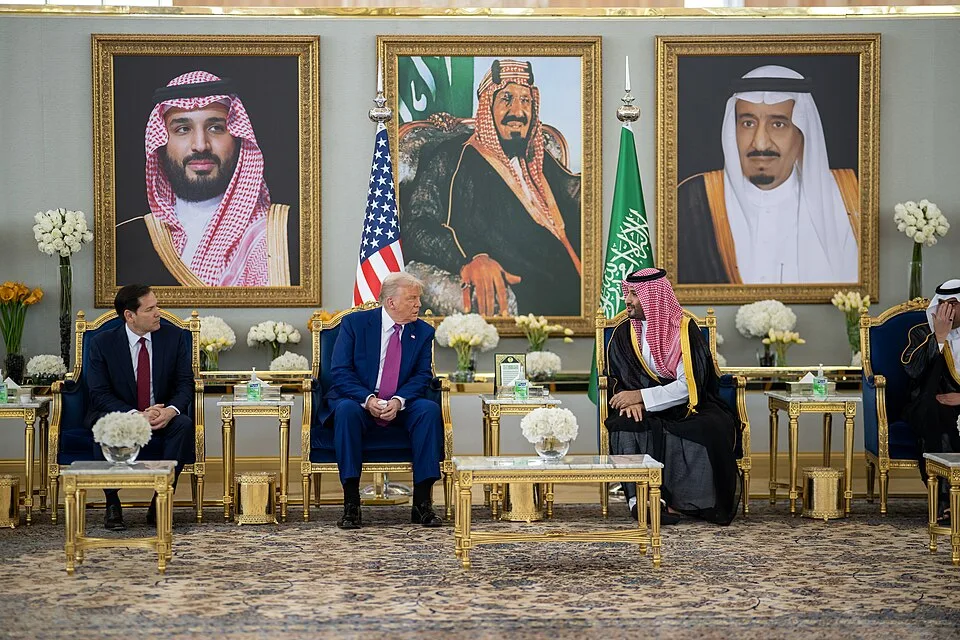
Saudi Arabia officially joined the US military in bombing Iraq this week, killing at least 20 fighters, and Iraqi leaders immediately said they had no idea it was coming. That's the state of Donald Trump's Iran war right now: expanding into new countries, choking off global oil supplies, and somehow getting worse by the day.
A 'Quick War' That Was Never Going to Be Quick
When Trump launched military action against Iran in late February, the White House framing was straightforward: hit hard, topple the regime, go home. That is not what happened.
According to The Guardian, the conflict has now spread across at least five additional countries, with attacks and counterattacks in Saudi Arabia, Iraq, Yemen, Jordan, and Egypt. The Pentagon is carrying out almost nightly strikes against Iran. Tehran is retaliating against US military bases across the region. Peace negotiations brokered by Pakistan and Qatar are, per The Guardian, making very little progress.
This is what regional wars look like. They don't stay neat. They spread, they deepen, and they cost money that ordinary people who had nothing to do with starting them end up paying.
Saudi Arabia Bombed Iraq and Iraq Says It Never Agreed to That
The week's single most alarming development came Wednesday, when Saudi Arabia announced it had carried out a series of airstrikes inside Iraq targeting Iranian-backed Popular Mobilization Forces, killing at least 20 fighters. The Guardian reports that Saudi officials blamed the Iraqi-based militias for launching drone attacks against Saudi oil facilities on July 27.
Trump publicly claimed the US and Saudi militaries coordinated with the Iraqi government before striking. Iraqi leaders immediately denied having any prior knowledge of the attacks. None. That gap between what Trump said happened and what actually happened is not a small detail.
Bombing another country's territory while claiming the host government signed off, only for that government to publicly call you a liar, is not a normal diplomatic situation. It's also a reliable way to push a country that has been trying desperately to stay neutral directly into the arms of the other side.
The PMF, for context, is not some fringe group. As The Guardian explains, it's a network of mostly Shia militias created in 2014 to fight ISIS, cultivated heavily by Iran after the US invasion opened the door for Tehran's influence. The US has a long and complicated history with this particular mess. It helped create the conditions for it back in 2003.
The Red Sea Is Now a Problem Too, Because of Course It Is
Iran shut the Strait of Hormuz after Trump launched the war in February, blocking roughly a fifth of the world's daily oil and liquid gas supply. So Saudi Arabia, like other producers, shifted exports toward the Red Sea. The Houthis, watching this happen, saw an opportunity.
The Guardian reports that on July 20, the Houthi militia declared a blockade on Saudi vessels transiting the Red Sea. Since then they have attacked multiple ships and, on July 25, claimed to have struck "sensitive" oil infrastructure sites inside Saudi Arabia with missiles and drones, hitting the Red Sea export hub of Yanbu. Saudi Arabia has been forced to reroute nearly half of its oil exports around the southern tip of Africa, adding weeks to journeys and costs to everything that moves by ship.
Anyone who lived through the 2023-2024 Houthi shipping disruptions in the Red Sea already knows what this looks like. Insurance premiums spike. Shipping companies reroute around Africa. The cost of goods in Europe and elsewhere climbs. That was during a conflict that didn't directly involve US forces fighting Iran. This version is considerably more serious.
Saudi Arabia's Economy Is Already Taking the Hit
Saudi Arabia's GDP dropped by nearly 5% in the second quarter of 2026 compared to the same period last year, according to The Guardian. That is a staggering number for an economy that size, and it reflects what happens when you're simultaneously dealing with a blocked strait, Houthi missile strikes on your oil infrastructure, and a regional war that keeps pulling you deeper in.
On Thursday, the Saudi defense ministry announced that 14 countries, including Turkey, Pakistan, Egypt, and Sudan, had agreed to join a new international maritime coalition to protect Red Sea shipping. The Guardian notes that it's genuinely unclear how this new Saudi-led effort would differ from the existing EU naval protection mission, Operation Aspides, which is already focused on the Red Sea.
So the plan is: form a coalition to protect shipping in the same waters where another coalition is already protecting shipping. Bold.
The Global Recession Risk Is Not a Fringe Concern
The Guardian frames what's happening explicitly: this war risks severely disrupting energy supplies and prices, and triggering a global recession. That is not hysterical language. That is what happens when two of the world's most critical oil shipping chokepoints, the Strait of Hormuz and the Bab el-Mandab, are simultaneously under threat.
Saudi Arabia's crown prince Mohammed bin Salman has reportedly tried to avoid direct confrontation with Iran throughout this conflict. That strategy just fell apart the moment Saudi jets joined US strikes inside Iraq. The kingdom is also reportedly planning a major military offensive against the Houthis in Yemen, which The Guardian notes risks reopening a very painful chapter: the disastrous Saudi-led coalition war in Yemen that began in 2015 and accomplished essentially nothing except mass civilian casualties.
The dominoes are not hypothetical. They are falling, one visible step at a time.
The Dingo Take
You are supposed to believe this is still a controlled military operation with clear objectives and a path to resolution. It is not. What The Guardian's reporting describes is a conflict that has already escaped whatever box it was supposed to stay in, is now actively pulling in new combatants, threatening two separate global shipping chokepoints, cratering the Saudi economy, and generating peace negotiations that nobody involved seems to think are going anywhere.
Trump launched this war claiming it would be quick. He told the Iraqi government he coordinated with them before bombing their territory. He did not. Every single element of the original framing has collapsed, and the replacement plan appears to be: keep striking Iran nightly, let Saudi Arabia join in, form a new maritime coalition that duplicates an existing one, and hope something changes. That is not a strategy. That is improvisation with warplanes.
A regional war that blocks the Strait of Hormuz, disrupts Red Sea shipping, pulls Saudi Arabia into direct combat in Iraq, and drags in fourteen additional countries to a new naval coalition while a global recession looms in the background doesn't stay a Middle East story for long. This one is coming home. The only question is how fast.




Comments