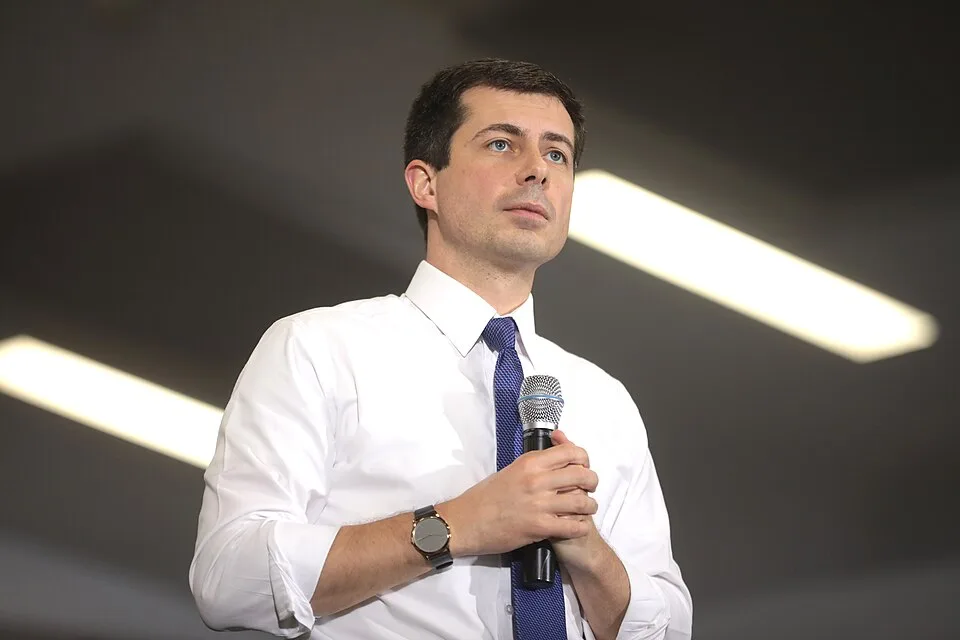
It is August of 2026, and Pete Buttigieg is the frontrunner for the 2028 Democratic presidential nomination in Michigan. Gavin Newsom, who has been not-quite-running for president since roughly the Biden inauguration, is sitting in fourth place at 10%. Kamala Harris, the woman who was literally Vice President of the United States eighteen months ago, is at 5.1%.
The Numbers That Will Ruin Someone's Sunday
The Public Sentiment Institute polled 762 likely Michigan Democratic primary voters between July 25 and July 29, and the results read like a fever dream. Buttigieg leads at 24.2%. Jon Ossoff, the Georgia senator who has explicitly said he is not running for president, is in second at 13.9%. Alexandria Ocasio-Cortez, who has given every indication she'd rather pass Medicare for All than live in the White House, is third at 10.7%.
Newsom clocks in at 10%. Harris at 5.1%. More than one in five voters — 21.7% — are still undecided, which is the pollster's polite way of saying the Democratic Party is currently a blank canvas with a deadline and no brushes.
To be fair, this is one state, one poll, and Michigan is a particular kind of bellwether — a place where the UAW still matters, where working-class anxiety runs deep, and where voters have personal, specific reasons to remember Pete Buttigieg as the guy who was Transportation Secretary when supply chains collapsed and a bridge fell down. So take it with appropriate skepticism. But also: Kamala Harris is at five percent.
How We Got Here: A Brief History of Not Learning
For context, the New York Post notes that a national Center Square Voters' Voice Poll released in June still had Harris leading the Democratic field at 27%, with Newsom at 14% and Buttigieg third at 11%. A May Emerson College poll had Newsom first at 16% and Harris at a humbling 10%. So the national picture is less catastrophic for the California wing of this not-yet-a-race, but the trend lines are not encouraging.
Harris dropped from 33% in October to 31% in March to 27% in June in that Center Square tracking. Newsom went from 21% to 14% in the same period. The field is opening up, which is a diplomatic way of saying the two people who were supposed to be the frontrunners are both losing ground simultaneously.
Prediction markets, for whatever they're worth, still see Newsom as the most likely Democratic nominee. Polymarket has him at 19% as of this weekend, with Ocasio-Cortez and Ossoff both at 15%, and Harris at 9%. Kalshi is nearly identical. So the money is cautiously optimistic about Newsom in a way that Michigan voters decidedly are not.
What the Candidates Have Actually Said About This
Harris told Reverend Al Sharpton in April she was thinking about another run. "I might. I am thinking about it," she said, then offered a reminder of her credentials that felt a little like someone listing their qualifications after already losing the job. "I spent countless hours in my West Wing office footsteps away from the Oval Office. I spent countless hours in the Oval Office and the Situation Room. I know what the job is, and I know what it requires." That is true. It is also true that she had those experiences and still lost to Donald Trump by several million votes and an electoral college that wasn't close.
Newsom told the Wall Street Journal in June of last year that a presidential run was "a path that I could see unfold." He is the most openly not-running person in American politics, which is its own kind of run.
Ossoff has been the most refreshingly blunt. He told CNN: "I am not running for president in 2028, I have no interest in running for president in 2028." He added that he is "laser-focused" on winning reelection to his Senate seat. That's a full, clear denial, which in 2028 Democratic primary politics essentially means he's already filed exploratory committee paperwork in his brain.
Ocasio-Cortez, speaking with former Obama adviser David Axelrod, took a different angle entirely, saying: "Presidents come and go. Senate, House seats, elected officials come and go. But single-payer healthcare is forever." Which is either the most principled thing anyone has said in this conversation or the best soft launch in recent political history. Possibly both.
The Rest of the Field, or: The Part Where It Gets Weirder
Illinois Governor JB Pritzker pulled 3.8% in the Michigan poll. Pennsylvania Governor Josh Shapiro got 3.6%. Shapiro also cracked double digits in that May Emerson poll, and Kentucky Governor Andy Beshear was at 9% nationally. So there is a real non-California, non-famous contingent beginning to cohere around the idea that maybe the party should try someone who didn't just lose a presidential election or run California.
The over-one-in-five undecided number is the figure that should concern Democratic strategists most. It is August 2026. The election is more than two years away. Roughly the same share of likely Democratic primary voters in a swing state have no preference at all as Pete Buttigieg has support. That is either a sign of a wide-open, exciting race or a party that hasn't processed what happened in 2024. Given recent history, it is probably both.
The Dingo Take
Here is the actual situation: the Democratic Party has two years to figure out who it is, and right now it is polling Kamala Harris at 5.1% in Michigan and treating that as a normal data point to include in a roundup. It is not a normal data point. Harris was on a national ticket fourteen months ago. She carried the weight of incumbency without any of its benefits, lost, and is now trailing a man who oversaw a baby formula shortage by nineteen points in a single-state survey. That's a collapse, not a slump.
Buttigieg leading at 24% is interesting, but what does it actually mean? He has no current office, no campaign infrastructure, and the last time he was in the news regularly it was because rail workers were furious at him and a train derailed in Ohio. He's charming, he's disciplined, he gives great Sunday show, and he may well be the best retail politician in the Democratic field right now. He also lost to Biden in 2020 after winning Iowa. The party has a long memory for some things and a remarkably short one for others.
The honest answer is that nobody knows who the 2028 Democratic nominee is, including the people who are definitely, absolutely, not-at-all thinking about running for president. What the Michigan poll actually tells us is that the California brand is damaged, the memory of 2024 is still radioactive for Harris, and voters are hunting for something new without being sure what it looks like. That's not a crisis. That's an opportunity. Whether the party is sharp enough to recognize the difference is, at this point, genuinely anyone's guess.

Comments