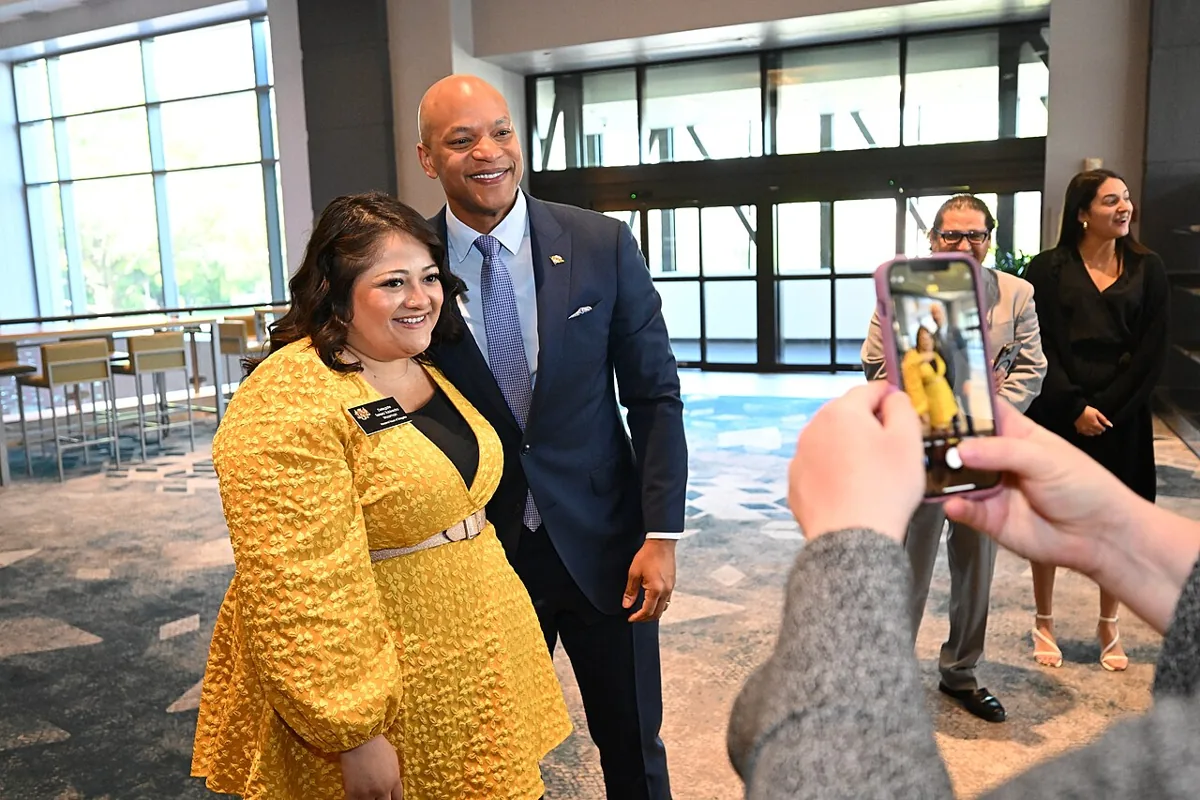
Wes Moore is going to cruise to re-election in Maryland next week. The part that's keeping him up at night is a ballot question asking his own party's voters to help him gerrymander the state, and a poll says 42 percent of Democrats would rather not. When you can't sell a power grab in one of the bluest states in America, it's worth asking what exactly you're selling.
The Governor Is Sweating a Race He's Winning
Per NBC News, Moore is expected to win a second term on Nov. 3 without much drama. The drama is on Question 3, a ballot measure that would let Maryland Democrats redraw the state's congressional map to favor their party even more than the current 7-1 split.
The pitch is simple. Trump and the Republicans have been redrawing maps in red states, so Maryland should hit back. Moore is making that argument. So is Barack Obama, which is the political equivalent of bringing in the closer in the third inning.
The argument should be easy in a deep-blue state. It's not landing the way anyone hoped. And with Moore's name floating around every 2028 speculation piece in Washington, a loss on the question he's pushing hardest would sting in a way that no landslide victory over his own opponent can fix.
Democrats' Own Poll Numbers Are the Problem
A University of Maryland, Baltimore County poll released this month found 53 percent of likely voters plan to vote against the measure. That includes 42 percent of Democrats, 74 percent of Republicans and 59 percent of unaffiliated voters.
Read that again. Four in ten members of the governor's own party looked at this and said no thanks. Mileah Kromer, who runs the UMBC Institute of Politics, put it plainly: "Do people want district lines to favor one party over the other? And most Marylanders don't like that idea."
The pollsters didn't hide behind legalese either. The survey used plain language instead of the dense wording that will actually appear on the ballot, and the opposition held across party lines anyway. You can't blame confusing language for this one.
How a Governor Gets Outmaneuvered by His Own Team
Here's the backstory, and it's a mess. Moore and his allies in Annapolis wanted to redraw the map this year and create eight Democratic-leaning districts. State Senate President Bill Ferguson, a fellow Democrat, shut it down, saying the push didn't have majority support in his chamber.
Ferguson had history on his side. Maryland Democrats tried a friendlier map in 2021, and a state judge tossed it out in 2022 over the state constitution. So Ferguson and other Democrats in the Legislature took a different route in August, voting overwhelmingly to put a measure before voters that would eliminate the requirement that congressional districts respect natural boundaries like the Chesapeake Bay.
That requirement happens to matter because the state's lone Republican House member, Andy Harris, represents a district built around the Eastern Shore. After a legal challenge, Maryland's Supreme Court let the question go forward in a form rewritten by state judges. The Moore-Ferguson split hasn't healed, either. Even raising money among Democrats for the measure has been an uphill battle, with that divide still simmering behind the scenes.
One Seat Isn't Much of a Revolution
This is where the math gets awkward. Kromer pointed out that Maryland voters may be reluctant partly because Democrats would pick up just one seat. California passed a similar measure last year that gained Democrats an advantage in five seats, steamrolling the state's independent redistricting commission just months after Texas redrew its maps to boost Republicans in five seats of its own.
So California gets a five-seat counterpunch and Maryland gets one. Asking voters to bless a mid-decade map grab for a single seat is a hard sell, especially when the party already holds seven of the eight.
A longtime Democratic strategist in the state, speaking anonymously, nailed the discomfort. Maryland voters are unusually well-informed about national politics, particularly in the counties bordering Washington. "If they heard anything in the news about mid-decade redistricting, it's about, you know, Republicans or Donald Trump breaking the rules," the strategist said. "They may not be that comfortable with that."
The Late Money Rush
The campaign knows it has a problem. After the poll dropped, Moore and his allies started spending in earnest. Fight Back MD, a group backing the measure, has put $550,000 into TV ads this month, according to AdImpact. Last week, Moore's campaign switched its own advertising from promoting his re-election to urging a yes vote on Question 3.
Think about that. A governor coasting to victory took his own campaign ads off the air to spend them on a ballot question. That's not a confident move.
There's a case for hope, though, and Kromer made it. Her survey ran before the heavy ad spending from both sides began. The anti-Trump framing could work on Democratic voters who don't love the idea but see it as necessary. As she put it, it might push people toward "I don't like it, but it's necessary." That's an inspiring slogan for the ages.
The Dingo Take
Imagine Texas Republicans going to their own voters and asking permission to draw a bigger map, and 42 percent of Republicans telling them to knock it off. Democrats would call it a principled revolt and write think pieces about the last honest conservatives. Now flip it. Forty-two percent of Maryland Democrats are telling their own governor they'd rather not rig the map, and the lesson here is the same. Plenty of voters on the left actually mean it when they say they care about fair elections.
Look, the fight-back argument isn't stupid. Trump and his allies tore up the norms first, and unilateral disarmament has not worked out great for anyone. California's response at least came with five seats attached. Maryland is asking its voters to blow up a principle for one seat in a state where Democrats already hold seven of eight. That's not fighting back. That's a rounding error with a PR budget.
And here's the part Moore should lose sleep over. He wants to be president, and he's learning that you can't beat a party of rule-breakers by asking your own voters to break the same rules for diminishing returns. The Democrats who plan to vote no aren't naive. They've watched what the other side does with power, and they're deciding they'd like to be the ones who didn't. You can call that squeamish. We'd call it the only brand Democrats have left.
Comments