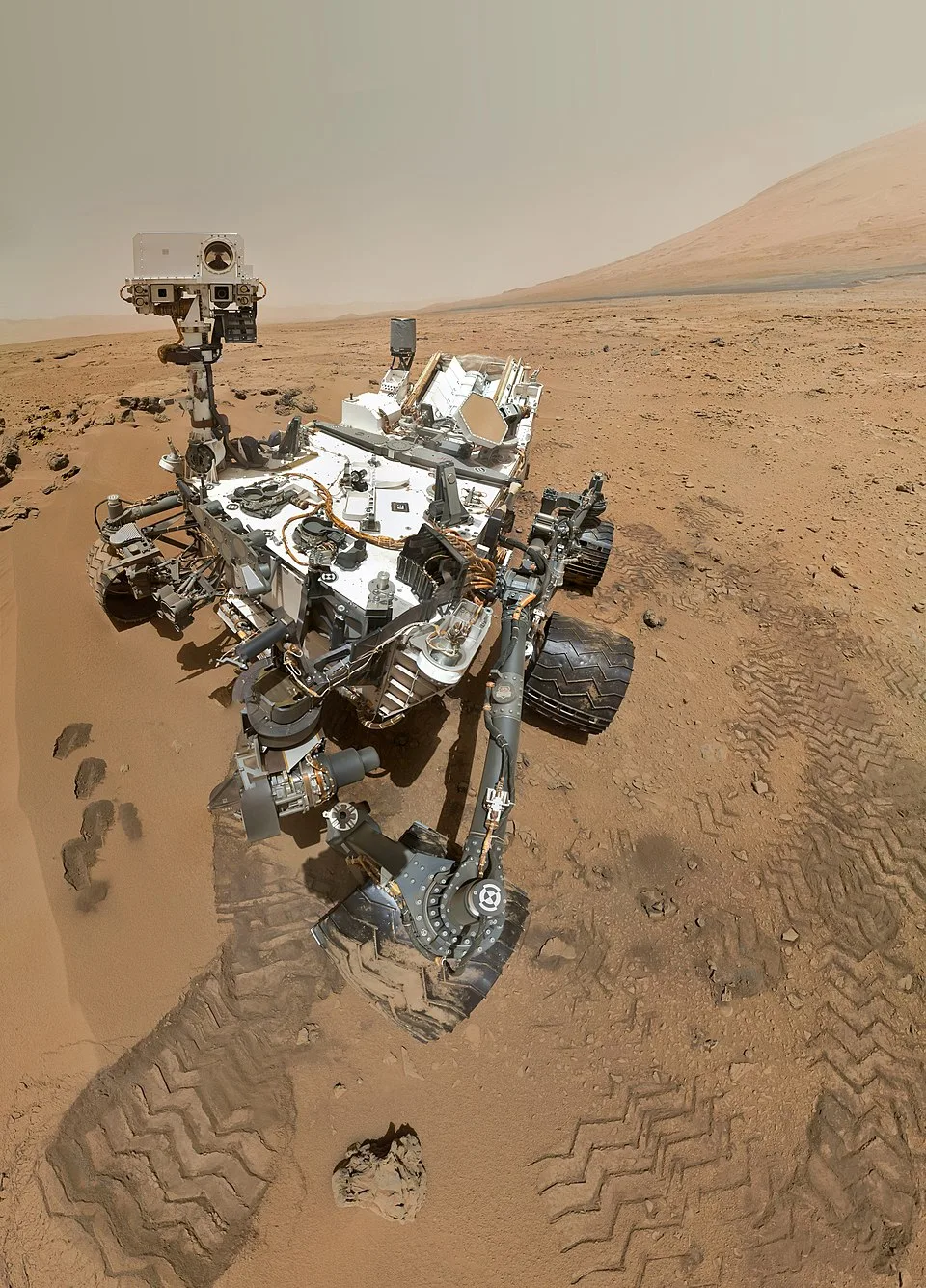
NASA's Curiosity rover just sent back images of something nobody has seen before on Mars: a vast, endless sea of honeycomb-shaped geometric textures stretching in every direction as far as the rover's cameras can see. Scientists have spotted small patches of these so-called polygonal fractures before, but nothing remotely at this scale. Nobody knows exactly how they got there.
What Curiosity Actually Found Up There
Back in June, Curiosity was climbing a Martian valley called Valle Grande when it captured a 360-degree panorama on June 19 and 20 that stopped mission scientists cold. The images showed polygon shapes spreading out in every direction, covering the ground like something between a dried lakebed and a giant reptile's back.
The shapes even wrap around the sides of a nearby butte the team nicknamed 'Miraflores,' a 20-foot-tall rock formation capped with a thick layer of sand. The Good News Network reports that NASA project scientist Ashwin Vasavada of the Jet Propulsion Laboratory described the scene bluntly: 'We've seen a lot of fascinating landscapes through Curiosity's eyes, but this sea of polygons took our breath away.'
When a NASA scientist says something took their breath away, it's worth paying attention. These are people who have spent years watching a robot car slowly drive around an alien planet. Their threshold for amazement is not low.
So What Actually Made These Things?
Here's where it gets interesting and also genuinely uncertain. Scientists have a few working theories, and none of them are mutually exclusive. Some polygonal fractures spotted earlier in the mission formed as mud cracks, the same basic process that makes a dried-up puddle look like a jigsaw puzzle. Others may have formed through repeated cycles of warming and cooling temperatures over geological time.
Another possibility, according to Good News Network's reporting, is that compression squeezed water out of ancient sediment when the surface was buried under later rock layers. The team measured the shapes and chemistry of the polygons carefully and says it's hopeful the data will yield clues. 'We measured their shapes and chemistry carefully and are hopeful there are clues in the data as to how these features formed,' Vasavada said.
Hopeful is doing some heavy lifting in that sentence. Translation: they don't know yet, but they're working on it, and they have receipts.
Fourteen Years of Surprises, and Mars Keeps Going
Curiosity landed on Mars in 2012. Fourteen years later, it is still climbing Mount Sharp, a 3-mile-tall mountain it has been ascending since 2014, and still finding things that require scientists to go back to the drawing board. The rover has turned up sulfur crystals, shiny meteorites, carbon-based molecules believed to be precursors to RNA and DNA, and repeated chemical evidence that ancient Mars had liquid water.
That last part is not a small discovery. Billions of years ago, the lower foothills of Mount Sharp were dotted with lakes and streams. The chemistry Curiosity has found in the rock record confirms Mars once had the water, the nutrients, and the right molecular ingredients to support microbial life. Not that life existed. Not that it didn't. That the conditions were there.
Now add a miles-wide honeycomb field to the list of things Mars has thrown at us without a full explanation. The planet is not done being weird.
Why the Scale of This Discovery Matters
Small polygonal fractures have shown up in Curiosity's images before. Scientists had explanations, filed the data, moved on. What makes Valle Grande different is sheer scope. A field of these shapes that extends to the horizon in every direction is not a local quirk of geology. It suggests a process that operated across a huge area, probably over a long period of time, under conditions that no longer exist on Mars today.
That kind of large-scale geological event is exactly the type of thing that leaves records of what Mars used to be. If the team can figure out what made these particular polygons, in this particular formation, at this particular scale, it could add another data point to the timeline of how Mars went from a wet, potentially life-supporting world to the freeze-dried rust desert it is today.
That is not a trivial question. And a rover that has been rolling around for fourteen years just found a new reason to keep asking it.
The Dingo Take
A robot the size of a car, running on nuclear power, climbing a mountain on another planet, just found something that stumped the people who built it. Sit with that for a second. While the news cycle churns through its usual diet of manufactured outrage and political theater, a machine we launched into the void over a decade ago is still out there doing actual science, on actual alien terrain, and occasionally sending back images that make PhDs say 'we have no idea what we're looking at.'
The honeycomb fields of Valle Grande are not going to fix anything here on Earth. They won't lower your rent or fix the highway. But they are a reminder that the universe is genuinely strange, that Mars specifically keeps refusing to be simple, and that the question of whether life ever existed beyond this planet is still very much open. Every piece of data Curiosity scrapes off that mountain is another paragraph in a story we've only just started reading.
Fourteen years. Still climbing. Still finding new things. If only our political institutions had half that track record.





Comments