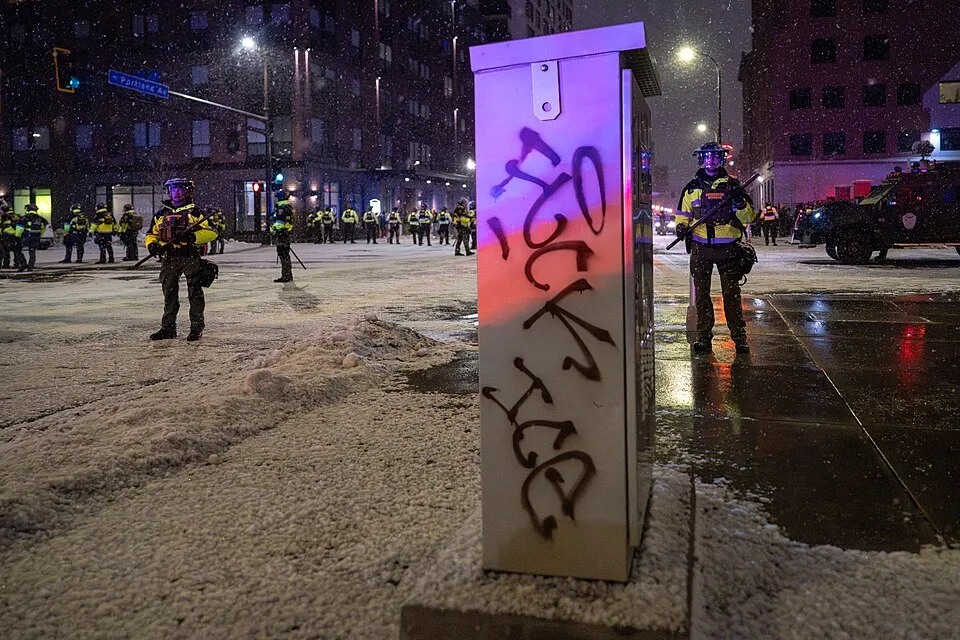
A Haitian immigrant with severe mental illness was released by ICE onto the streets of Pittsburgh in 20-degree weather, wearing summer clothes, with a phone she couldn't use, in a city she didn't know. Three days later, maintenance workers found her frozen to death at a bus shelter. The Allegheny County medical examiner ruled it a homicide.
What Actually Happened to Daphy Michel
Daphy Michel, 31, had spent six months in a Pennsylvania jail after suffering a mental health crisis on the street in Charleroi, a small western Pennsylvania community with a significant Haitian population. According to The Guardian, a judge dismissed the criminal charges against her on February 26th of this year. Her brother was told she'd be released soon and that someone would call him so he could come pick her up.
That call never came. The next call he received was on Monday morning, from a Pittsburgh hospital. His sister was dead.
Maintenance workers had found Michel at a bus shelter on Pittsburgh's South Side, more than 20 miles from her home in Charleroi. She was dressed in summer clothes. The temperature that morning was 20 degrees Fahrenheit. She had no pulse and wasn't breathing. Footage obtained by Pittsburgh's Public Source from bus stop cameras showed she hadn't moved from that shelter for more than 24 hours.
ICE's Role: Arrested Her, Dumped Her, Walked Away
Here's where the federal government enters the picture. The Department of Homeland Security acknowledged to The Guardian that ICE officers arrested Michel immediately after she was released from Washington County Jail and placed her in removal proceedings, despite the fact that she had an upcoming asylum hearing. Then they released her onto the streets of Pittsburgh with an ankle monitor.
Her family's attorney, Joseph Murphy, told The Guardian that Michel didn't speak English, was illiterate, and that her mental illness was plainly visible. Her phone, even if fully charged as DHS claimed, was useless because her plan had lapsed during her six months behind bars. Murphy said she was deposited in a neighborhood he described as a 'dangerous' part of the South Side, a city she had never lived in and didn't know.
People familiar with Michel noted she had apparently refused to bathe during her incarceration, a detail that speaks to how severe her mental state was. This was not a woman who needed a bus ticket and a wave goodbye. This was a woman who needed someone to make a phone call.
DHS Says It Has 'NOTHING' to Do With This
In June, the Allegheny County medical examiner ruled Michel's death a homicide. The office cited her status as a 'vulnerable adult' suffering from 'untreated severe mental health issues and a significant language barrier.' A homicide ruling. Not an accident. Not misadventure. A homicide.
The Department of Homeland Security responded to this on X, as one does. The agency posted that ICE had 'NOTHING to do with this woman's death' because 'she passed away THREE days after ICE encountered her.' The caps are theirs. The DHS also called Michel 'an illegal alien from Haiti' and insisted she was released 'with all of her belongings, including a fully charged phone, in sunny weather in the middle of Pittsburgh, where public transport is readily available.' Attorney Murphy disputes the framing on nearly every point, telling The Guardian that neither her entry nor her presence in the US were illegal, and that the sunny weather claim obscures a critical fact: it was 20 degrees outside.
The Guardian reports that DHS did not respond to follow-up questions about the story. Shocking.
This Is Standard Practice, Not a Rogue Agent
It would be convenient to pin this on one bad ICE officer who made a terrible call. The reality, according to advocates, is worse than that.
Adriana Torres-García, deputy director of the Free Migration Project in Philadelphia, told The Guardian that this is simply how releases work, under both current and past administrations. 'At no point have I seen ICE show concern about people reaching their final destinations after release from detention,' Torres-García said. 'Once people leave the detention center or jail where they were held, it's as if it's no longer ICE's responsibility.'
Torres-García described the previous practice at Pennsylvania's Berks County Residential Center, which closed in 2023: handing someone a bus ticket and saying 'well, good luck,' regardless of season or whether the person had family. Community organizations, not the federal government, were the ones who would step in to figure out where a released detainee needed to go and get them there. That community safety net wasn't available for Daphy Michel on a Thursday night in February.
A Family Left With Grief and a Lawsuit
Michel came to the United States from Haiti in 2022 looking, her brother told Pittsburgh's Action News 4 through an interpreter, for 'a safer life.' He asked to remain anonymous in the interview. He said that when he last saw her in court, on the day the charges were dismissed, she seemed okay. 'She wasn't having any problem,' he said.
He was told to expect a call. He waited Thursday. He waited Friday. He waited through the weekend. Monday morning, the Pittsburgh hospital called instead.
According to The Guardian, a lawyer for the Michel family announced on Saturday that they will be filing a lawsuit 'very soon' because, in the attorney's words, they want justice. The family will need a lot of luck. Suing the federal government is expensive, slow, and often futile. But the medical examiner has already said the word that matters: homicide.
The Dingo Take
Twenty degrees Fahrenheit. Summer clothes. A dead phone plan. Severe mental illness. No English. A city she'd never lived in. ICE looked at all of that and said, 'here's an ankle monitor, see you never.' Then, when she turned up frozen to death at a bus stop three days later, the Department of Homeland Security took to X in all-caps to explain that this was absolutely, definitively, one hundred percent not their problem.
The three-days defense is genuinely something. By that logic, you could push someone off a cliff and, as long as they took a few days to die from the injuries, you'd be in the clear. What ICE did was release a woman who was visibly, obviously unwell, into freezing weather, in an unfamiliar city, with no working phone and no way to call her family, and then drove away. The medical examiner used the word homicide. That word has a meaning.
This is not a story about one rogue agent or one bad day at one field office. Torres-García laid it out plainly: this is the system working exactly as designed, under multiple administrations, and community organizations have been cleaning up the wreckage for years because the government won't. What changed under this administration is the volume, the speed, and the complete shamelessness about it. Daphy Michel's brother waited by his phone all weekend. His government was not waiting with him.




Comments