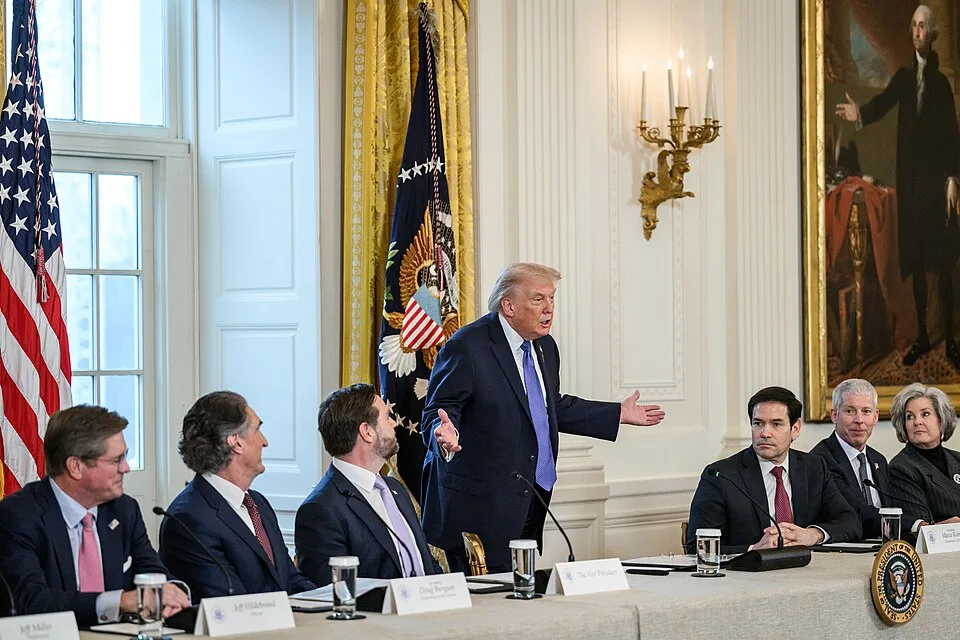
The President of the United States stood in the Oval Office on Monday and demanded that oil companies give back profits they made from the war he started. Donald Trump, who has spent months cheering on U.S. military action against Iran — a conflict that choked off crude transit through the Strait of Hormuz and sent gas prices past four dollars a gallon — is now publicly furious that oil companies made money during the oil supply crisis his war produced. This is, to use a technical term, a lot.
What He Actually Said, Word for Word
During an executive order signing at the Oval Office, CBS News reports, Trump turned his attention to Chevron and ExxonMobil and let them have it. "They made too much money, too much money. Chevron, too much money. Exxon Mobil, too much. Too much money," Trump said. He added, for clarity, "I'm not happy about it."
He also issued what sounded very much like a threat. "When you look at one company, where they made 12 times what they made the year before, they're going to give some of that back to the public, and they better cut the retail price, the consumer price," Trump said. The word "better" is doing real work in that sentence.
ExxonMobil declined to comment. Chevron did not immediately respond. Both companies are presumably consulting lawyers and quietly reviewing how much political donation it takes to make a presidential scolding go away.
The War, the Strait, and the Price at the Pump
Here is the part that deserves to be read slowly. Gas prices are above four dollars a gallon right now, up from about three dollars before the Iran conflict began, according to CBS News. The reason prices spiked is not complicated: the war largely halted crude oil transit through the Strait of Hormuz, one of the most critical chokepoints for global oil supply. Less supply, same demand, higher prices. This is economics at the level of a middle school textbook.
Brent crude, the international benchmark, did fall more than 4% on Monday to around $84 a barrel amid diplomatic signals that the conflict might wind down, CBS News reports. But it remains well above pre-war levels. Trump predicted Monday that oil prices would "drop through the floor" once the Iran conflict ends, which is probably true, and which raises an obvious question about why we're here in the first place.
Trump also took a separate shot at Chevron CEO Mike Wirth over the weekend, criticizing him in a Fox News interview with Maria Bartiromo and then following up with a social media post that read, in part, "without the genius, foresight, strength, and stability, of the TRUMP Administration, the Oil Industry, and our Country itself, would be DEAD!" The Chevron CEO's apparent crime was failing to sufficiently praise the Trump administration. Loyalty tests, now, for Fortune 500 oil executives.
A Quick Lesson Oil Companies Did Not Ask For
Let's deal with the mechanics here, because they matter. Oil companies do not actually set fuel prices in the United States. According to the Energy Information Administration, as cited by CBS News, crude oil itself accounts for 51% of what you pay at the pump. Refining adds another 20%. Marketing and distribution make up 11%. Taxes cover the rest.
So when Trump demands that Chevron and ExxonMobil "cut the retail price, the consumer price," he is describing something closer to a PR gesture than a functional policy. The single biggest lever on gas prices is crude oil cost, which is determined by global commodity markets, not by executives deciding to be nicer to consumers. The president either does not know this or does not care, and at this point it's genuinely hard to tell which is worse.
For what it's worth, CBS News notes that Chevron executives have argued that increased crude imports from Venezuela are actually helping curb U.S. gas prices, which is its own separate geopolitical headache given Trump's longstanding position on Maduro's government.
Americans Are Feeling It, and They're Not Buying the Spin
While Trump and oil executives perform their Washington kabuki, real people are paying real money. A recent CBS News poll found that about half of Americans say elevated fuel costs are causing them financial difficulties. That is not a rounding error. That is tens of millions of households.
The same poll found that roughly eight in ten Americans believe the Trump administration is not focusing enough on lowering consumer prices. Eight in ten. That number cuts across partisan lines in ways that should concern anyone in the White House thinking about midterm math.
For context, CBS News also notes that former President Biden made similar moves, publicly attacking oil companies for their profits as inflation spiked during his term. Biden got hammered for it. The attacks didn't move prices. The playbook didn't work then, and there's no particular reason to think it works now just because the guy delivering it is angrier and louder.
The Dingo Take
Trump started a war. The war disrupted the global oil supply. Oil companies made money from the disrupted oil supply. Trump is now angry at the oil companies. This is the entire story, and the internal logic of it should bother you regardless of how you feel about corporate profits or the Iran conflict.
You are supposed to believe that the solution here is the President of the United States publicly shaming two of the largest energy companies on Earth into voluntarily lowering prices they don't directly control, in a commodity market driven by forces that exist well outside their boardrooms. That is not an energy policy. That is a man pointing at a flood and yelling at the river.
What Trump will not do is examine the decisions that produced this situation. He will not ask whether the war was worth four-dollar gas and half the country struggling to fill up their tanks. He will not acknowledge that "drill baby drill" did not, in fact, magic away the consequences of a major regional conflict in one of the world's most critical oil corridors. He'll call the Chevron CEO ungrateful, post in all caps, and declare victory. Gas will stay expensive. The poll numbers will keep sliding. And someone else will get blamed.


Comments