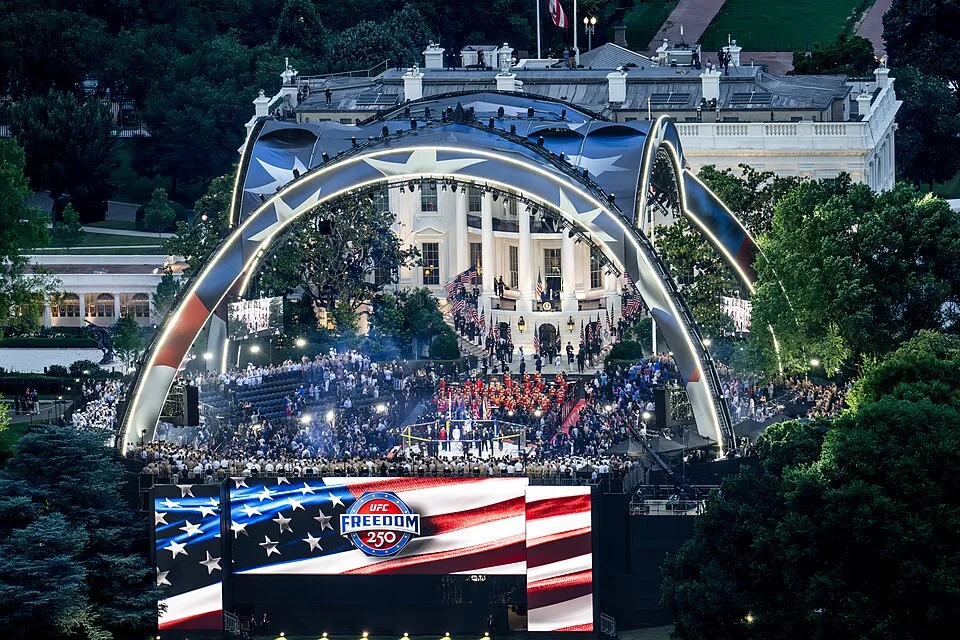
The UFC lost thirty million dollars staging a fight event on the White House lawn for Donald Trump's 80th birthday, and they knew it was going to happen before they did it. That's not a business decision. That's a tribute payment with a cage in the middle.
What Actually Happened on the South Lawn
On June, the UFC staged something called Freedom 250, an invite-only mixed martial arts event on the South Lawn of the White House, framed as part of America's 250th birthday celebrations and timed, conveniently, to coincide with Donald Trump's 80th birthday. About 4,300 guests showed up, including Trump and Vice President JD Vance, none of whom paid a ticket price because tickets were never sold to the general public.
According to BBC Sport, the event cost more than $60 million to stage. UFC clawed some of that back through sponsorships, media rights, and what the company calls partnerships, but when all was said and done, the organization was down $30 million. TKO Group Holdings, UFC's parent company, confirmed the loss to investors on Monday without apparent embarrassment.
In May, reports had suggested that so-called high-roller guests could pay $1.5 million for special access packages. UFC sources confirmed to BBC Sport that such packages existed, but declined to say what they actually cost. So somewhere between zero and one and a half million dollars, a small number of wealthy people got to watch people punch each other near the Rose Garden.
Dana White Has a Friend in Very High Places
UFC president Dana White and Donald Trump have a friendship that predates Trump's return to the presidency. White was an early and vocal Trump supporter, spoke at Republican conventions, and has spent years doing the kind of public loyalty performance that tends to get rewarded in this administration. The Freedom 250 event is the reward made physical, broadcast-ready, and apparently tax-deductible.
Andrew Schleimer, TKO Group's chief financial officer, told investors Monday that the company "incurred significantly higher than normal costs" for Freedom 250, which they "partially offset with sold-out global partnerships inventory." That sentence is doing extraordinary work. Translated out of earnings call language: they knew they were going to lose money, they tried to lose less of it, and they still lost thirty million dollars.
Schleimer added that the loss "meaningfully impacted" UFC's margins and the company's consolidated results. Which, sure. Thirty million dollars has a way of doing that.
The Numbers That Make This Look Less Insane
Here is the part where we have to be honest about what the event actually delivered, because the story isn't purely one of reckless sycophancy. Freedom 250 drew an average of 34 million viewers worldwide, according to BBC Sport, making it one of the most watched mixed martial arts events in history. That is a genuinely enormous audience, and media exposure of that scale has real long-term value that doesn't show up cleanly in a single quarter's loss column.
TKO also reported that UFC's overall revenue increased 29% year over year for the second quarter of 2026, hitting $535.7 million. A $64.7 million jump in media rights revenue, driven by UFC's new seven-year, $7.7 billion deal with Paramount, accounts for a significant chunk of that growth. The White House event aired exclusively on Paramount+, which was presumably a very good day for Paramount+ subscriber numbers.
So the UFC lost thirty million dollars on a single event that may have been worth considerably more than thirty million dollars in brand exposure and subscriber acquisition for its new broadcast partner. The math is not insane. The optics, however, are a different matter entirely.
What the White House Got Out of This
The Trump administration got a globally televised sports event staged on the grounds of the executive mansion, watched by 34 million people worldwide, that existed primarily to celebrate the sitting president's birthday and his 250 years of America having been America. No public funds appear to have been reported as covering the cost. A private company ate the bill.
This is legal. It is also the kind of arrangement that would have generated roughly seventeen congressional investigations and a week of wall-to-wall cable news coverage if it had happened under a Democratic administration. A corporation run by a personal friend of the president absorbing a $30 million loss to produce a spectacle that flatters the president on his birthday, broadcast exclusively on the streaming platform of a media company with massive pending business interests before federal regulators. There are a lot of threads there. Nobody seems particularly interested in pulling them.
The Dingo Take
Thirty million dollars. Gone. Knowingly. For a birthday party that the guest of honor did not have to pay for, in a venue he did not have to rent, that his administration approved the use of. And TKO disclosed this to investors on a Monday earnings call with the energy of someone mentioning they bought an expensive bottle of wine at dinner.
You are supposed to read this story and think: a company spent thirty million dollars of shareholder money to throw the president of the United States a birthday bash at the White House, and the reason we know about it is because securities law requires public companies to tell investors when they lose significant amounts of money. Not because anyone investigated it. Not because anyone in Congress raised an eyebrow. Because of a quarterly earnings report.
The UFC is fine, by the way. Revenue is up 29%. The Paramount deal is printing money. Dana White's friendship with Donald Trump continues to bear fruit. The thirty million dollars is the cost of access, prestige, and whatever goodwill flows from being the guy who gave the president the most watched MMA event in history as an 80th birthday present. Whether that's a smart investment or a very expensive loyalty oath depends entirely on how the next few years go for TKO, and for the United States. History will have thoughts.

Comments