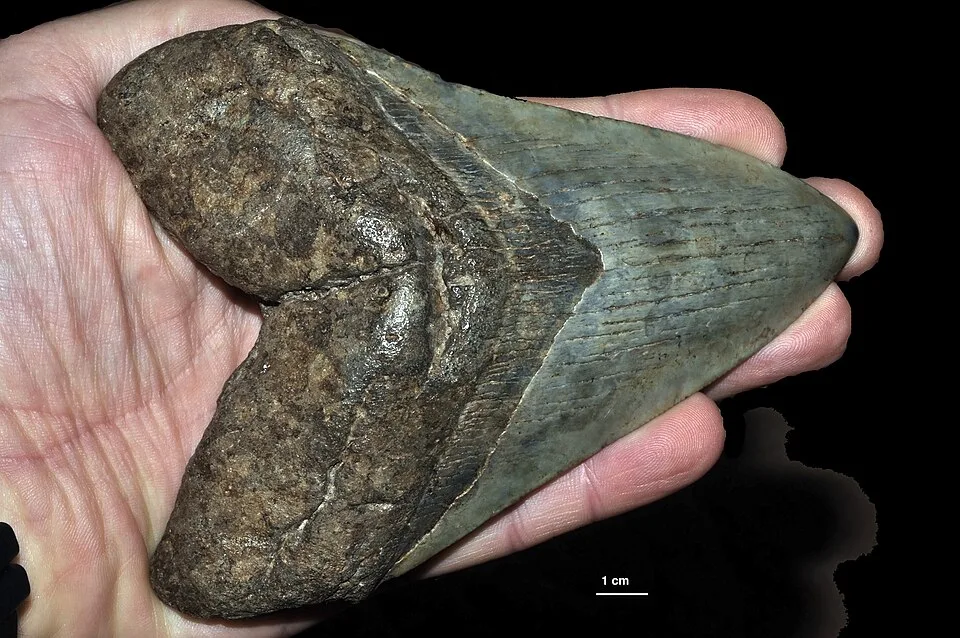
Scientists trolling the bottom of the South Pacific just pulled up teeth from a shark the size of a railroad car that went extinct three million years ago, and they are genuinely thrilled about it. NOAA researchers using remotely operated vehicles near the Cook Islands found several fossilized megalodon teeth on the ocean floor, each measuring three inches long. The ancient ocean's most terrifying apex predator is still somehow making headlines.
A Tooth the Size of Your Palm, From a Shark the Size of Your Nightmares
To understand what was just pulled off the floor of the South Pacific, you need to hold the size of this thing in your head for a second. According to the National Museum of Natural History, the megalodon was roughly 60 feet long and weighed around 50 tons. That is the approximate dimensions of a railroad car. With teeth.
The teeth researchers found measure three inches in length, which the New York Post notes is consistent with megalodon. For context, a great white shark's teeth max out around two inches. The megalodon was approximately three times the length of a modern great white. It had the jaw strength to tear chunks off the largest whales alive at the time. It was, in short, the most catastrophically overbuilt predator that has ever existed in any ocean.
The good news is it has been extinct for over three million years. The less comforting news is that we are still finding its teeth on the ocean floor, like it just walked out and forgot its keys.
What NOAA Was Actually Doing Down There
This was not a megalodon hunting expedition. NOAA researchers were conducting a remotely operated vehicle survey along the southwestern portion of the Cook Islands when they stumbled onto the fossilized teeth. Science, much like comedy, is often about showing up and being surprised by what you find.
The discovery is significant for reasons beyond the obvious thrill of holding a piece of a prehistoric sea monster. According to NOAA, fossilized fish teeth are exceptionally good at absorbing rare earth elements from surrounding seawater. That makes them a kind of time capsule, trapping chemical signatures from the ancient ocean that researchers can analyze to reconstruct what ocean circulation looked like millions of years ago.
"Fish teeth are also often the nucleus around which polymetallic nodules form, with minerals such as manganese and iron slowly accumulating around the tooth, layer by layer, over millions of years," NOAA said in a statement. So the tooth does not just tell you about the shark. It tells you about the entire ocean that shark swam through. That is a remarkable amount of information packed into something that used to sit in a jaw built for destroying whales.
The Megalodon's Actual Resume
The megalodon dominated Earth's oceans roughly 3.6 million years ago, and it did not do so quietly. As the New York Post reports, it roamed every corner of the ocean, making it one of the most geographically dominant predators in the fossil record. It was not a regional specialist. It was everywhere, eating everything large enough to bother with.
Its extinction remains one of paleontology's more active debates. Climate shifts, changes in prey availability, and competition with ancestors of the modern great white are all candidates. What is not debated is that it was the largest shark to ever live, and that its teeth, scattered across ocean floors worldwide, remain some of the most direct physical evidence we have of what prehistoric marine ecosystems actually looked like.
As NOAA put it: "While they have been extinct for over 3 million years, save for in the movies, their teeth continue to provide us with valuable clues about the ocean environment." That parenthetical about the movies is doing a lot of quiet work in an otherwise straightforward scientific statement.
Why Ocean Floor Science Matters Right Now
Here is the part that makes this more than a cool monster story. Understanding ancient ocean circulation patterns is directly relevant to understanding how modern oceans are changing. The deep ocean drives climate systems, regulates heat distribution across the planet, and absorbs a staggering portion of the carbon dioxide humans pump into the atmosphere every year.
Finding a natural chemical recorder sitting on the ocean floor, one that has been passively logging data about water chemistry for millions of years, is genuinely useful. Rare earth element concentrations in fossil teeth can help scientists map how ocean currents shifted during periods of dramatic climate change in the prehistoric past. That information feeds into models that help us understand where current ocean systems might be heading.
So yes, the megalodon teeth are cool. But they are also, in a very literal sense, a scientific instrument that has been running unattended on the ocean floor for three million years. NOAA just found the readout.
The Dingo Take
You are supposed to believe that the most interesting things happening in science right now involve billionaires shooting themselves into low Earth orbit and arguing about who owns the moon. Meanwhile, NOAA researchers are on the actual ocean floor finding the teeth of a 50-ton prehistoric killing machine and using them to decode the chemistry of ancient seas. One of these things is science. The other is expensive tourism with better branding.
The megalodon story is a reminder that the ocean floor is basically a library that nobody has fully catalogued, and the books down there are genuinely extraordinary. Three-million-year-old shark teeth sitting on the Cook Islands seafloor, quietly accumulating manganese and iron around themselves, patiently waiting for someone with a remotely operated vehicle and some curiosity to come along. That is the job. That is what scientific funding is supposed to make possible.
Which is worth keeping in mind the next time someone in Washington starts asking what federal ocean science agencies are actually for. Turns out they are finding the teeth of the largest predator in the history of Earth and learning things about ocean circulation that climate scientists genuinely need. But sure, let us debate the budget again.




Comments