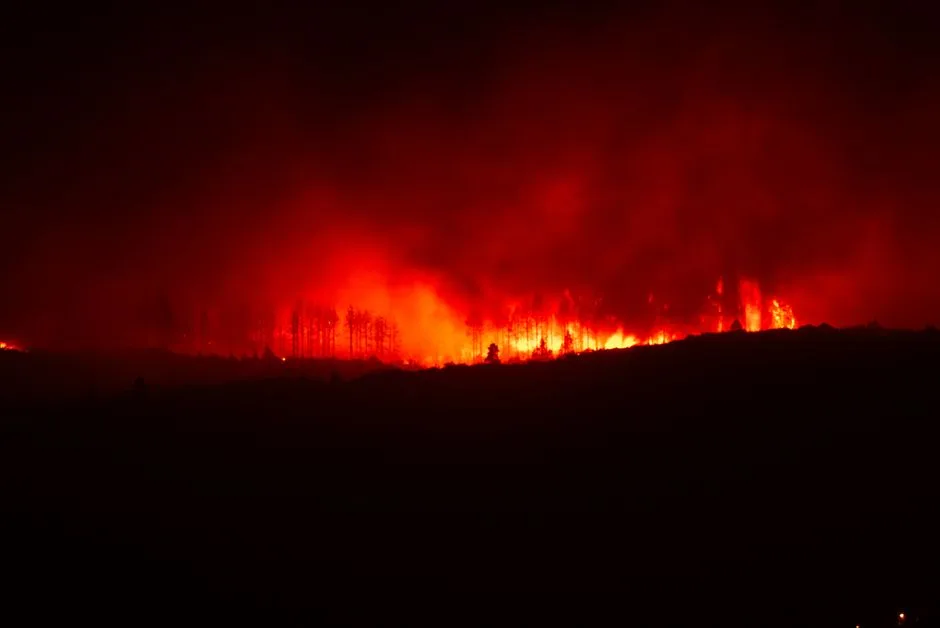
Seattle, a city people move to partly because it doesn't feel like it's on fire, is currently buried under wildfire smoke. The source is Spokane, Washington, where a historic wildfire is doing what historic wildfires do now, which is remind everyone that the old maps of where it's safe to live are completely useless.
The Smoke Doesn't Care About Your Zip Code
Axios is reporting from a smoke-choked Seattle that the reach of destructive wildfires is growing in ways that are genuinely hard to process. This isn't a story about a remote stretch of forest catching fire and burning itself out. This is wildfire smoke reaching a coastal city hundreds of miles away and settling in like an uninvited houseguest who read the lease wrong.
That detail matters more than it might seem. For years, the implicit bargain in American geography was that you could calculate your risk. Flood plains, hurricane corridors, tornado alleys. There was a map, and you could look at it. That map no longer works the way it used to, and the smoke hanging over Seattle is the evidence.
Spokane Is the Epicenter Right Now
The immediate crisis, as Axios reports, is centered on Spokane, Washington, where a historic wildfire is burning. Spokane sits in eastern Washington, drier and more exposed than the wet side of the Cascades, and it has been hammered before. But the scale and intensity of what's happening now fits a pattern that climate scientists have been documenting for years and that the rest of us have been watching in real time whether we wanted to or not.
The West has been running out of easy explanations for individual fires. You can call one fire a drought anomaly. You can call two a bad season. When the smoke from a Spokane wildfire is making Seattle air quality alerts a recurring event, you are no longer talking about anomalies.
What the Scientists Are Actually Saying
Climate scientists, per Axios, study how global warming increases the odds of wildfire. That framing is important. They're not predicting specific fires, and they're not claiming to know exactly which city burns next. What they are saying, with increasing confidence, is that the conditions that produce catastrophic wildfires are becoming more common, more widespread, and more intense everywhere.
Axios describes wildfires intensified by climate change as "an unforgiving spotlight sweeping across the world." Nobody knows where it stops next. That's not a rhetorical flourish designed to scare you. That is the actual state of scientific understanding right now. The uncertainty isn't reassuring. It's the opposite of reassuring.
The warming that's driving this isn't subtle. Hotter temperatures mean drier vegetation. Drier vegetation means more fuel. More fuel means fires that are harder to contain and spread faster than firefighting resources can respond to them. This is not a complicated causal chain.
The Question Nobody Has a Good Answer To
Axios frames the human experience of this moment sharply. Climate scientists are studying probabilities and risk multipliers. The people actually living through the smoke and the evacuations and the air quality alerts are asking a different question: where is safe anymore?
That question is spreading fast. It shows up in real estate searches. It shows up in conversations about where to retire, where to raise kids, where to put down roots. And right now, standing in the smoke in Seattle looking east toward Spokane, the honest answer is that nobody has a satisfying response. The Pacific Northwest was supposed to be a refuge from the worst of climate-driven disasters. The smoke disagrees.
Climate anxiety isn't a soft, therapy-session concept here. It's a rational response to watching your geography become unpredictable in ways that feel permanent.
This Is Not a Regional Story
It is tempting to file this under Pacific Northwest Problems and move on if you don't live there. That would be a mistake. The same dynamics playing out in Spokane and Seattle have already visited California, Colorado, Oregon, Montana, Canada, Australia, southern Europe, and Siberia in various forms over the past decade.
The spotlight Axios describes isn't aimed at one region. It sweeps. It has been sweeping. And the arc of where it lands keeps expanding because the underlying conditions that power it keep getting worse. What's happening in Washington state right now is a preview, not an exception.
The Dingo Take
You are supposed to look at wildfire smoke choking a coastal city and think: weather event, seasonal problem, isolated crisis. That framing is wrong and has been wrong for a while now, and the fact that we keep reaching for it anyway is its own kind of disaster.
The political dimension here is not subtle. Every year that meaningful climate policy gets strangled in Congress, rolled back by executive order, or traded away for some marginal deal is another year the conditions that produce fires like the one burning through Spokane right now get a little worse. The people asking where it's safe to live deserve better than thoughts and prayers and a federal government that spent years treating climate science like a partisan attack. They are not getting better. They are getting smoke.
Spokane is burning. Seattle is choking. The scientists are telling us, as clearly as scientists are allowed to tell us anything, that this is the direction things are going and the speed is not decreasing. At some point the question stops being 'is climate change making this worse' and becomes 'what exactly are we going to do about it before there are no good answers left.' We are getting close to that point. The smoke is hard to miss.


Comments