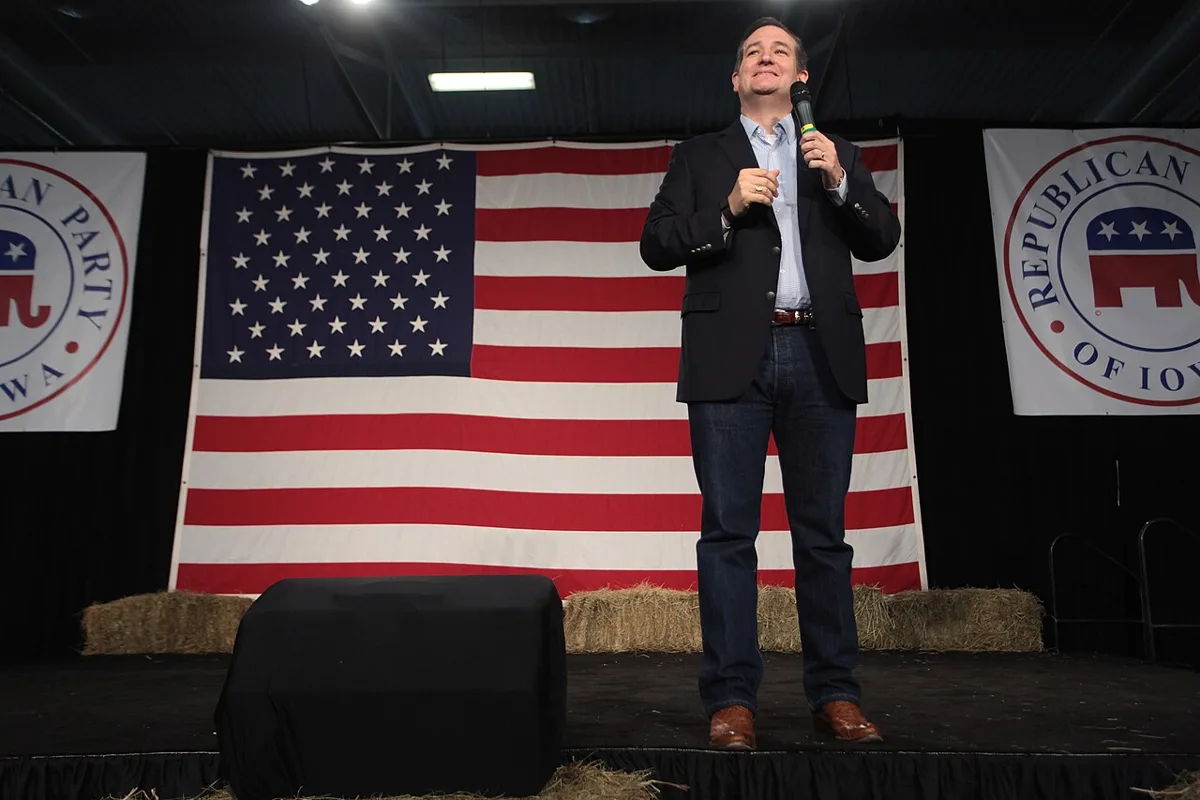
Six months into an active war with Iran, Ted Cruz has a plan: hand out guns to Iranian protesters, watch the regime collapse, and figure out the rest later. The senator from Texas, a man whose most recent foreign policy credential is losing a Senate primary to a guy who called him "Lyin' Ted," is now lobbying the president to back a covert insurgency in a country of 90 million people, with no particular vision for what comes next.
The Plan, Such As It Is
Cruz laid out his thinking on the "School of War" podcast with CBS News national security analyst Aaron MacLean, and it goes roughly like this: keep bombing Iranian military targets, tighten the blockade choking off Iran's oil exports, and arm the Iranians who oppose their own government. "What I believe we should do, what I have urged President Trump repeatedly, what I've urged Israel to do repeatedly, is arm the protesters, give them the guns, to let them overthrow their own government so that it's not American boots on the ground, it's Iranians fighting for their own country," Cruz said.
The context matters here. Iran cracked down on what CBS News describes as the country's largest wave of demonstrations in years back in January, killing at least 12,000 people according to sources. Cruz first called for arming protesters then. A month later, the U.S. and Israel started striking Iran. Now we are six months into a live military conflict, a June memorandum of understanding between the U.S. and Iran has already collapsed, and Cruz's answer to all of this is to escalate further by flooding an already burning country with weapons.
Who Gets the Guns, Ted?
Here is where it gets genuinely remarkable. When asked who he'd like to see take power if Iran's clerical regime collapsed, Cruz said he doesn't "particularly care who comes next" as long as they are "not an Islamist who hates America and is actively trying to kill Americans." That's it. That's the vetting criteria.
He name-checked a few options: exiled crown prince Reza Pahlavi, whose father was overthrown as Iran's shah in 1979, or the Mojahedin-e-Khalq, an opposition group that spent years on the U.S. State Department's own terrorist list and is regarded by most Iran experts as a cult with essentially no grassroots support inside Iran. Cruz said he has "no dog" in the fight between those options. Which is a fascinating thing to say when you're proposing to arm one of them.
Trump, for his part, said back in March that he wanted a personal role in choosing Iran's next leader, which is a sentence that should terrify everyone regardless of where you land on the political spectrum. He has already expressed doubts about Pahlavi, saying the prince "seems very nice" but "I don't know how he'd play within his own country." The man running the United States government is evaluating potential heads of state the way you'd evaluate a dinner party guest.
The Deal Cruz Hates
Cruz's position is partly a reaction against the diplomatic track the Trump administration has been pursuing. The U.S. and Iran struck a memorandum of understanding in June aimed at halting the conflict, restoring shipping in the Strait of Hormuz, and eventually loosening sanctions. Cruz called it a "disaster" and a "terrible deal," warning it would hand Iran billions in sanctions relief and $300 billion in economic development funds.
The Trump administration pushed back on that framing, clarifying in June that the $300 billion in reconstruction funds would be voluntary contributions from Gulf states and private investors, not the U.S. government. Cruz doesn't seem particularly interested in that distinction. "You'll forgive me if I'm not terribly eager to give them $300 billion to facilitate their carrying out their stated intent of murdering us," he said. The deal has since collapsed anyway, though Iran is now reportedly inching toward a separate agreement with Oman to allow shipping in the strait, which could open the door to resumed U.S.-Iran talks.
Trump, who called critics of the original deal "fools" and "either jealous, bad people, or stupid," is now apparently angling for a new deal. Cruz, undeterred, is still calling for regime collapse.
The GOP Is Eating Itself Over This War
Cruz is not alone in his hawkishness, but the Republican Party is visibly fracturing over Iran in ways that will matter for years. Sen. Bill Cassidy called the June memorandum "the worst foreign policy blunder in decades." Sen. Tom Cotton said parts of it were "a step in the wrong direction." On the other end, Sen. Rand Paul has criticized the entire war as a mistake from the start.
At the center of this is Vice President JD Vance, who helped lead the U.S.-Iran negotiations and is growing visibly frustrated with the hawks. On Joe Rogan's podcast last month, Vance pushed back hard on the idea that diplomacy is weakness. "I'm very frustrated by the Americans and, frankly, by people in other countries who are like, 'You cannot negotiate with the Iranians,'" Vance said. "Well, then, what is your proposal to get people to stop shooting at ships in the Strait of Hormuz?" It is a fair question. Cruz's answer, apparently, is more guns to people he can't identify aimed at a regime he wants collapsed into a vacuum he hasn't thought through.
The Iraq-Shaped Elephant in the Room
Cruz acknowledged, to his credit, that "regime change" carries baggage. He specifically cited the chaos that followed the U.S. toppling of Saddam Hussein in Iraq as an example of what he wants to avoid. He said he doesn't view himself as an interventionist, telling MacLean: "I think the interventionists are too quick to send the Marines. That's their solution for everything."
His solution, to be clear, is to send guns instead of Marines and hope the resulting power struggle produces someone who clears a very low bar. This is not a fundamentally different idea. It is the same idea with better branding. The graveyard of American foreign policy is full of headstones marked "we armed the opposition and figured out the rest later." Afghanistan. Libya. The early days of Syria. Cruz knows this history. He's a Princeton and Harvard Law graduate who has argued before the Supreme Court. He is not stupid. Which makes this worse, not better.
The Dingo Take
You are supposed to believe this is the serious, responsible alternative to a diplomatic deal. Ted Cruz, who wants to arm unnamed Iranian protesters toward an undefined post-regime order led by whoever, as long as they clear the bar of not actively trying to murder Americans. That's a bar so low you could trip over it in the dark.
The thing about Cruz's position is that it isn't actually a policy. It's a posture. It lets him position himself as the toughest guy in the room during a war without being responsible for any of the consequences of that toughness. If Trump cuts a deal, Cruz gets to say it was a sellout. If the war drags on, Cruz gets to say we weren't aggressive enough. If some armed faction the CIA quietly supports ends up being a catastrophe, Cruz will have moved on to the next podcast. The Iraq comparison he himself raised is doing a lot more work than he wants it to.
Meanwhile, actual people are dying. At least 12,000 Iranians were killed by their own government in the January crackdown alone, before the U.S. and Israel started striking. The Strait of Hormuz is a choke point for global shipping. The whole region is on a knife's edge and the senior senator from Texas is on a podcast saying he doesn't care who takes over a nation of 90 million people as long as they seem chill about America. Somewhere, a history teacher is screaming into a pillow.

Comments