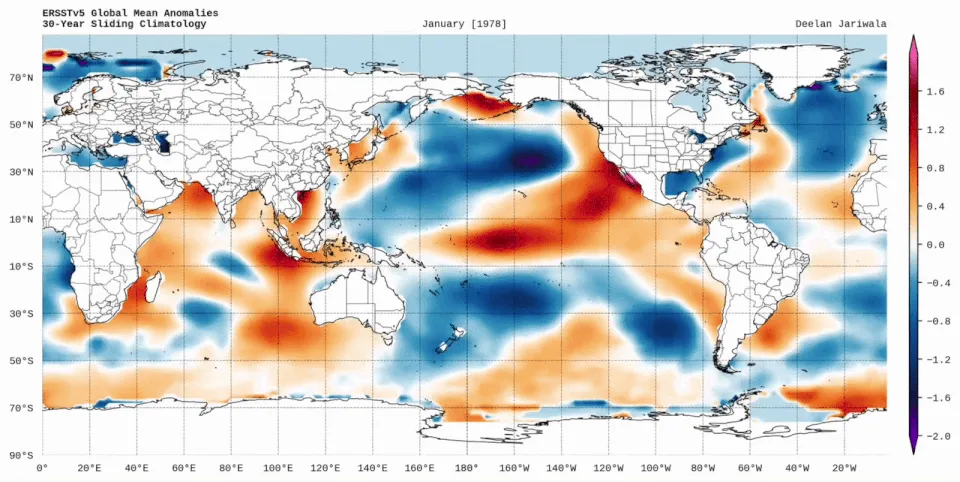
Climate scientists are calling this winter's incoming El Niño the strongest of the century, and they are not being dramatic about it. The last time California took a hit this bad, 17 people died, thousands of homes were destroyed, and the beaches eroded so badly that cliffs started collapsing into the ocean. This one is supposed to be worse.
What We're Actually Dealing With
El Niño is a recurring climate phenomenon where above-average sea surface temperatures in the equatorial Pacific mess with wind patterns and send ripple effects across global weather systems. A "super" El Niño earns that label when sea surface temperatures climb by at least 2 degrees Celsius. According to the Guardian, this year's event is expected to hit that threshold and then keep going.
The US National Oceanic and Atmospheric Administration projects the system will intensify through fall and winter and persist into early spring 2027. That is a long time for the western United States to be in the crosshairs of a supercharged weather machine with a historically bad track record.
The European Center for Medium-Range Forecasts has put California's odds of above-average rainfall at somewhere between 70 and 100 percent along the coast. That is not a model telling you it might rain a bit more than usual. That is a model telling you to move anything valuable out of the basement.
The History Is Not Comforting
California has been through this before, and it has not gone well. The Guardian reports that the 1982-83 El Niño destroyed 33 oceanfront homes outright and damaged 3,000 others, according to the California Coastal Commission. The 1997-98 version killed 17 people and triggered massive flooding across the state. During the 2015-16 El Niño, state officials recorded record coastal erosion on California beaches.
Mark Merrifield of the Scripps Institution of Oceanography explained at a state-hosted virtual town hall this week exactly why that beach erosion matters so much right now. "With less beach in front of the coastline, the waves will have even greater impact on the shoreline with more likelihood of flooding and undercutting of cliffs," he said. In other words, years of prior El Niños have already stripped away the natural buffer. This one arrives to find the coastline already weakened.
And it is not just California. The Guardian notes that Florida and the Gulf Coast up through the mid-Atlantic are also facing elevated precipitation odds. During the 1998 El Niño winter, an outbreak of unusually strong tornadoes in central and south Florida killed 42 people and caused more than $100 million in damage.
Flooding Won't Even Fix the Drought
Here is the brutal irony sitting at the center of this story. The US southwest is in the middle of a serious drought, with some reservoirs at all-time lows. You might think a super El Niño dumping historic rainfall on the region would at least solve that problem. It would not.
Dr. Joel Lisonbee, a senior associate scientist at the Cooperative Institute for Research in Environmental Sciences at the University of Colorado Boulder, told the Guardian back in June exactly how grim the math is. "It would have to be exceptionally wet" to erase the drought, he said, and then came the kicker: "That would also mean flooding, and the destruction and potential loss of life that comes along with that." So the choice is essentially: stay in drought, or get enough rain to refill the reservoirs while also watching towns wash away. Great options. Love to see them.
What the Scientists Are Actually Saying
UCLA climate scientist Daniel Swain was careful at this week's virtual town hall, hosted by California state senator Mike McGuire, not to oversell certainty. "El Niño is never going to guarantee any particular outcome in any California winter," he acknowledged. But he was equally clear that an event this strong shifts the probabilities dramatically, and specifically raises the likelihood of coastal flooding during strong storms and during king tide events.
Merrifield put the larger context plainly. While El Niño is a natural cycle, he said, the temporary sea-level rise it produces in California amounts to "a bit of a stress test of what the state is likely to experience with future climate change." He called it "a sobering look at what we can expect." Climate scientists tend to be careful with their language, which makes it notable when they reach for words like "sobering."
Experts are also warning that no two El Niños are identical. Some bring hurricanes and flooding. Others trigger heat and drought. The precise geographic distribution of the damage is never fully predictable until it is already happening.
The Dingo Take
The strongest El Niño of the century is arriving on a coastline already worn down by the last few, pointed at reservoirs that are critically low but can't absorb what's coming without flooding, and the federal government's climate science infrastructure has spent the last year being systematically dismantled by an administration that finds atmospheric physics politically inconvenient. NOAA, the very agency tracking this system and issuing these warnings, has faced staff cuts and budget pressure under the current administration. So the institution we are relying on to tell us how bad this gets is operating with fewer people and less funding than it had before the threat was identified.
The scientists are being measured and responsible about uncertainty, as scientists are trained to be. But read what they are actually saying underneath the careful hedging: a 70 to 100 percent chance of above-average coastal rainfall, a "sobering" preview of climate change impacts, and a drought so bad that fixing it would require flooding that kills people. That is not a weather forecast. That is a dispatch from a future we keep being told isn't coming.
Prepare accordingly. Check your flood maps. Look up whether your home insurance actually covers what you think it covers, because it probably doesn't. And maybe hold your elected officials to account for what preparation money has actually been spent and where, because after the water recedes, there will be a very loud argument about who saw this coming and who chose not to.


Comments