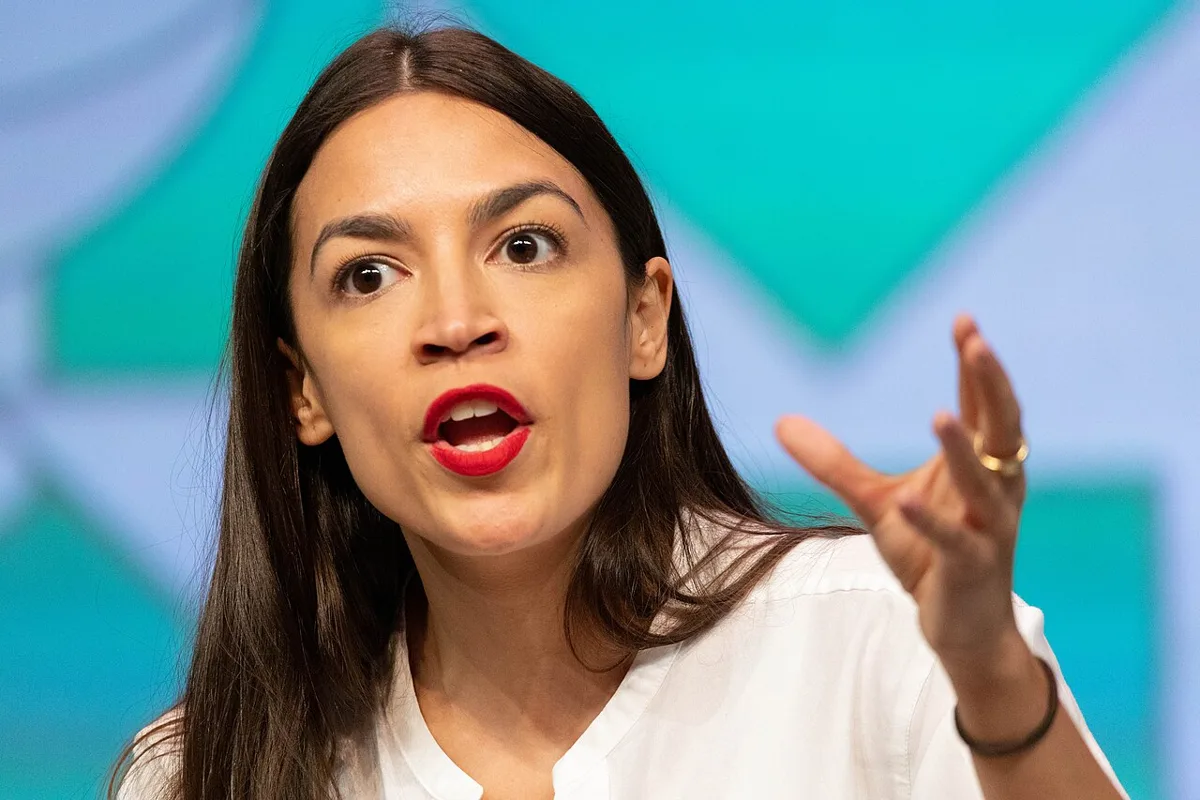
Alexandria Ocasio-Cortez went on ABC Sunday and declined to rule out either running for president in 2028 or kneecapping her own Senate colleague Chuck Schumer in a primary. That's not a non-answer. That's a grenade rolled into the middle of the Democratic Party's already chaotic house.
What She Actually Said
ABC's Jonathan Karl asked Ocasio-Cortez directly about a 2028 presidential run on "This Week," pointing out that a recent New Hampshire poll already has her leading the prospective Democratic field. She left the door open. Both doors, actually.
According to Axios, AOC didn't commit to a presidential run, but she didn't commit to staying out either. And when the Schumer question came up, same deal. Open door. No closure. Maximum political ambiguity executed with surgical precision.
This is not an accident. Politicians at AOC's level do not accidentally leave two doors open at once on a Sunday morning news show. Every syllable is a choice. She is telling someone something.
The New Hampshire Poll Is Not Nothing
Let's pause on that detail for a second, because it's easy to breeze past. A poll of New Hampshire Democrats, taken this early, in 2026, already has Ocasio-Cortez leading a hypothetical 2028 field. New Hampshire. The first primary state. The state that has historically been the graveyard of candidates who looked inevitable in August two years out, and the launchpad for candidates everyone underestimated.
Now, early polls are famously unreliable predictors of anything. They mostly measure name recognition and vibes. But leading in New Hampshire in August 2026 is not nothing. It means she has a base. It means donors will take calls. It means the story writes itself.
The Democratic Party's 2028 primary field is already shaping up to be a full ideological brawl, and AOC just fired a flare gun into the sky to let everyone know she's in the woods.
The Sanders Heir Question
Axios frames this explicitly: Ocasio-Cortez is emerging as the leading potential heir to the movement Bernie Sanders built. That framing matters, because the Sanders movement didn't disappear when Bernie lost in 2016 or 2020. It metastasized. It took over local races, school boards, city councils, congressional primaries. It is now a structural force inside the Democratic Party that the party's establishment has consistently failed to either absorb or defeat.
Sanders himself is 84. He's not running in 2028. That constituency, which delivered him millions of primary votes twice, is looking for somewhere to go. AOC is the most obvious answer, and she knows it. Everyone knows it.
Whichever direction she goes, this is the engine she'd be driving. And unlike Bernie, who ran as an independent in Vermont for decades before running as a Democrat for president, AOC has been inside the Democratic Party the whole time. She knows exactly how the machine works. She's watched it try to stop her. It didn't.
The Schumer Option Is Genuinely Terrifying to the Establishment
Here's the thing about the Schumer primary threat: it might actually be the more powerful play. Chuck Schumer is the Senate Democratic leader, a five-term senator, and one of the most institutionally powerful Democrats alive. He is also deeply unpopular with the progressive base, which has never forgiven him for a string of perceived capitulations and procedural failures.
A Schumer primary would be a knife fight in a phone booth. AOC would enter it with massive small-dollar fundraising infrastructure, national profile, and the progressive base locked up. Schumer would enter it with institutional support, union relationships, and decades of favors owed across New York's Democratic establishment. It would be the kind of race that defines a party's direction for a generation.
And AOC winning that Senate seat would give her something a presidential run from the House doesn't: a Senate platform, foreign policy credibility she'd need to build, and six years to keep building national infrastructure before 2032 or beyond. That's the long game. The fact that she won't close the door on it tells you she's thinking about the long game.
What the Democratic Party Does Now
The Democratic establishment is currently in the middle of a full-scale identity crisis, still processing the wreckage of the 2024 election and arguing furiously about what went wrong and who gets to fix it. Into that vacuum, AOC just dropped a very loud hint that she intends to be a major part of the answer, whether the establishment wants her to be or not.
The party's moderate wing will panic about this. They will produce polls showing she can't win a general election. They will warn about overreach, about the center, about electability, a word that has been used to stop progressive candidates for decades and has delivered the party approximately mixed results in return.
What they won't be able to do is pretend she isn't there. She's leading in New Hampshire. She's on national television not ruling things out. She has a movement, she has money, and she has the one thing no consultant can manufacture: people who actually get excited when they hear her name.
The Dingo Take
You are supposed to look at a politician refusing to rule something out on a Sunday show and call it a non-answer. That's the conventional read. Write it off as speculation, note that she said she's "focused" on the present, move on. Don't do that here. AOC going on ABC and leaving the presidential door and the Schumer primary door both hanging open is a statement. It is a very deliberate, very calculated statement wrapped in the language of humble deflection.
The Democratic Party has spent the better part of a decade trying to figure out what to do with its progressive wing. Tolerate it. Co-opt it. Sideline it. None of those strategies have worked, because the progressive base kept winning primaries, kept raising money, and kept producing the party's most nationally recognizable faces. AOC is the apotheosis of that trend. She is the argument that the left makes to itself every four years, finally arriving with a New Hampshire poll and a refusal to say no.
Schumer or the White House. A Senate seat or the Oval Office. Either way, the Democratic Party's next chapter just announced it's coming, and it's not asking permission. Whether that's good news depends entirely on who you are and what you think the party is for. But it is news. Real, consequential, watch-this-space news. And anyone telling you it isn't hasn't been paying attention.




Comments