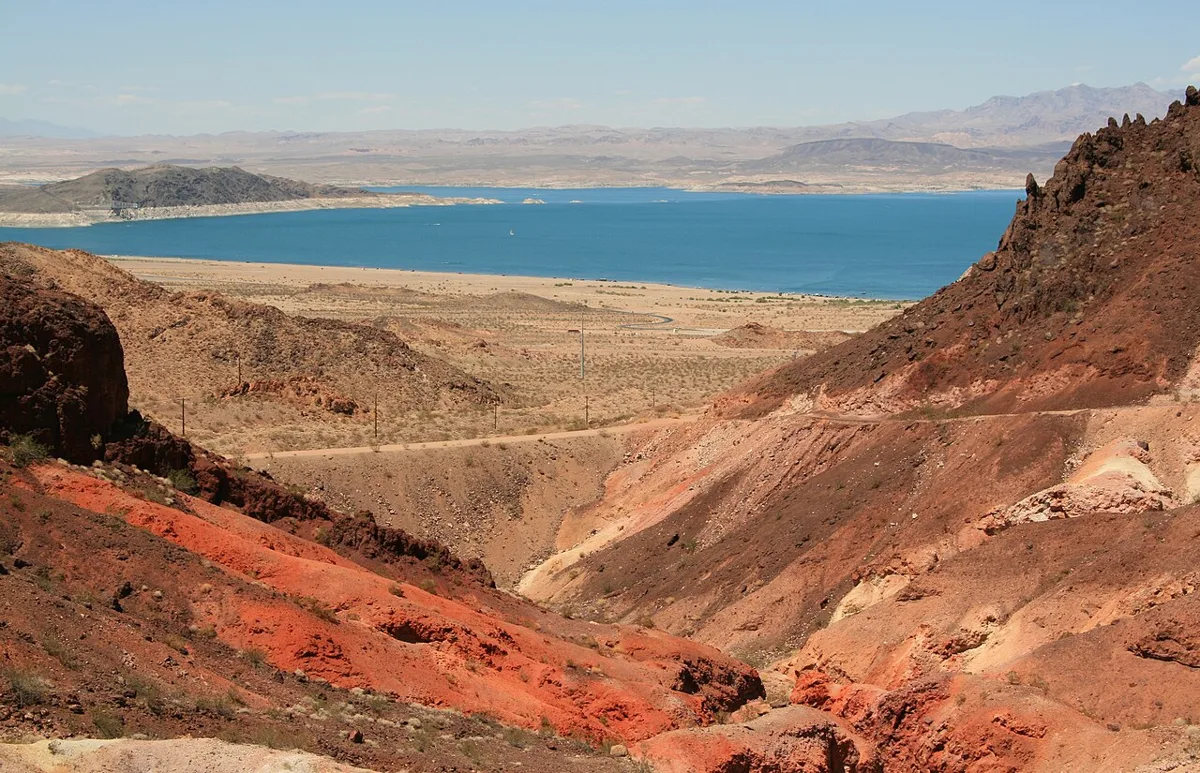
Lake Mead just hit the lowest water level recorded since the reservoir was filled roughly ninety years ago. Not a seasonal dip. Not a bad month. The lowest point in the entire history of the largest reservoir in the United States. According to The Guardian, federal modeling says it's going to keep falling.
The Number That Should Be on Every Front Page
On Friday, Lake Mead's water level dropped to 1,040.4 feet above sea level, according to federal data cited by The Guardian. That barely edges below the previous record set on July 28, 2022, per the US Bureau of Reclamation. The reservoir sits on the Arizona-Nevada border outside Las Vegas and is the anchor of the entire Colorado River storage system.
The Colorado River supplies roughly 40 million people across seven US states, tribal nations, and Mexico. It irrigates millions of acres of farmland. It is not a regional curiosity. It is the plumbing for a significant chunk of the American West, and right now it is running dry in slow motion.
Lake Powell, the second major reservoir on the Colorado, is also at historic lows. Nine of the 54 western reservoirs tracked by the Bureau of Reclamation recently recorded their lowest levels in three decades. This is not one bad reservoir having a rough summer. This is a system-wide collapse in progress.
The Snowpack Was the Worst on Record. Then Came the Heat.
The Colorado River depends heavily on snowmelt from the Rocky Mountains to stay alive. This past winter delivered the worst snowpack on record for the entire basin, according to The Guardian. You could not have scripted a worse setup heading into another brutal summer.
Drought conditions have stretched along the full length of the river and are especially severe at its source. Overuse compounded by rising temperatures and prolonged drought have been draining both Lake Mead and Lake Powell for years now. The math is simple and catastrophic: more water going out than coming in, and less snow every winter to close that gap.
Farmers, cities, Native nations, wildlife, and hydropower producers are all pulling from the same shrinking pool. And it is shrinking faster than most of the public seems to understand.
Thirty Million People Are Directly at Risk. Yes, Really.
JB Hamby, chair of the Colorado River Board of California and a board member of the Imperial Irrigation District, the largest user of Colorado River water, did not mince words when speaking to The Guardian. "It's extremely significant and extremely concerning," he said. "You have three-quarters of the population of the Colorado River basin, some 30 million people, who are directly impacted by risks to Lake Mead."
Thirty million people. Not a hypothetical. Not a worst-case projection buried in an appendix. Thirty million people whose water supply is tied to a reservoir that just broke a ninety-year record on its way down.
In 2022, when the last record was set, the drought had already exposed human remains on the lakebed. Las Vegas was already pumping water from deeper and deeper within the reservoir just to keep the taps on for its residents. That was four years ago and the situation has gotten worse since.
The States Can't Agree and the Feds Are Improvising
Here is where you might expect some reassuring news about bold government action. You are going to be disappointed. The Guardian reports that California, Colorado, Arizona, Nevada, New Mexico, Wyoming, and Utah have failed to reach a long-term agreement on how to share the dwindling water. Seven states, one dying river, no deal.
The federal government stepped in with a short-term proposal from the Bureau of Reclamation calling for the Lower Basin states of Arizona, California, and Nevada to take less water. The plan is described as flexible, meaning deeper cuts in drier years with more time for states to collectively figure out the rest. A final "record of decision" is expected in coming weeks.
Experts have already warned The Guardian that the federal plan may not be enough. The government is offering a short-term patch for a long-term structural failure, and even that patch is still being finished. Meanwhile, federal officials announced they will stop releasing cool water from Glen Canyon Dam to protect the humpback chub, a threatened native fish, prioritizing what's left for hydropower generation. Every decision now is a triage call.
And the Models Say It Gets Worse Before It Gets Better
Federal officials do not believe this record will hold for long. According to modeling done in July and reported by The Guardian, Lake Mead is forecast to keep dropping through much of the rest of the year. The record set Friday is likely a waypoint, not a floor.
Boat ramps at Lake Powell have had to be moved, shut down, or rebuilt from scratch as water levels fell. Nine western reservoirs beyond Mead and Powell have hit thirty-year lows. The scale of what is happening across the West right now is genuinely hard to absorb, which is probably one reason it does not dominate the national conversation the way it should.
The Dingo Take
Forty million people. One river. A ninety-year record shattered on a Friday in August with zero fanfare from the federal government and a modeling forecast that says the bottom has not arrived yet. You are supposed to look at this and feel calm because a short-term federal proposal is in the works and the states are still talking. Do not feel calm.
Seven states could not agree on how to share a resource all seven of them literally cannot survive without. That is the sentence that should haunt every water meeting, every agriculture conference, and every city council session from Las Vegas to Los Angeles. The collective action failure here is staggering. The Colorado River Compact, the original framework dividing up the river's water, was written in 1922 based on flow estimates that turned out to be wildly optimistic. The states have been arguing about an imaginary surplus for a hundred years while the actual water disappeared.
The humpback chub is a threatened fish and it deserves protection. But the fact that federal officials are now making real-time calls about which parts of a collapsing system get water and which do not tells you everything about where this is headed. There is no plan that makes this comfortable. There is only who absorbs the cuts and how fast the cuts come. The record set Friday will be broken again. The question is what, exactly, breaks with it.


Comments