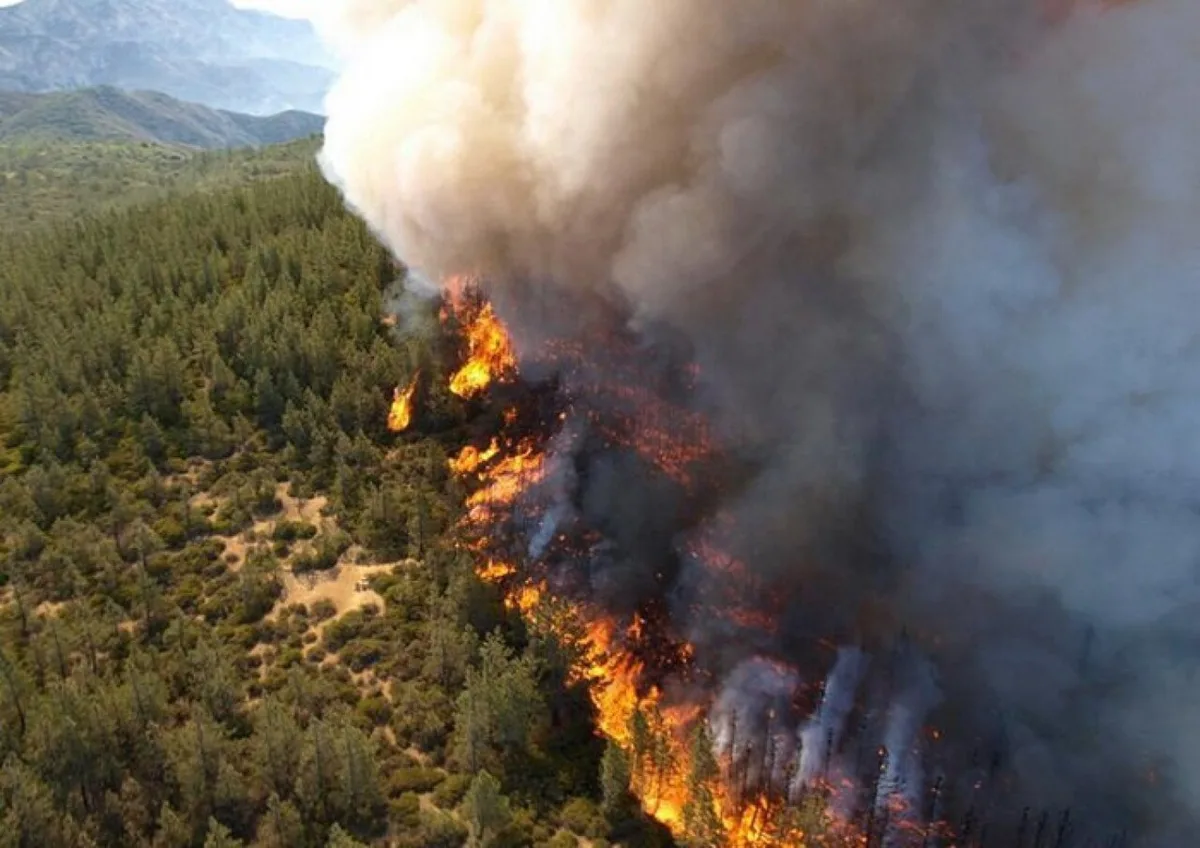
Two helicopter pilots died fighting a Utah wildfire on Friday. A bulldozer operator died battling a different fire in Oregon the same day. Sixty thousand people fled their homes near Spokane. It is August 9th, and the American West is having a very bad week.
The Numbers Are Staggering, and They Keep Moving
As of Sunday, the National Interagency Fire Center reported 183 new fires across the U.S. since Saturday alone, including eight large ones. More than 94 large fires are currently burning across the country. Over 30,000 personnel with more than 640 crews are deployed. That is not a fire season. That is a siege.
In Utah, close to a dozen active wildfires have scorched more than 300,000 acres as of Sunday evening, according to NPR. The Widemouth 2 Fire in Fishlake National Forest has burned over 118,000 acres, making it the largest fire in the state this year. It was 27% contained as of Sunday morning. The Babylon Fire, which burned over 107,000 acres and was previously the state's biggest, has now been overtaken. That sentence should not be possible to write.
The Rocky Canyon Fire, about 30 miles northeast of Salt Lake City, grew to more than 2,800 acres since igniting Friday and is, as of Sunday, exactly zero percent contained. That is the kind of number that makes emergency managers drink. Evacuations are in place in Morgan County.
Three People Did Not Come Home
The U.S. Forest Service confirmed Sunday that two pilots died Friday when their helicopter crashed while they were fighting the Widemouth 2 Fire. Utah Governor Spencer Cox mourned them in a social media post: "They put themselves in harm's way to protect our state and gave their lives in that service."
In Oregon, a bulldozer operator identified by officials as Jason Ensign died battling the Wrights Spring Fire, which has spread over 33,000 acres and was 0% contained as of Sunday afternoon, NPR reports. Three people in two states on a single Friday. Three people who drove to work that morning to do one of the most dangerous jobs in America and did not return.
Let that be the anchor for everything else in this story. Every percentage point of containment, every evacuation order, every abstract acreage number has a person attached to it, grinding through smoke and heat and impossible odds.
Spokane Got Lucky, Relatively Speaking
At least 60,000 people were evacuated in the Spokane, Washington area as firefighters worked to contain multiple fires that scorched over 10,000 acres. Local fire officials said Sunday that "crews made exceptional progress" and were working to ensure there are "no remaining heat sources posing threats," per NPR.
That is genuinely good news, and it is worth saying clearly: the crews working those fires did something remarkable. The bad news is that "exceptional progress" in a region that just evacuated the equivalent of a mid-sized city still means tens of thousands of people who do not know if their neighborhood is standing.
Large fires are also burning in Washington state, Idaho, Montana, and Colorado. Pick your Western state, there is probably a fire there.
Canada Is Having It Just as Bad
Across the border, British Columbia has declared a state of emergency. The province had more than 100 active wildfires as of Sunday, according to the British Columbia Wildfire Service. The Bald Range wildfire alone has prompted more than 20,000 people to evacuate.
The British Columbia Wildfire Service warned Sunday of "high potential for lightning-caused wildfire starts, particularly in the central Interior and the Okanagan which are receiving limited precipitation and dry lightning." New ignitions in hot, dry conditions, they noted, "can establish and spread quickly." That is technically an understatement.
British Columbia Premier David Eby said on social media that authorities are "focused on ensuring that emergency crews have the tools they need to protect people." High temperatures and wind gusts were expected to linger across the southeastern parts of the province and the Okanagan region through Sunday.
How Did We Get Here? Ask a Dry Winter
The U.S. Forest Service's Fishlake National Forest put it plainly: "An abnormally dry and warm winter has led to an extremely difficult fire season." That is the official, bureaucratically cautious way of saying what scientists have been saying for years, which is that the conditions for catastrophic wildfire are getting worse, that fire seasons are getting longer, and that the West is becoming a place where the question is no longer whether a catastrophic fire season will happen but how bad this particular one will get.
This is not normal, even as it becomes routine. The scale of what is happening right now, across Utah, Oregon, Washington, Idaho, Montana, Colorado, and British Columbia simultaneously, represents an enormous, coordinated drain on firefighting resources, on emergency management systems, on the people doing the actual work on the ground. Thirty thousand personnel deployed across 94 large fires is not a workforce anyone planned to need every August.
The Dingo Take
Three firefighters died in one day fighting fires in two different states, and by Sunday it was already the sixth paragraph of the story. That is how normalized this has become. We lead with the logistics, the acreage, the containment percentages, and the human cost gets woven in because otherwise the numbers would be too abstract to process. Both choices are wrong, and we are stuck making them every fire season.
The U.S. Forest Service said a dry, warm winter caused an "extremely difficult fire season." What they did not say, because federal agencies tend not to say it in so many words, is that this is a preview. Not of next year. Of the rest of this century, if the policy response to climate change stays roughly what it has been, which is to say, inadequate and intermittently catastrophic. The West has 30,000 people fighting fires right now and the season is not done.
Jason Ensign drove a bulldozer into a wildfire in Oregon and did not come back. Two pilots flew a helicopter into smoke above Fishlake National Forest and did not come back. Whatever political fight you want to have about climate policy, about forest management, about federal land use, you can have it. But have it knowing that the stakes have names.



Comments