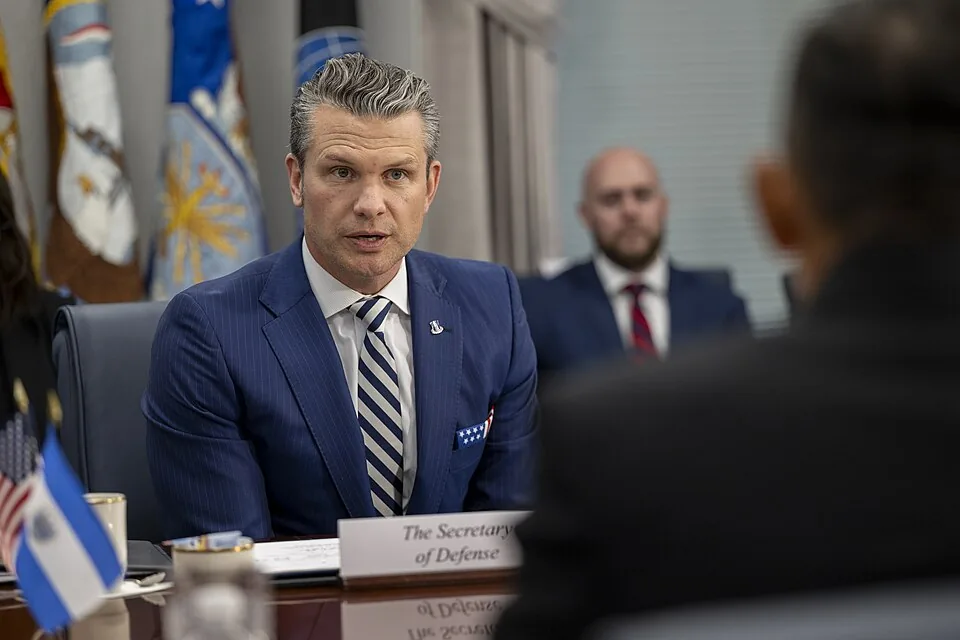
Pete Hegseth just stocked the Pentagon's premier advisory board with two men who have direct financial ties to a venture capital fund co-run by Donald Trump's son. The fund in question has made billions from federal defense contracts handed out by the very administration these men now advise. If you are looking for a cleaner definition of a conflict of interest, you are going to be looking for a while.
The Setup Is Not Subtle
Here is what The Guardian found. Marc Andreessen, of the Silicon Valley giant Andreessen Horowitz, and Blake Masters, the former Arizona Senate candidate, both now sit on the Defense Policy Board, which advises Hegseth and Pentagon leadership on strategy, force structure, and national security priorities.
Andreessen Horowitz, better known as a16z, co-invests alongside 1789 Capital in at least three defense contractors. Donald Trump Jr. is a partner at 1789 Capital. Blake Masters sits on the boards of three separate ventures tied to 1789 Capital through a network of blank-check companies run by the fund's co-founder, Omeed Malik.
Both men now advise the Pentagon on the exact sector where those companies operate and compete for government money. Both men declined, through their representatives, to comment to The Guardian. The Department of Defense did not respond either. Shocking behavior from all parties.
The Money Is Not Small
Let's put some numbers on this because the scale matters. The Guardian reports that companies jointly backed by a16z and 1789 Capital have already pulled in billions in federal loans and contracts since Trump's second term began.
Anduril Industries is the crown jewel here. A16z has been Anduril's foundational venture backer since 2019, leading or co-leading every major funding round. In May 2026, a16z co-led a five-billion-dollar round that doubled Anduril's valuation to sixty-one billion dollars. This came just months after the US Army handed Anduril a contract worth up to twenty billion dollars. CNN reported that Anduril collected roughly 1.25 billion dollars in federal money during the first 500 days of Trump's second term, up from about 760 million in the comparable Biden period. 1789 Capital is also an Anduril investor.
Then there is Hadrian, a defense manufacturing startup that both a16z and 1789 have backed, and SpaceX, which a 1789 partner has described as the fund's single biggest investment. These are not hobbyist portfolios. This is an industrial-scale alignment of financial interest between a presidential family and the advisory apparatus of the world's largest military.
The Board Itself Has a History
The Defense Policy Board was created in 1985 to give the Pentagon secretary independent advice on strategy and national security. Independent being the operative word that is currently doing the most strained work in the English language.
This is not the first time the board has looked less like an independent brain trust and more like a defense contractor networking event. A 2003 investigation found that at least nine of its thirty members had ties to defense contractors holding billions in Pentagon business. That board, chaired at the time by Richard Perle, was also busy making the case for the Iraq War. Perle resigned as chairman that March amid conflict of interest allegations. The lesson, apparently, was not learned.
Hegseth disbanded the board entirely in April 2025, cleared it out under the guise of bringing in "fresh thinking" and "bold changes," and then reconstituted it on June 29, 2026, with fifteen new members. Robert Lighthizer, the former US trade representative, chairs it now. The people Hegseth removed included holdovers from previous administrations. The people he replaced them with include Marc Andreessen and Blake Masters.
The Experts Are Not Reassured
Scott Amey, general counsel at the Project on Government Oversight, told The Guardian that advisory committees like this one are routinely stacked with people seeking government business. "You worry: are some of these people here to raid the cupboards and learn as much as they can to give a competitive advantage to their employer or clients? Or are they trying to push contracts in a way that would benefit an employer or client?" Amey said.
Nick Cleveland-Stout, a research associate at the Quincy Institute for Responsible Statecraft, pointed out that about half of the current board comes from the defense industry and is actively working in it. He noted that even during the second Bush administration, when the board's conflicts drew heavy scrutiny, only about a third of members had actively worked for defense contractors. The current composition, he told The Guardian, is not too dissimilar. That is a diplomatic way of saying things have not improved.
What 1789 Capital Actually Is
1789 Capital is not some shadowy entity you need to squint to see. Donald Trump Jr. is a partner. Its co-founder, Omeed Malik, runs Farvahar Capital, an investment bank that has been engaged as a strategic consultant to PublicSquare, a conservative shopping platform, at eighty thousand dollars a month, according to company filings The Guardian reviewed. Malik was also paid one hundred fifty thousand dollars plus shares equivalent to four percent of deal value for advising on PublicSquare's 2024 acquisition of Credova, a firearms lender.
Blake Masters sits on the boards of three Colombier blank-check companies that Malik chairs or runs. These are the vehicles through which the 1789 Capital network has been building its positions in companies that now hold or are competing for major Pentagon contracts. Masters is now on the Pentagon advisory board. The line from the president's son's fund to the advisory body shaping defense priorities is not a dotted line. It is direct.
The Dingo Take
You are supposed to believe this is all a coincidence. That Hegseth looked across the full breadth of American expertise in defense, technology, and national security strategy, and the people who kept rising to the top happened to be two guys with financial entanglements running straight to the president's son's investment fund. Sure. That is what happened.
What is actually happening is the systematic conversion of the federal government into a revenue engine for the people already closest to power. The Defense Policy Board does not set contracts directly, which is the fig leaf everyone will hide behind. But it advises the people who do. It shapes the strategic priorities that determine which technologies get emphasized, which companies get looked at favorably, which sectors receive the Pentagon's attention and eventual dollars. Putting Marc Andreessen and Blake Masters on that board while their financial networks are tangled up with 1789 Capital is not a gray area. It is a choice.
Richard Perle resigned as DPB chairman in 2003 over conflict of interest allegations that look almost quaint by comparison to what The Guardian just documented. There is no indication anyone in the current administration is contemplating anything similar. Why would they? The whole operation only works if nobody blinks.


Comments