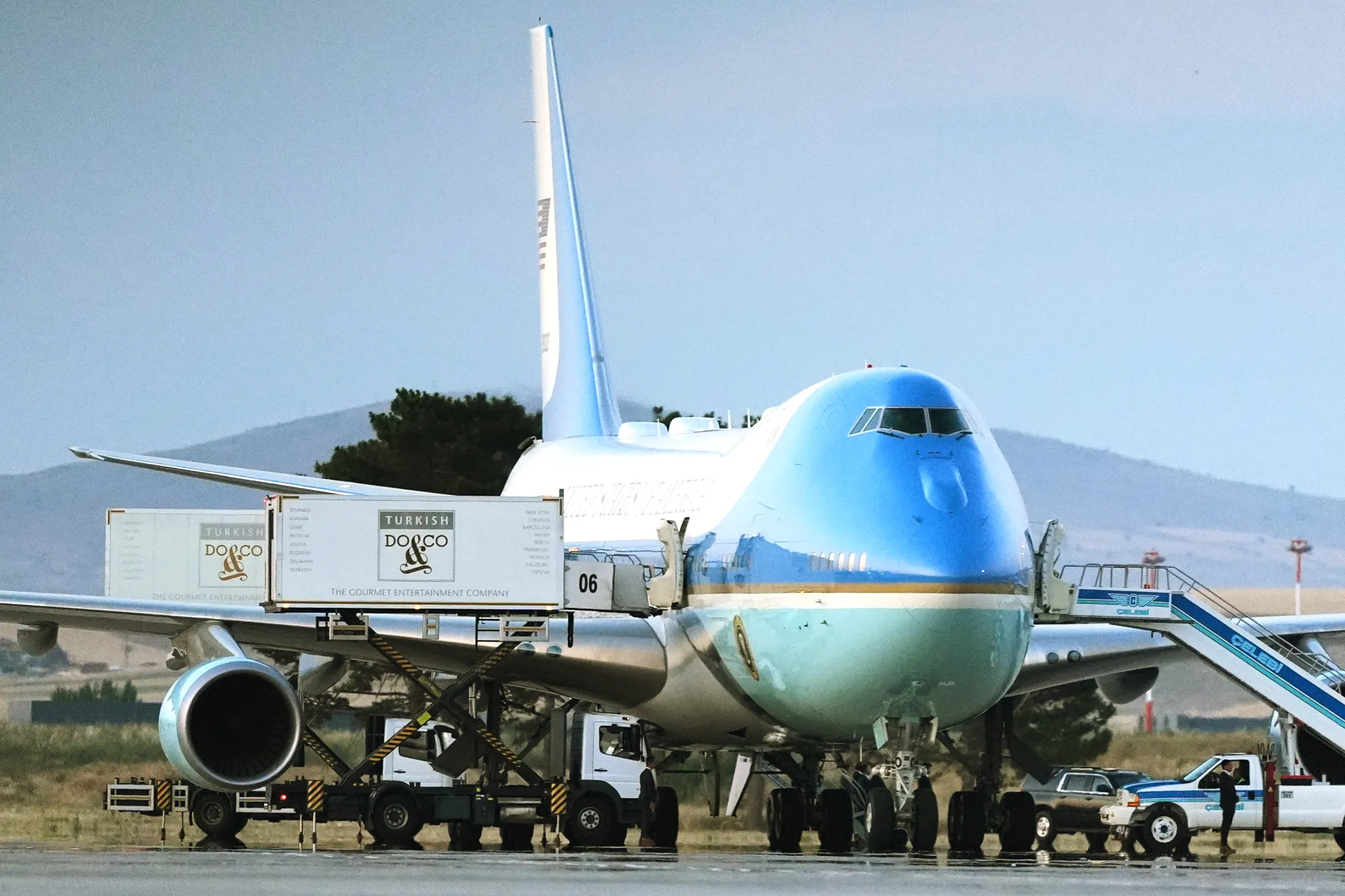
Iran had a credible plan to shoot a missile at Air Force One as it left Turkey. The President of the United States escaped by hiding in an airport catering truck. This is not a thriller novel synopsis. This is what happened at the end of last month's NATO summit, and CBS News is just now reporting it.
The Catering Truck That Saved the President
According to CBS News, which broke this story exclusively, U.S. intelligence detected a credible Iranian plot to fire a missile at the plane carrying President Trump as it departed Ankara at the close of the NATO summit. The response, engineered with the help of a U.S. official with direct knowledge of the operation, was to quietly pull Trump off Air Force One and load him onto a different aircraft using an airport catering truck as cover.
A catering truck. The man who has spent the better part of six months prosecuting a war against Iran, who called himself Iran's "number one target" while standing at the NATO summit, snuck out of Turkey wedged behind what we can only hope was a rolling cart of pre-packaged airline pretzels.
The ruse worked. Trump made it out. The plot, presumably, did not. But the fact that we are now in a world where the American president has to do a covert vehicle swap at a foreign airport to survive a missile threat tells you everything you need to know about where this war stands five and a half months in.
Two Countries, One Blockade, Zero Ships Moving
The U.S.-Iran war, which began February 28, has produced one of the most consequential chokepoints in modern economic history. Before the war, roughly 20% of the world's oil supply passed through the Strait of Hormuz. That number is now essentially theoretical. Trump told reporters Monday, from the Oval Office, that the United States Navy has a blockade that's been "infallible" and that the U.S. is the only one with real control of the waterway.
Iran says the exact same thing. Both sides claim control. Both sides are occasionally shooting at ships that try to cross. And the ships, accordingly, are mostly not crossing.
Brent crude sat at $87.72 a barrel Tuesday after surging 5% on Monday, according to the Associated Press. That followed a month in which oil swung between $72 and $102 as markets tried to read diplomatic tea leaves that kept blowing in different directions. The market's current read: nothing is getting resolved soon. Hard to argue with that assessment.
The Compensation Arms Race Nobody Asked For
Here is the diplomatic situation as of Monday. Iran said it will consider reopening the Strait of Hormuz, but only if it receives compensation for war damage. That is Iran's opening position. Trump, who has never in his life heard a demand he didn't immediately try to reverse and double, fired back with his own compensation demand on Truth Social.
"I am likewise demanding compensation from Iran, for all of the people that they have killed and gravely wounded with their roadside bombs and many conflicts," Trump wrote. He added the families of the 17 sailors killed in the 2000 USS Cole bombing, "thousands of others killed in combat," and then, in a number that would require its own accounting department, the families of "52,000" people he says Iran has killed in the last five months of the conflict, plus "hundreds of thousands of innocent protestors" killed over the last 50 years.
Trump said he's instructed his negotiating team to make this counter-demand a formal part of all future talks. So the peace process now involves both sides submitting competing invoices for atrocities. This is what passes for diplomacy in August 2026.
What "Iran Is Broke" Means When Oil Is at $87
Trump's other notable comment Monday was that Iran "can make trouble, but they're broke." That is probably partially true. Iran's economy has taken a serious beating from the war and from blockade conditions cutting into its own oil exports.
The problem is that a broke country with missiles and allied proxy forces and an apparent willingness to shoot at presidential aircraft is still a country that can cause an enormous amount of damage. The oil price spike tells you the market is not particularly soothed by the "they're broke" framing. Broke adversaries in active conflicts have a long and storied history of continuing to be adversaries.
The Strait of Hormuz remains, by any functional measure, closed to normal commerce. Five months in. With no deal visible on the horizon. And oil at $87 a barrel on a relatively calm Tuesday.
The Dingo Take
Five months into a war with Iran, the American president is sneaking onto alternate aircraft using catering trucks to avoid getting blown out of the sky. Let that sentence sit for a second. Whatever your politics, whatever you think about Trump or Iran or the decision to go to war in the first place, that sentence describes something that has never happened in modern American history. The leader of the United States could not board his own plane safely. That is the condition the world is currently in.
The peace process, such as it is, now consists of both countries publicly posting lists of what the other owes them. Iran wants compensation for bombs. Trump wants compensation for the USS Cole, roadside bombs across multiple conflicts, and fifty years of Iranian domestic repression. These are not negotiating positions that fit on the same spreadsheet. These are two governments performing for their domestic audiences while oil traders lose their minds and ships stay in port.
Twenty percent of the world's oil used to flow through that strait every day. It mostly isn't flowing now. Brent crude is at $87 and swung thirty dollars in a single month. The global economy is eating the cost of this war in real time, every time someone fills up a tank or prices a shipment or tries to run a business that depends on fuel. Nobody in Washington appears particularly close to fixing it. But at least we have the catering truck story. That one is going to age like a very strange wine.


Comments