
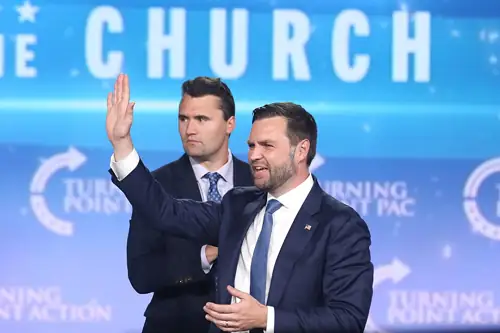
JD Vance went on Fox News Thursday to explain that keeping oil and gas cheap for Americans is now "goal number one" in the Iran war. The average gallon of gas in the United States currently costs more than four dollars, up from under three dollars before the United States started the war. That is the war. The one he is currently running.
The Man Said the Quiet Part Into a Microphone
Let's just sit with this for a moment. According to NBC News, Vance told Fox News on Thursday that "goal number one" in the U.S. war with Iran is keeping oil and gas cheap. Not stopping a nuclear program. Not protecting American sailors. Not stabilizing a region the U.S. just set on fire. Cheap gas.
He then added, almost as an afterthought, that "goal number two is ensure that Iran never gets a nuclear weapon." The nuclear weapon goal is number two. The gas prices goal is number one. In a war the U.S. started by attacking Iran on February 28th.
Iran, for its part, has consistently said it has no desire to develop a nuclear weapon. Whether you believe that or not, it is a strange thing to rank second behind the price of a fill-up at a Sunoco in Akron.
What the Numbers Actually Say
Here is what has happened to gas prices since the United States launched this war to keep gas prices low. Per NBC News, the international oil benchmark Brent Crude sits just above $87 a barrel, which is 45% higher than it was in January. The average American gallon of gas has crossed four dollars. Before the conflict, it was below three.
Oil and gas spiked immediately after the U.S. and Israel attacked Iran. Markets calmed somewhat from those early peaks, but prices rose again Friday morning after the latest round of bellicose American rhetoric. Every time someone in the administration opens their mouth, the commodity markets apparently take it as a cue to go haywire.
So the scorecard reads: war launched, gas prices up forty-plus percent, Vance now publicly declares keeping gas prices low is the war's primary objective. You genuinely could not write a more efficient summary of this administration's relationship with cause and effect.
The Strait of Hormuz Is Not Exactly Under Control
Trump announced Wednesday that the U.S. has "total control" over the Strait of Hormuz and described the American naval blockade as a "wall of steel." The UK Maritime Trade Operations Center reported Thursday that a tanker suffered damage when it was struck by an Iranian aerial drone while trying to exit that same strait.
Iran's military spokesman said plainly that "no vessel can safely transit the Strait of Hormuz without Iran's authorization and supervision." NBC News reports that traffic through the strait remains a trickle compared to the 130 to 140 vessels that passed through during peacetime. The U.S. is blockading Iranian ports. Iran is shooting at ships. Both things are simultaneously true.
Before this war began, some 20% of the world's energy supply moved through that waterway. Now it is choked off, and the ripple effects have hit not just oil and gas but fertilizer supplies globally. The wall of steel appears to have a drone-shaped hole in it.
Indefinitely, They Say
Defense Secretary Pete Hegseth told reporters Thursday that the U.S. can maintain its naval blockade on Iran "indefinitely" by rotating ships in and out. This is the same blockade that has kept the USS Abraham Lincoln at sea for approximately 250 days, without a port call for more than 200 of them. Families of the 5,000 sailors and Marines aboard describe deteriorating conditions and low morale, NBC News reports.
The USS George Washington is now sailing to the Middle East to replace the Lincoln. So the plan is: keep one exhausted carrier group on station, swap it for a fresh one, repeat forever, while gas costs four dollars a gallon and Iran drones commercial shipping.
Hegseth's confidence would perhaps land better if this same strategy had not already depleted U.S. reserves of missile interceptors and produced, in NBC News's description, a "deadly cycle of tit-for-tat exchanges that produced no clear resolution."
The Rationale Has Been Rotating Since February
NBC News lays out the shifting public justifications for this conflict with admirable clarity. The Trump administration initially said it attacked Iran to support mass anti-government protests inside the country. Then it was about defanging Iran's nuclear program. Then it was about regime change. Now Vance is on television saying it is about gas prices, with nukes demoted to the silver medal position.
Trump himself has signaled a move away from active military strikes toward what he called "low-keying it" with economic pressure. Treasury Secretary Scott Bessant went on Newsmax Thursday to promise measures "like have never been seen in the history of economic isolation on a country," while declining to specify what any of those measures would actually be. Watch this space, he said.
Trump has made dramatic threats toward Tehran before and then pulled back, NBC News notes, typically citing a diplomatic breakthrough that never quite arrives. So the current strategy appears to be: threaten extraordinary economic pain, wait for a deal that does not materialize, watch oil prices tick up every time someone gives a TV interview about it.
The Dingo Take
You are supposed to believe that a war which has pushed gas prices 45% higher is primarily a strategy for keeping gas prices low. That is the official position of the Vice President of the United States, stated on camera, Thursday afternoon. Not as a gaffe. Not as a slip. As a declared priority, ranked above nuclear nonproliferation, ranked above anything else anyone in this administration has previously offered as a reason for why American sailors are circling the Persian Gulf on a carrier that has not seen a port in seven months.
The rotating rationales for this conflict have been something to watch. Protests. Nukes. Regime change. And now: your gas bill. Every few months the stated goal reshuffles like a playlist nobody controls, while the actual situation, burning tankers, depleted missile stocks, a choked strait, a wrecked global fertilizer supply, remains constant. Bessant promised on Newsmax that unprecedented economic measures are coming "next week." He did not say which next week.
The people paying four dollars a gallon for the privilege of watching this unfold should probably know that the guy who says keeping their costs down is the whole point of this war has produced, so far, a 45% increase in oil prices and a blockade that Iran's military is actively defying with drones. At some point the gap between the stated mission and the actual results stops being a communications problem and starts being the story itself. We are well past that point.



Comments