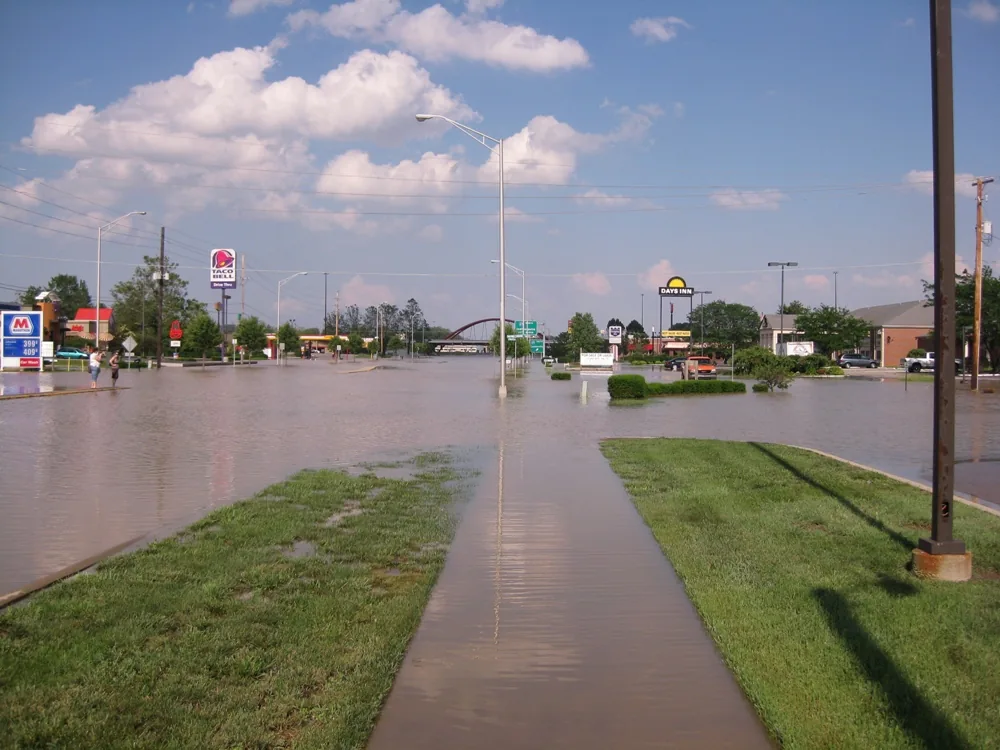
The White River crested nearly two feet above a record that had stood since 1913, and Indiana is still counting its dead. At least five people are gone, 91 residents and 45 of their pets have been pulled from floodwaters, and the Marion County emergency management director is calling it a once-in-a-lifetime event — which is a phrase that keeps coming up a lot more than once in a lifetime these days.
Records That Held for 113 Years Are Gone
The National Weather Service reported more than 11 inches of rain fell across parts of central Indiana in just two days. The White River crested just shy of 25 feet in Anderson and Noblesville on Friday, according to CBS News — more than a foot above the previous record, which was set in 1913. To be clear: that record survived two World Wars, the Dust Bowl, and every storm system that came through central Indiana for over a century. Gone now.
"This is one of those once-in-a-lifetime type floods," Jacob Spence, director of Marion County Emergency Management, told the Associated Press. "So yeah, this is an unprecedented event and unfortunately we're setting some new records." You can hear the exhaustion in that quote. The man is watching history get broken in real time and has to stand in front of cameras and explain it.
Five Dead, Dozens Missing, and the Water Was Still Rising Saturday
Gov. Mike Braun confirmed five deaths linked to the storms. In Delaware County, sheriff's deputies found the body of a 58-year-old woman who authorities believe tried to drive through floodwaters on Friday. The county also confirmed Saturday that 18-year-old Matthew Morey, an incoming Purdue freshman who entered the Mississinewa River with three others on Wednesday, was found dead. He had been missing for days.
"There are no words that can ease the pain of losing a child," the Delaware County Sheriff's Office told CBS News. That is correct. There aren't. And yet here we are.
As of Saturday afternoon, Indianapolis Fire Department spokesperson Rita Reith put the rescue count at 91 people and 45 pets. About 400 residents in northern Indianapolis evacuated on their own. More than 350 evacuations occurred in Delaware County. A senior mobile home community in Tipton County was being cleared out. National Guard vehicles were in the water helping with rescues. Todd Wilson, the city's public works director, told residents plainly: "The water is still rising, so heed the warnings."
Indianapolis Mayor Declares Emergency, Trump Approves Federal Aid
Indianapolis Mayor Joe Hogsett declared a local emergency Friday as creeks and streams overwhelmed their banks across central Indiana. He appeared Saturday alongside emergency managers urging anyone living along the river to get out. Flash-flood warnings and watches remained in place across a wide swath of the state.
Gov. Braun said he spoke with President Trump, who approved a presidential emergency declaration on Saturday. That unlocks up to $5 million in federal resources for response and recovery, according to CBS News. Five million dollars sounds like a lot until you start looking at footage of vehicles swallowed whole by floodwater and a power pole toppled by a current that looks more like a river than a street.
The Human Cost Behind the Statistics
The Yorktown Public Library in Delaware County posted footage to Facebook showing roughly a foot of floodwater throughout the entire building. "Seeing our library in this state yesterday was nothing short of devastating. We're definitely all feeling a little heartbroken," the library said. A public library. Flooded to the shelves. The kind of loss that doesn't show up easily in a damage estimate but hits a community in ways that last years.
Residents all over the region posted their own videos: cars stranded axle-deep in rushing water, intersections turned into brown lakes, a power pole going down in real time. The damage concentrated along the river corridor running from Hamilton County into Indianapolis's northern suburbs, but CBS News reports that rescues and welfare checks were happening as far east as Fayette County. This was not a local event. This was a regional catastrophe.
This week's storms also tore across a broader stretch of the Midwest, bringing tornadoes, flash flooding, and severe damage from the Chicago area all the way to western Pennsylvania. Indiana just caught the worst of it.
The Dingo Take
Five people are dead. Flood records from 1913 are gone. The emergency management director used the phrase "once-in-a-lifetime" to describe something that, if you've been paying attention to the last decade of extreme weather events, is starting to feel like it happens every other summer somewhere in this country.
The federal emergency declaration freeing up $5 million is the right call and the minimum possible response. For context, $5 million is roughly what a mid-tier Trump golf weekend costs the Secret Service in security logistics. It is not nothing, but it is also not a plan. Indiana's rivers didn't just have a bad week — they shattered benchmarks that stood through every storm of the last 113 years, and the question of why that is keeps getting shuffled to the back of the conversation every time there's a more immediately urgent news cycle to chase.
Matthew Morey was 18 years old and was supposed to start at Purdue this fall. The 58-year-old woman in Delaware County tried to drive through water that looked passable and wasn't. These are the specific, actual human costs of infrastructure that wasn't built for this, warnings that came too late or weren't heeded, and a broader political culture that treats "unprecedented flooding" as a weather story instead of a policy failure. The water recedes. The question of how we got here doesn't.





Comments