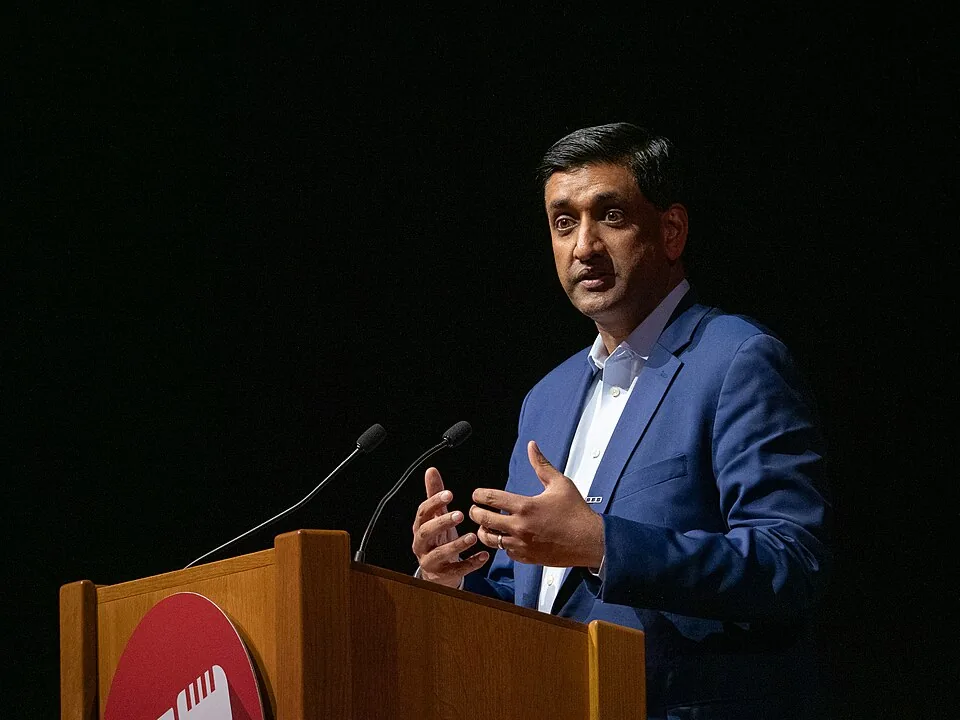
Seventy-one percent of Americans say they oppose building AI data centers in their communities. That is not a fringe position. That is a supermajority, and Ro Khanna just decided to run with it.
What Khanna Is Actually Proposing
Khanna, a progressive California congressman who has spent years trying to be taken seriously as the Democratic Party's tech-savvy voice of reason, introduced a resolution this month called the Data Center Bill of Rights. According to NBC News, the resolution would affirm that communities can ban data centers in residential areas, reject increases in electric bills, and require that data centers use clean energy.
On Meet the Press, he spelled it out plainly: data centers should not be built on farmland or in residential neighborhoods, and local communities should have actual input before one shows up next to their kids' school. "You can't shove a data center down the throats of a local community without any say that that community has," he told moderator Kristen Welker.
He also said, when pressed on whether he opposes data centers altogether, that he does not. "I believe it needs regulation." That is a pretty straightforward position. It is, somehow, a controversial one in Washington.
The Problem These Things Are Actually Causing
Data centers are not abstract. They are enormous, loud, thirsty, power-hungry facilities that have been springing up across the country to feed the AI boom, and the communities near them have noticed. As NBC News reports, residents have raised serious concerns about water and energy consumption, noise pollution, and air quality.
Your electric bill going up is not a hypothetical. Water tables getting strained is not a hypothetical. A giant humming warehouse appearing on the edge of a neighborhood where no one voted for it and no one had any say is not a hypothetical. These are things that are happening right now in communities from Virginia to Texas to rural Iowa.
A March Gallup survey found that 71% of Americans somewhat or strongly opposed local construction of AI data centers. That number deserves to sit there for a second. Seventy-one percent. There are almost no issues where you get 71% of Americans to agree on anything. The fact that the tech industry and most of Washington have treated this as a nuisance complaint rather than a legitimate policy debate says everything about whose interests are actually being represented.
The AI Leadership Question Is a Trap and Khanna Knows It
Welker asked Khanna the question that tech lobbyists love to frame as a gotcha: can the U.S. lead the world in artificial intelligence if it opposes data center infrastructure? It is a clever framing. It implies that any regulation equals opposition, that slowing down in any way means China wins, and that the only patriotic position is to let the industry do whatever it wants wherever it wants.
Khanna did not take the bait. "Even the technology leaders understand that there needs to be a pause so that we can get this right," he said. That is a carefully worded answer, and it is worth paying attention to. He is not saying stop. He is saying slow down enough to not completely blow up the communities where these things land.
The framing of "regulation versus AI dominance" is a false choice the industry has been pushing hard, and it has worked remarkably well on both parties for years. The fact that someone is finally pushing back on it in explicit policy terms is actually news, even if it does not feel like it yet.
Oh Right, He Might Also Run for President
Khanna did not rule out a 2028 presidential run when Welker asked him about it, which means he absolutely wants to run for president in 2028 and is doing the thing where you do not say it out loud yet. He has been floated as a potential contender, as has Alexandria Ocasio-Cortez, and NBC News reports that Welker asked him directly why he would be a better progressive leader than AOC.
His answer was diplomatic. He called Ocasio-Cortez "a phenomenal talent," said the progressive movement would have many voices, and then spent the rest of the answer talking about himself. He is pitching something he calls "economic patriotism," a national economic vision that he says is the Democratic Party's path back from the wilderness.
"The Democrats' path back out of the wilderness is to have a clear national economic message," he told Welker. That is either the setup for a serious presidential campaign or the most elaborate way anyone has ever talked around one. Possibly both.
Why This Issue Actually Matters Electorally
Data centers have become a genuine electoral issue, NBC News reports, with candidates across the country now forced to have a position on whether these facilities should be able to land in their districts with minimal community input. That is a significant shift from even two years ago, when this was mostly a zoning and utility nerd issue.
The reason it has broken into the mainstream is simple: the AI boom is not abstract anymore either. People are seeing their electricity prices rise. They are seeing massive construction projects approved with minimal public process. They are seeing local officials who are either enthusiastic boosters or completely overwhelmed, with not much in between.
Khanna is betting that being the Democrat who shows up with an actual framework for this, rather than vague promises to "work with industry," is worth something politically. Given that Gallup number, it is hard to argue he is wrong.
The Dingo Take
You are supposed to believe that any politician who says the words "data center regulation" is a technophobe standing in the way of American progress. That is the story the industry wants told, and largely the story that has been told for the past several years while these facilities multiplied and local communities had essentially no recourse. Seventy-one percent of Americans opposing something does not usually get treated as a fringe position. But when the industry spending billions on AI infrastructure does not want regulation, suddenly the overwhelming majority view becomes a problem to be managed rather than a mandate to be respected.
Khanna's resolution is not radical. Banning data centers from residential areas and farmland is common sense zoning. Requiring clean energy use is something the industry claims to want anyway. Giving communities a voice in decisions that directly affect their water supply, their air quality, and their electricity bills is not anti-innovation. It is the minimum baseline of democratic accountability. The fact that this needs to be spelled out in a resolution at all is a pretty damning indictment of how badly this sector has been allowed to self-regulate.
The 2028 presidential angle is real, and Khanna is clearly using this issue as part of his pitch. Fine. Politicians run on issues. The more interesting question is whether the Democratic Party is actually willing to engage with tech regulation as a populist economic issue rather than tiptoeing around the donors who benefit from the status quo. Khanna is making a bet that it has to. The Gallup poll suggests he has a point.



Comments