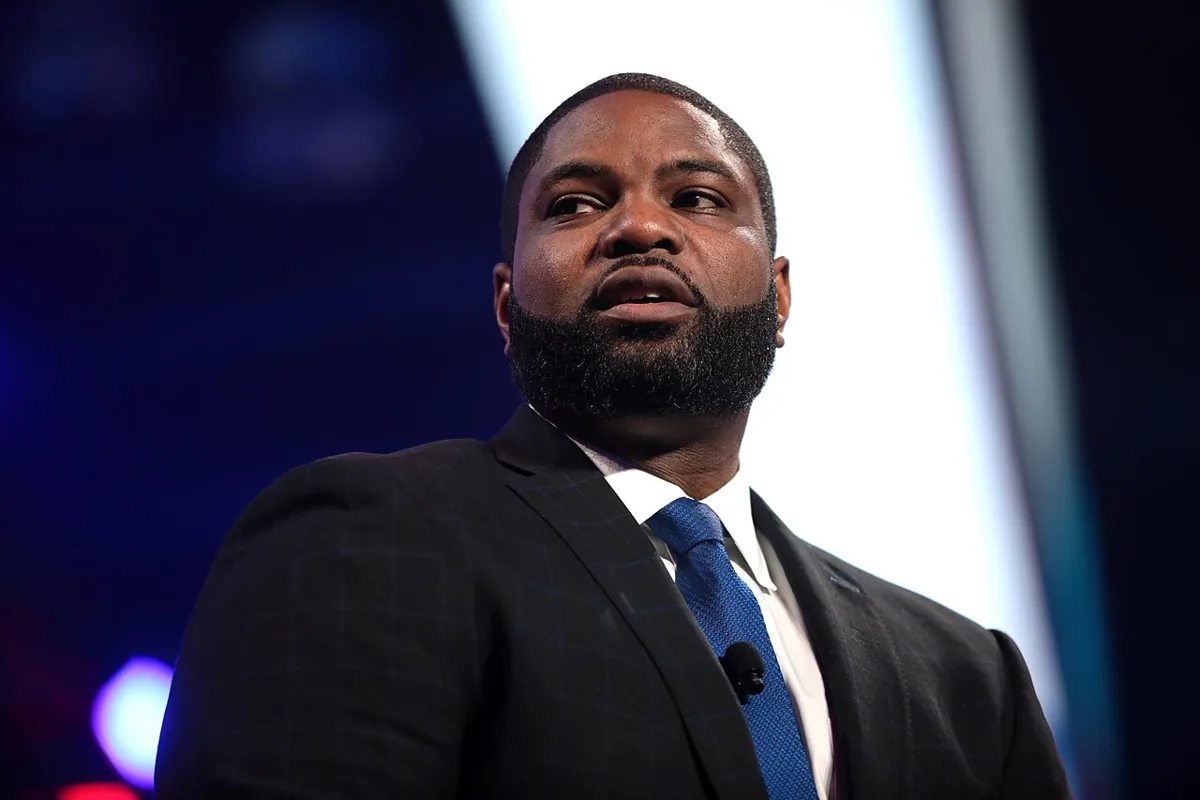
Byron Donalds, Republican congressman and Florida's GOP gubernatorial nominee, went on national television Sunday morning and told Margaret Brennan that measles outbreaks in America are caused by illegal immigration. He offered no evidence. He does not have any. What he does have is a governorship to win and a base that would apparently prefer a scapegoat to a shot.
The Vaccine Question He Couldn't Answer
CBS News aired the interview on Face the Nation, and to Brennan's credit, she did not let Donalds off easy. She came with a specific, concrete, uncomfortable question: Florida is below the 95% immunization threshold needed for measles herd immunity. Are you going to tell Florida parents to get their kids vaccinated against measles?
Donalds did not say yes. He did not say no. He said illegal immigration.
"The reason why we have seen a measles outbreak in certain parts of the country is because of rampant illegal immigration into the United States from the previous administration," Donalds told Brennan. When she asked what evidence he had for that claim, he pointed to outbreaks in El Paso and Southwest Florida and gestured vaguely at the existence of unvaccinated people who crossed the border. That is not evidence of causation. That is a talking point wearing a lab coat.
Brennan pushed again: so you want them to be vaccinated? Donalds pivoted to costs. He wanted to talk about price transparency and the Affordable Care Act. He very much did not want to talk about whether the man who might be Florida's next governor thinks children should get the MMR vaccine.
The Actual Science, Which Was Also on the Show
Here is a detail that makes the Donalds segment land harder: earlier in the same broadcast, Brennan interviewed former FDA Commissioner Dr. Scott Gottlieb, who sits on the boards of Pfizer and United Health. They were discussing a genuine mRNA breakthrough, a collaboration between Moderna and Merck that has shown real promise in preventing melanoma recurrence in high-risk patients.
Gottlieb was careful and precise. He pushed back on the White House's claim that this breakthrough vindicated HHS's decision to slash federal mRNA vaccine research funding. "The statements from HHS pertain, in particular, to mRNA vaccines used for infectious diseases," Gottlieb said. "This is different." He explained that the melanoma treatment is a form of cancer immunotherapy, training T cells to identify and attack cancer proteins, not a vaccine in the traditional sense. The distinction matters, and Gottlieb made it clearly.
So in one hour of television, you had a credentialed former regulatory official explaining, carefully and accurately, what vaccines do and do not do, and a man running to govern 22 million people suggesting that measles is fundamentally an immigration enforcement problem. The contrast was not subtle.
What Donalds Actually Said About Mandates
To be precise about what Donalds did and did not commit to, because the evasion is itself the story: he said he agrees with Governor DeSantis and Surgeon General Ladapo's moves to give parents the ability to opt out of rulemaking vaccines. On polio and MMR, the ones mandated under Florida law, he said he wants to "study" the issue and "work with the legislature" before making any decisions. That is not a commitment to keep them. It is a commitment to keep his options open.
He also endorsed spreading out the childhood vaccination schedule, citing his 22-year-old son's different vaccine timeline as evidence that the current schedule is too aggressive for infant immune systems. This is a claim that has been studied extensively. The current schedule is not too aggressive. The American Academy of Pediatrics, the CDC, and decades of safety data say so. But Donalds presented it as common sense, and in the current political environment, that is often enough.
Brennan noted that the Florida Department of Health can already change certain mandated vaccines under rulemaking authority. Donalds did not dispute this. He changed the subject to the Affordable Care Act.
Haitian Immigrants, TPS, and the Art of the Non-Answer
The vaccine section of the interview was not even the only place Donalds demonstrated this technique. Brennan also pressed him on the 158,000 Haitians legally living in Florida under Temporary Protected Status, a program the Trump administration terminated. She listed what the State Department itself says about Haiti: crime, terrorism, no healthcare access, kidnapping. Shouldn't conditions that terrible justify temporary protection?
Donalds started to answer and the transcript cuts off, which is a shame, because his answers on immigration throughout the interview followed a clear pattern. Legal immigration good. Illegal immigration caused measles. Haitians under TPS were, in his framing, beneficiaries of a program that was only supposed to be temporary, with the implied suggestion that the conditions creating the crisis are someone else's problem to solve.
This is the rhetorical infrastructure of a man who has decided that specifics are dangerous. Stay general. Invoke the border. Pivot to costs. Repeat.
Meanwhile, in the Senate Primary Next Door
Also on the program Sunday was Rep. Seth Moulton, Democrat of Massachusetts, who is primarying 78-year-old Senator Ed Markey ahead of a September 1st vote. Moulton, backed by a Boston Globe endorsement that flipped from its 2020 Markey support, made the generational change argument that has defined his political career across failed presidential runs, early Biden-should-not-run calls, and attempted Pelosi ousters.
His most effective line was straightforward: at a recent debate, Markey said he could not tell which apps on his phone use AI, then tried to clean it up by comparing AI regulation to seatbelts. "The world has just moved on," Moulton said. He also landed a clean hit on Markey's campaign finance: Markey took $62,000 from Chuck Schumer's Senate majority fund, money raised nationally to flip red seats in Maine, Ohio, and Alaska, and redirected it to his own primary defense. That is not a great look for a senator running as a progressive institution.
Moulton's pitch is genuine, his record of bucking his own party is real, and his odds heading into September 1st remain unclear. He is the more interesting candidate. Whether Massachusetts Democratic primary voters find that interesting enough is a separate question.
The Fed, $40 Trillion, and the Art of Saying Nothing Reassuring
Rounding out the Sunday show was Minneapolis Fed President Neel Kashkari, who joined Brennan to discuss the U.S. hitting $40 trillion in national debt. His message, delivered with the careful non-alarm of a central banker who has been trained since birth to not say anything that moves markets, was essentially: yields are high but not historically unprecedented, the Treasury market is functioning, and it is not the Fed's job to fix the debt.
Kashkari acknowledged that the Congressional Budget Office has long flagged the debt trajectory as unsustainable, and that many Fed leaders have said so for years. But he declined to endorse investor Mohamed El-Erian's warning, published in the New York Times, that a "breathtaking leap in the cost of borrowing" could mark "the beginning of a structural economic shift more enduring and more globally consequential than most previous episodes of market volatility." Kashkari allowed that there are both negative and optimistic interpretations of why bond yields are rising globally and said it is hard to know which is the bigger driver.
That is technically true. It is also the most reassuring thing a person can say while not actually being reassuring.
The Dingo Take
Byron Donalds is running to govern a state where measles vaccination rates have fallen below herd immunity thresholds, and his answer to that fact is to blame undocumented immigrants and change the subject to hospital price transparency. You are supposed to look at that and think it is a serious healthcare policy platform. It is not. It is a man who has calculated, correctly based on recent electoral history, that his base responds better to border rhetoric than to public health data, and who has decided to govern accordingly before he has even won the office.
The measles-immigration claim is worth staying on for a moment because Donalds stated it flatly and with apparent confidence. Measles outbreaks in the United States have multiple documented causes, chief among them declining vaccination rates in communities that have embraced vaccine skepticism, much of it driven by the same political movement Donalds belongs to. The CDC has tracked this. Researchers have studied it. The link between vaccine hesitancy and outbreaks is not ambiguous. The link between measles and the Biden administration's immigration policy is something Donalds asserted on television without a shred of supporting data, and CBS News broadcast it.
What made Sunday's Face the Nation genuinely instructive is that you could watch Scott Gottlieb explain, in careful and exact terms, how mRNA technology trains the immune system to identify cancer proteins, and then 30 minutes later watch a man who wants to run the third-largest state in America tell you that measles is an immigration problem. One of these men has spent his career trying to make vaccines work better. The other is trying to make vaccines someone else's fault. Florida gets to decide in November which approach it prefers.


Comments