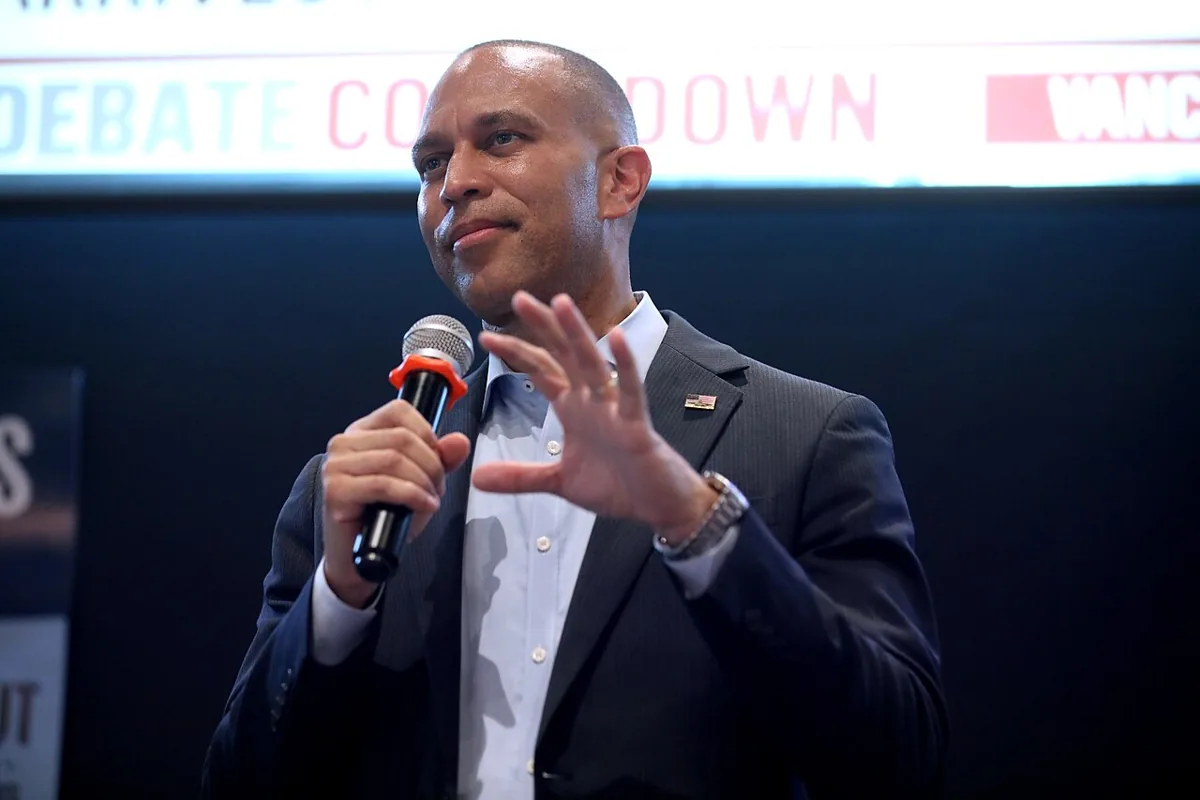
Hakeem Jeffries, the man tasked with leading House Democrats back to a majority, sat down with Jared Kushner — former presidential son-in-law, current walking conflict of interest, and professional vibes-only political operator — and his own party is now eating itself alive over it. Jeffries posted a defense video to social media explaining that Kushner 'asked for a meeting, and I took it, to discuss the affordability crisis.' That sentence alone is enough to send the Democratic left directly into the sun.
What Actually Happened Here
According to Axios, Jeffries met with Jared Kushner, and the Democratic leader's explanation was about as brief and unadorned as you'd expect from a man who clearly did not think this was going to become a story. Kushner asked. Jeffries said yes. They talked about affordability. End of meeting, beginning of crisis.
The problem isn't entirely what happened in the room. It's who Jared Kushner is, who he's connected to, and what it looks like when the top Democrat in the House sits across from the president's son-in-law for a chat about housing costs or grocery prices or whatever 'the affordability crisis' is supposed to mean this week. It looks bad. It looks like either naivety or a photo op Kushner can use later. Possibly both.
Jeffries did nothing technically wrong. Meeting with people across the aisle, or even across the family tree of the sitting president, is part of the job. The question is whether this particular meeting, with this particular person, at this particular moment, was worth whatever came out of it. Based on the fallout, the answer is a pretty emphatic 'probably not.'
The Left Was Already Annoyed at Jeffries. Now They Are Fully Annoyed.
Axios reports that this incident has resurfaced long-standing tensions between Jeffries and his party's progressive wing. That framing is doing a lot of heavy lifting. 'Long-standing tensions' is the polite way of saying that a substantial portion of the Democratic base views Jeffries as too cautious, too corporate-friendly, and not nearly confrontational enough with a Republican Party that has spent the last decade setting the rulebook on fire.
The Kushner meeting handed those critics exactly what they wanted: a concrete, undeniable, screenshot-able example of their leader cozying up to the Trump orbit. It doesn't matter that Jeffries has spent years opposing Trump's agenda. One meeting with Kushner and suddenly every complaint the left ever had about him gets a fresh coat of paint.
This is how Democratic circular firing squads work. Someone does something that looks bad, the left fires, the center fires back at the left for firing, and by the end of the week nobody remembers what the original argument was actually about. Meanwhile, Republicans are off somewhere unified and smiling.
Why the Timing Makes This Worse
Axios points out the obvious electoral logic here: if Democrats win back the House with a narrow majority, Jeffries needs every last member of his caucus to be more or less on the same page. Narrow majorities are brutal. They mean one bad week, one defection, one unexpected resignation can turn a governing coalition into a headache.
Blowing up your relationship with the left before you've even won the majority is not optimal strategy. These are the same voters and activists who are supposed to be showing up in force, donating, canvassing, and generally behaving like a political coalition with a will to live. Giving them reasons to stay home or primary their own members is the kind of thing that ends up mattering in November by margins of a few thousand votes.
Jeffries knows this. He is not a stupid man. Which is exactly why the Kushner meeting is so baffling. Whatever came out of that conversation about affordability would have to be genuinely historic to be worth this.
The Jared Kushner Factor
Let's be clear about who Jared Kushner is in 2026. He is the president's son-in-law, a man whose business entanglements have attracted sustained scrutiny for years, whose Middle East portfolio during the first Trump term produced a lot of meetings and very little peace, and who has continued to operate in the financial and political orbit of a family that does not clearly separate personal business from state power.
Meeting with Kushner is not the same as meeting with a Republican senator or even a White House chief of staff. Kushner occupies a weird zone where it is never entirely clear whether he is acting as a government official, a private citizen, a family member, or all three simultaneously. That ambiguity is a feature, not a bug, from the Trump world's perspective. It makes accountability slippery.
So when Jeffries says Kushner 'asked for a meeting,' the follow-up question the progressive left wants answered is: why? What did Kushner want? What did Jeffries give him by agreeing? And what does Kushner plan to do with the optics of having sat across from the top House Democrat while Trump's approval ratings do whatever they're doing this month?
Jeffries' Defense and Why It Didn't Land
The video Jeffries posted defending the meeting was, by all accounts, measured and straightforward. He took the meeting. It was about affordability. He's the minority leader and part of his job is to engage across lines when constituents' real problems are on the table. That is a reasonable argument made by a reasonable person.
Reasonable doesn't trend, though. Reasonable doesn't fire up the base. And reasonable definitely doesn't quiet down a progressive wing that was already wound tight and looking for a reason to go loud.
Axios frames this as a recurring dynamic, and that framing is correct. This is not the first time Jeffries has had to spend political capital defending himself to his own party's left. That pattern itself is a story. If you are constantly having to explain to your own coalition that you are actually on their side, something in the relationship is broken, and a social media video is not going to fix it.
The Dingo Take
You are supposed to believe that Hakeem Jeffries sitting down with Jared Kushner to discuss 'the affordability crisis' is just normal legislative outreach, a leader doing his job, keeping lines of communication open. Fine. Sure. Except Jared Kushner is not a normal interlocutor. He is the president's son-in-law, a man whose presence in any political meeting raises questions that a brief explainer video does not answer. What was the ask? What was exchanged? Who benefits from the imagery of this meeting existing? Those are not paranoid questions. They are the obvious questions.
The deeper problem for Jeffries is that this is structural, not situational. He leads a coalition that contains genuine ideological fault lines, and he has never fully resolved his relationship with the progressive bloc. Every time something like this happens, it doesn't just create a news cycle. It deposits another layer of distrust that compounds over time. Democrats heading into a potential narrow-majority scenario with a leader their left flank doesn't fully trust is not a recipe for smooth governance. It is a recipe for exactly the kind of chaos that made the last several years of House leadership look like a hostage negotiation.
Jeffries might be completely right that the meeting was productive and innocent and totally worth it. But in politics, perception is the whole game, and right now the perception is that he handed Jared Kushner a gift and got a headache in return. Not great trade.



Comments