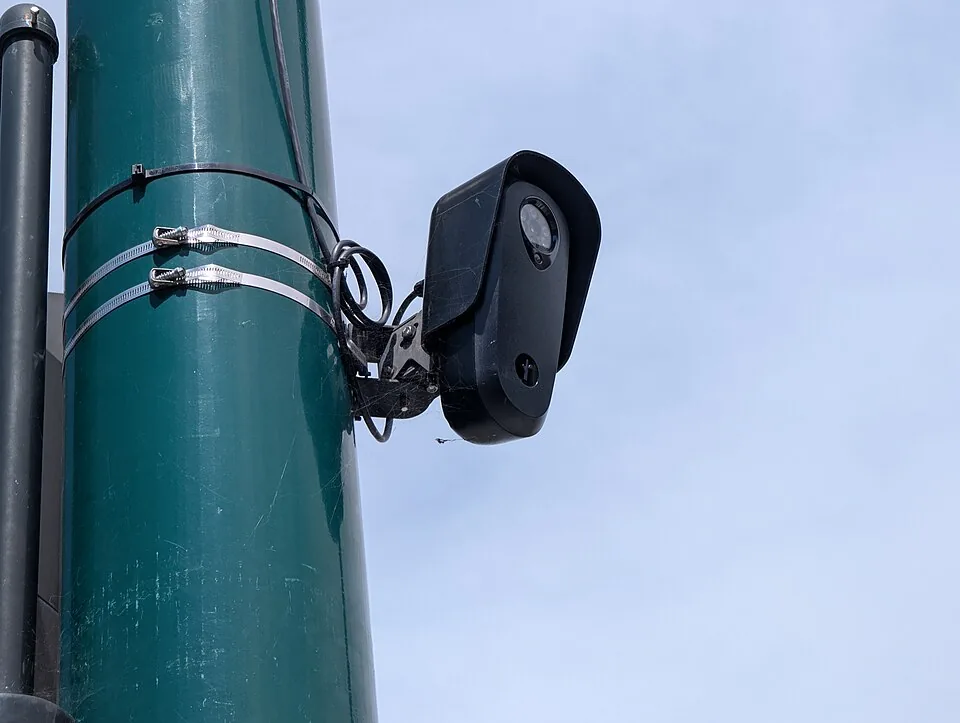
A Kentucky cop used a police surveillance network to track his ex-girlfriend more than 2,000 times. Florida watched that story land, and on Monday the state yanked approval for license plate readers on every state highway in the state. Turns out even Ron DeSantis has a line, and apparently it's a cop with a spreadsheet and an obsession.
What Florida Actually Did
Will Watts, the chief operating officer of the Florida Department of Transportation, sent local law enforcement agencies a one-page memo revoking all previously issued approvals for license plate readers in state rights-of-way. That is the strip of land next to or part of a state road. Gone. Effective immediately.
Watts cited a "recent exponential increase" in camera deployments, along with "concerning reports of misuse, data privacy concerns, and surveillance schemes" that he said required immediate action to preserve what he called Floridians' "sovereignty and quality of life." That is bureaucratic language for: something has gone badly wrong and we need cover.
The order does not touch cameras on private property or local rights-of-way, which is where DeSantis himself said 98% of the surveillance cameras actually sit. So this is more symbolic than surgical. But Jacksonville's Sheriff's Office went further anyway, announcing it would discontinue license plate reader technology across all of Duval County, home to one million people, "effective immediately." They also called the technology "an enormously valuable investigative tool" in the same breath, which tells you something about how much pressure these agencies are feeling.
What Flock Safety Is and Why People Are Furious
Flock Safety is the company that turned license plate readers from a niche law enforcement tool into a nationwide surveillance grid. The technology itself has been around since the 1970s, but as NBC News explains, cheaper hardware and smarter software have sent deployments through the roof in recent years. Flock's specific contribution is a shared network that lets law enforcement agencies across the entire country pool footage from their cameras with other departments anywhere in the country.
That's the part that went sideways. What started as a tool to catch car thieves and find missing kids became something that a single officer could weaponize to track a specific person's movements, over and over again, with essentially no oversight. According to NBC News, a Kentucky police officer was arrested after investigators found he had queried the Flock system more than 2,000 times to monitor his ex-girlfriend. Two thousand times. That is not an accident. That is a stalking apparatus with a badge.
Public anger has curdled into something physical. NBC News has identified 50 locations across the country where Flock cameras have been vandalized since 2024, smashed or spray-painted or cut down entirely. Drivers have also filed suit against the company, organizing into a proposed class action. When people start physically destroying infrastructure with their own hands, you are well past the point where a press release about privacy guardrails fixes anything.
The Backlash Is Spreading Fast
Florida is not operating in isolation here. Texas Gov. Greg Abbott ordered a halt to state funding for Flock cameras last week, according to the Texas Tribune, and the issue has bled into midterm election campaigns. The Institute for Justice, a Virginia-based advocacy group that argues the technology is unconstitutional, says more than 100 local governments have canceled or declined to renew their LPR contracts since the beginning of last year.
DeSantis made the political calculation explicit on the Real America's Voice podcast last Friday, before the memo dropped Monday. "We're gonna clear the state right-of-ways," he said, adding that the cameras are likely capturing far more than license plates. "These cameras that are out there now, who's to say they're only doing the license plate?" That is a governor of a major state saying out loud that he does not trust the company's disclosures. That is a real thing that happened.
Flock's Defense Is Getting Weaker by the Week
Flock Safety put out a statement calling a ban "the wrong reaction," pointing to recent cases in Florida where the technology helped find missing children, led to the arrest of a murder suspect, and assisted in solving other crimes. Those are real outcomes, and they matter. Nobody serious is arguing that license plate readers have never caught a bad guy.
But Flock also announced, just in recent weeks, that it was cutting the default data retention period from one month to one week, and pledged to do more to lock out users showing "abnormal activity." That is an admission that the previous setup was a problem. You do not voluntarily shrink your data retention window because everything is going great. You do it because a cop used your system 2,000 times to stalk a woman and the story made national news.
The Dingo Take
You are supposed to believe that a company storing every vehicle's movement data for a month, sharing it freely across law enforcement agencies nationwide, with essentially no real-time oversight of who is running queries or why, is a public safety tool that just needs some light tweaking. You are supposed to accept that the 2,000-search stalker was an isolated bad actor and not evidence of a system with no guardrails. Flock wants you to weigh the missing kids against the ex-girlfriend and call it a wash.
It is not a wash. The whole architecture is wrong. A network this powerful, this loosely supervised, accessible to thousands of officers across the country, will be abused as surely as water runs downhill. The Kentucky case is not the edge case. It is the logical destination of a system where individual users face no meaningful check on their queries. Cutting retention from 30 days to 7 days is the equivalent of a bank robber wearing a mask and calling it fraud prevention.
And look, there is something genuinely strange about Ron DeSantis and Greg Abbott being the ones to pump the brakes here, given that both have spent years enthusiastically expanding surveillance powers when the targets were immigrants or protesters or teachers with the wrong books. But a broken clock and all that. The backlash building around Flock cameras is one of the rare issues where the anger is running across normal political lines, and if it takes Republican governors grandstanding on podcasts to actually pull these things down from state highways, fine. Take the win. Demand the rest.



Comments