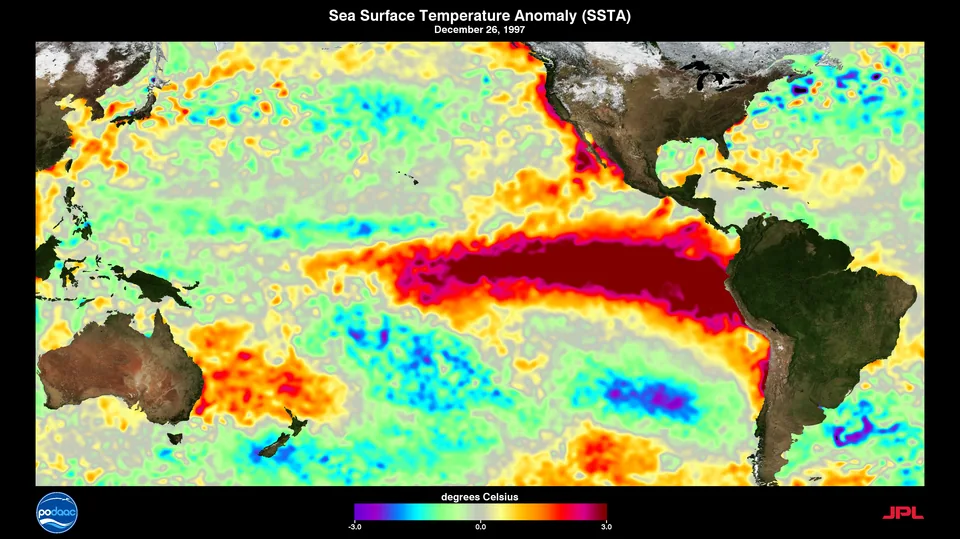
Forecasters say this year's El Niño could become the strongest on record, and the farms that survive it best are the ones with something green growing in winter. So naturally, Senate Republicans have spent the farm bill negotiations trying to cut the programs that pay farmers to do exactly that. The weather is coming whether Congress is ready or not.
The Sponge Beats the Slab
In a Guardian op-ed, Liz Carlisle, an environmental studies professor at UC Santa Barbara who has spent 15 years visiting resilient farms, lays out the difference between the farms that cope with extreme weather and the ones that drown or dry up. The resilient ones keep roots in the ground all year. In winter, when most fields sit bare, they still have something growing.
The payoff is real and measurable. Those farms build up carbon-rich organic matter in the soil, which lets the land soak up and hold moisture like a sponge. Carlisle describes farms that took in heavy rain while their neighbors had inches of standing water, and farms that hit 80% of their average yields in years when they got just 40% of their average moisture.
That is not a rounding error. That is the difference between a bad year and a bankruptcy.
The Numbers Are Not Subtle
Researchers Andrea Basche and Marcia DeLonge found that planting a soil-building cover crop in the offseason, or growing perennials that live for multiple years, increases the space between soil particles by 8%. Sounds small. It is enough to make 16% more water available to plants during a drought.
When the rain comes instead, the effect gets bigger. Forecasters expect heavy rain across the entire southern half of the US this winter, and cover crops can increase infiltration of those storms by 35%. Perennials can push it to 59%, which in many cases is enough to absorb a heavy rain event of an inch per hour.
The benefit does not stop at the fence line. If a third of Iowa's cropland grew perennials or cover crops, Basche and DeLonge found, runoff and flood frequency would drop by one-fifth in particularly wet years. Farmers growing prairie strips between rows of corn and soy cut sediment loss by 95%, according to Iowa State University researchers. This is flood control that grows food.
Why You Don't See It From the Highway
So if this works so well, why does a drive through the major farming regions of the country show so little of it? Because the system is rigged toward the crops your great-grandfather planted.
Crop insurance for corn, soybeans, wheat and cotton is generously subsidized, to the point where a farmer can lose an entire harvest and still come out OK. Cover crops and perennials reduce a farmer's long-term risk of losing the crop, but they often increase the short-term risk of losing income. Guess which one the insurance rewards.
Plant elderberries or hazelnuts and you are largely on your own. The Whole Farm Revenue Protection program is, in Carlisle's words, one that nearly everyone in the industry agrees is woefully inadequate. And perennials take years to mature and produce food, so a farmer needs other support to get through the wait.
Farmers Are Getting Creative Anyway
Plenty of farmers get this and are doing it despite the incentives. Some are planting fruit and nut trees in rows between their annual crops. Some use berry bushes as hedgerows at the edge of their fields, or experiment with newly developed perennial grains. Others graze livestock on perennial pasture or plant strips of native prairie between rows of corn and soy.
These are not hobbyists. They are people managing risk in a world where a flooded field or a missed planting window can end a family operation. They just have to do it with one hand tied behind their back by a federal insurance structure built around the commodities of the last century.
The Farm Bill Is the Fix, and Republicans Are Sitting on It
Here is where Congress comes in. The farm bill is a once-in-a-decade chance to invest in the resilience of the food system, and it is being negotiated right now, as the super El Niño gains steam.
Buried in that massive legislation are the Conservation Stewardship Program and the Environmental Quality Incentives Program, both of which support farmers who want to add cover crops and perennials. So far, Senate Republicans have insisted on decreasing funding for them. They have not even entertained deeper reform to crop insurance. That is one reason, among many, that the bill has not advanced.
The US will not be hit as hard as Central and South America, the Caribbean or southern Africa. But Carlisle warns that severe weather could still cause significant crop loss in some parts of the country. Those places are where the cuts will land hardest.
The Dingo Take
Do you really need a record-breaking weather event to explain why paying farmers to keep soil healthy beats paying them to lose a harvest and shrug? Apparently someone in the Senate does. Carlisle ends her piece hoping the super El Niño will be the nudge Congress needs. That is a generous way to describe what it takes to move people who respond to flooded fields with a spreadsheet.
The logic here is not complicated. A cover crop costs money up front and saves money later. A perennial takes years to pay off and then keeps paying off. The current system hands out generous subsidies for the crops that do worst in a flood and a drought, and leaves the farmers who plant the resilient stuff to fend for themselves. That is not free-market conservatism. That is a subsidy for fragility, delivered in the name of tradition.
So when the rains hit the southern half of the country this winter, remember who had the chance to put the money where the roots are. The science was on the table. The forecasts were public. The bill was right there. Senate Republicans looked at a sponge and decided the budget needed trimming.


Comments