While the rest of the country has been watching its electricity bills climb 32% over the last five years, New Mexico somehow went the opposite direction — cleaner grid, lower bills, and a utility that is five years ahead of its own legally mandated schedule. This is not a fantasy. This is a real place that made real choices, and the results are sitting right there in black and white on your utility bill — or, rather, on theirs.
From 80% Coal to 80% Clean in Five Years Flat
As recently as 2021, nearly 80% of the electricity delivered by the Public Service Company of New Mexico, or PNM, came from coal and gas. As of 2025, according to Good Good Good's reporting, PNM says it delivered 80% carbon-free electricity. That is a complete reversal of the company's entire energy mix in half a decade. To put that in context: most utility companies move slower than continental drift.
Solar carries the load during the day. Batteries store the surplus and discharge it after sunset. Wind turbines pick up what the batteries don't cover. It's not complicated in concept. What's complicated is actually doing it, which is why so few states have.
PNM also committed to hitting 100% zero-carbon electricity by 2040 — five years ahead of the deadline set by state law. Laurie Williams, PNM's senior vice president of integrated planning and transmission development, told Good Good Good the shift was driven by company culture as much as legal compliance. "We've got to be part of solving the problem," she said. Thirty-four years at the company, and she's watched the mindset change in real time.
A Law That Actually Did Something
The engine behind all of this is a 2019 state law called the Energy Transition Act. It set hard targets: 50% renewable energy statewide by 2030, 80% for investor-owned utilities by 2040, and 100% zero-carbon by 2045. That's not a suggestion. That's the law.
The Act also forced the closure of the San Juan Generating Station, a large coal plant that PNM had a majority stake in. It shut down in 2022. PNM replaced every megawatt it lost from San Juan with renewables. Not some of it. All of it.
This is what policy that works looks like. It sets a clear target, mandates accountability, and doesn't leave an escape hatch for utilities to hide behind while stringing ratepayers along for another decade of fossil fuel dependency.
The Workers Who Got Left Behind — and the Law That Tried to Fix That
Let's be honest: coal plant closures have a long history of leaving workers and communities to rot while politicians congratulate themselves on their environmental wins. The Energy Transition Act at least tried to do something different.
The law set aside money specifically to retrain workers who lost jobs at the San Juan plant and mine, and to develop new renewable energy in the same county. Advocates rightly criticized a three-year delay in getting that money out the door. But it did eventually move. The state government reported that 2,800 workers have been retrained, well above the original target of 2,000, according to Good Good Good.
The Act also created a dedicated fund for Native American communities near fossil fuel plants that close. Every tribe living near a shuttered plant gets automatic membership on a committee deciding how those funds get spent. Money has gone toward sustainable agriculture, food sovereignty, irrigation, solar projects, worker retraining, and direct payments to displaced workers. It is not perfect. But it is not nothing, which is more than most states have managed.
Solar for the People Who Can't Afford Solar
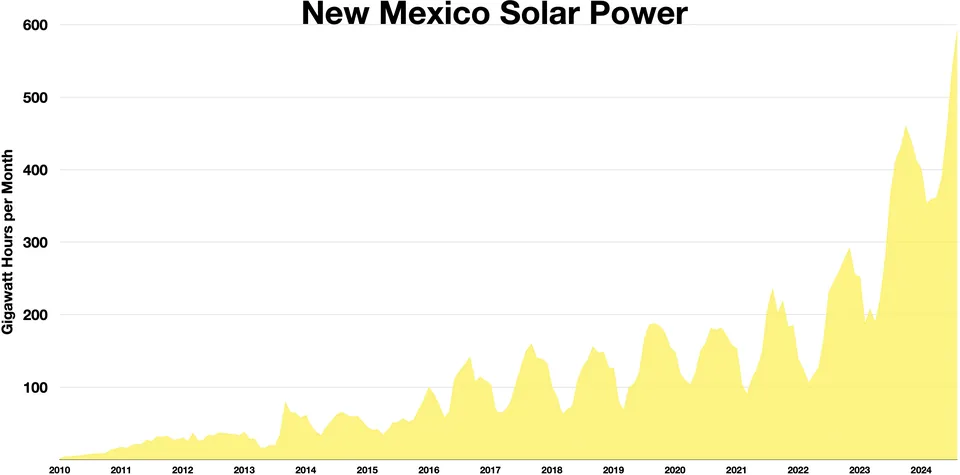
Small-scale solar installations in New Mexico more than doubled between 2020 and 2025, and PNM now counts over 13,000 customers with rooftop solar panels, according to Good Good Good's reporting. That's great if you own a home with a suitable roof and the capital to put panels on it. Most people don't.
New Mexico has a work-around: community solar. Sixteen projects are already operating, 31 more are in the pipeline, and together they will deliver 200 megawatts of shared solar power. Residents who can't or don't want panels on their roofs can buy small shares of large solar farms and get the benefits on their bill.
Here's the part that should make you angry: the Biden-era Inflation Reduction Act had allocated $156 million to help build solar specifically for low-income New Mexico communities. The Trump administration clawed it back. Not redirected it, not renegotiated the terms. Took it. Because apparently the goal is for poor people to keep paying more for dirty power.
Your Bill vs. Their Bill
The nationwide average residential electricity price jumped 32% between May 2021 and May 2026. New Mexico's went up 7% in that same window. Seven. The state's residential electricity rate sat at $0.14 per kilowatt-hour in May 2026, compared to the national average of $0.18. That 22% gap in price per unit translates to some of the lowest household electricity bills in the entire country.
The fossil fuel industry has spent decades selling the story that clean energy means expensive energy. New Mexico just spent five years proving that story wrong in the most direct way possible — on actual bills, paid by actual people, in a state that is not exactly flush with money to begin with. Williams noted that New Mexico's economy leans heavily on oil and gas, making the renewable build-out more than an environmental statement. "It feels like there is a chance to diversify the economy here in a way that could be really meaningful for the citizens and for the future of the state," she said.
The Boring Piece That Makes All of It Work
There is one part of this story that does not make for good cable news graphics but explains why New Mexico succeeded where other states stall: interconnection policy. When you add renewables to a grid, every new project needs to be physically connected to that grid. In most states, that process takes years. New Mexico made it fast, cheap, and transparent.
Quick turnaround times on applications, low interconnection fees, public data sharing — the Interstate Renewable Energy Council and Vote Solar recently graded every state on these policies. New Mexico was the only one to earn an A. The only one. "The moral of the renewables story is transmission," Williams told Good Good Good. You can build all the solar you want. If you can't plug it in, it doesn't matter.
The Dingo Take
You are supposed to believe that a rapid clean energy transition is economically reckless, technically impossible, or politically suicidal. New Mexico did it in five years, cut the growth of electricity prices to a fraction of the national rate, retrained thousands of coal workers, set up dedicated funds for Native communities, and earned the only A grade in the country for grid connection policy. The argument against this was always a lie, and now there's a working example sitting in the American Southwest proving it.
The Trump administration's decision to claw back $156 million in low-income solar funding tells you everything about who this fight is actually for. It is not about fiscal responsibility. The money was already allocated. It is about making sure that clean energy stays the province of people who can afford it, while everyone else keeps subsidizing the profits of the fossil fuel industry through their monthly bills. That's the policy. That's the choice being made on purpose.
New Mexico is not a rich state. It is not California with its enormous tech economy or Texas with its oil wealth. It is a state that struggles, as Williams put it herself, where opportunity is scarce and dependence on extractive industries runs deep. And it still pulled this off. Every politician in every other state who tells you clean energy is too expensive or too complicated is either lying or hasn't done the homework. At this point, those are basically the same thing.





Comments