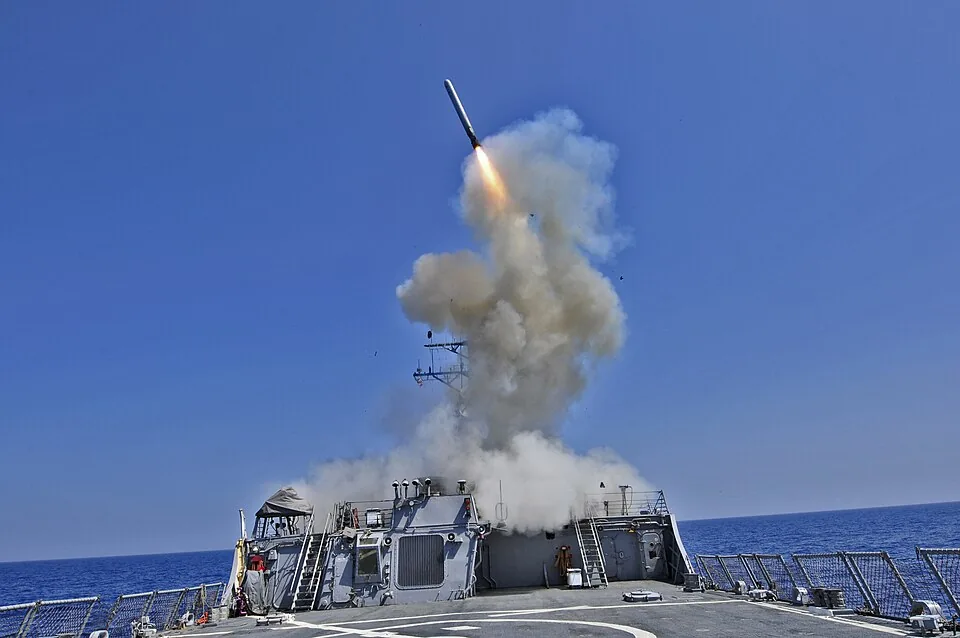
A U.S. cruise missile struck a home hosting a wedding party in a small Iranian coastal town, killing two women and two children aged 4 and 16, and wounding at least 68 others. This is what month six of the U.S.-Iran war looks like. The party was in Kuhestak, a town overlooking the Strait of Hormuz, which is now the most consequential stretch of water on the planet.
What happened in Kuhestak
According to Iranian state news agency IRNA and state television, Tuesday night's U.S. strikes on Iranian military targets included a hit on a residential home where a wedding was being held. Security camera footage carried by the semiofficial Fars news agency showed heavy explosions shaking the town, fireballs lighting up the night sky over a neighborhood of densely packed houses.
Two weapons experts told The Associated Press that fragments recovered from the site match a U.S.-made SLAM-ER cruise missile. That is a precision-guided weapon. "Very precise" is the phrase experts used. Precise enough to thread through a neighborhood of tightly packed homes and land on the one hosting a wedding.
Images from Iran's Tasnim news agency showed hospitalized children being treated in the nearby town of Minab. That town has its own history with American ordnance. NPR reports that a U.S. missile strike on the opening day of the war hit a primary school in Minab, killing more than 100 children. Six months in, and the region's hospitals are still filling up with kids.
The death toll shifted between Iranian officials during the night. The province's deputy governor initially told state television five people were killed. The count later settled at four. No explanation was offered for the discrepancy.
The war that wouldn't end just restarted
This latest round of violence came after a full month of relative quiet, which apparently everyone was hoping meant something. It did not mean something. NPR reports that the six-month conflict between the United States and Iran had been in a holding pattern since both sides stopped short of crossing into full-scale war.
The monthlong lull ended when the U.S. military struck Iranian rocket launchers on an island in the Strait of Hormuz over the weekend. U.S. Central Command said Iran was preparing to use the launchers to shoot mines into the waterway. Iran responded by firing missiles at American bases in Jordan, which were intercepted. Then came Tuesday night's broader bombardment of Iranian military targets, which U.S. Central Command described as air defense sites, radar systems, and maritime assets. Plus, apparently, one wedding.
Iran's response on Wednesday targeted American allies across the Gulf. Kuwait and Bahrain both reported coming under attack, though without casualties. In Iraq, Kurdish authorities said they intercepted 10 armed drones near Irbil. Iranian television claimed American bases in Irbil had been targeted. Hezbollah fired two explosive drones at Israeli soldiers in southern Lebanon. The whole region woke up in motion.
Oil, economics, and who is losing this slowly
Since the fighting resumed this week, the price of Brent crude oil has climbed back to around $95 a barrel, up more than 30% from the start of the war, according to NPR's reporting. The Strait of Hormuz is the reason. Roughly a third of the world's seaborne oil passes through that narrow channel, and six months of this war have made global markets deeply, chronically anxious about it.
Last week, U.S. Central Command's Admiral Brad Cooper announced that the strait had been secretly cleared of mines and that the Navy had helped nearly 1,500 commercial vessels carrying some 750 million barrels of oil pass through in recent months. He was making the case that the U.S. had the upper hand. Sascha Bruchmann, an analyst with the International Institute for Strategic Studies' Middle East office in Bahrain, told the AP that Iran felt it had to respond to Cooper's show of confidence. "The Iranians had to respond to that by reinserting insecurity and doubt," Bruchmann said. Wednesday's strikes were Iran's version of reinserting doubt.
Iran's economy is visibly cracking. The Iranian rial hit another record low on Wednesday, with traders in Tehran exchanging 2.20 million rials for one U.S. dollar. That is a 10% drop from last week's record low, according to the AP. Iran's new security chief, Mohsen Rezaei, posted on X that Iran's new strategy "will shatter your foundations." People tend to post things like that when the other guy's currency is holding and theirs is in freefall.
The political math back home
The war is not just a military and economic crisis. It is becoming a political one for President Trump, with November midterm elections approaching. NPR reports that the six-month conflict has posed "increasing political problems" for Trump's Republican Party, even as his administration has framed the ongoing strikes as proof of American strength.
The problem with that framing is that strength is supposed to produce results. Six months of strikes, mine-clearing operations, escalating naval confrontations, oil price spikes, and dead children at a wedding in coastal Iran are not what a clean victory narrative looks like. The goalpost has never been clearly stated. Is it regime change? A nuclear deal? Simply keeping the strait open? Nobody is saying out loud.
Hamidreza Azizi, a senior Iran analyst at the Crisis Group, told the AP that neither side can sustain this middle state forever. "At some point, one of the sides may see a need to escalate in order to break this cycle," he said, warning that both sides have been trying to avoid full-scale war. The keyword there is "trying." Trying and succeeding are different things, and Tuesday night in Kuhestak is evidence of the gap between them.
What the U.S. military says it was targeting
U.S. Central Command confirmed Tuesday's strikes but described them as focused on Iranian military infrastructure: air defense sites, radar systems, and maritime assets. The statement made no mention of the wedding.
The SLAM-ER, the cruise missile weapon experts identified from fragment images, is a precision weapon. It is designed for exactly this kind of environment, hitting a specific target in a complex area. That does not mean it cannot hit a wedding. It means that if it hit a wedding, it hit a wedding on purpose, or it hit the wrong target with a weapon the U.S. advertises as very accurate. Neither explanation is comfortable. The U.S. military has not commented on the specific strike in Kuhestak.
The Dingo Take
A 4-year-old is dead at a wedding because a precision cruise missile hit the house. Read that sentence again, slowly. The U.S. government will either say the intelligence was wrong, that military assets were co-located, or it will say nothing at all and let the news cycle move on. That is the playbook and it is older than most of the people reading this.
What is genuinely terrifying about where this war sits right now is the absence of any articulated endpoint. The Trump administration launched this conflict, has sustained it for six months, and has never clearly told the American public what winning looks like. Keeping oil flowing through a strait while spending billions and killing people at weddings is not a strategy. It is a situation that has gotten away from everyone involved, dressed up in the language of resolve.
Azizi's warning about escalation is the one to hold onto. Both sides have been "trying" to avoid full-scale war. Six months ago, they were "trying" to avoid this war entirely. At some point, trying stops being enough, and the thing everyone said they were avoiding becomes the thing that is simply happening. We may be close to that point. The oil market, the Iranian rial, the midterm polls, and a bullet-riddled roof in Kuhestak all suggest the same thing: nobody is in control of where this ends.



Comments