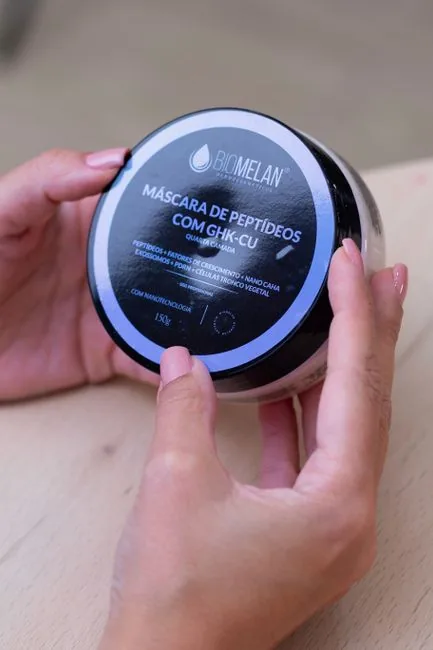
People are drawing a blue peptide compound into syringes and injecting it under their skin, guided primarily by social media influencers and online grey-market suppliers, with zero published human data confirming it's safe to do so. The compound is called GHK-Cu, it's been a staple of face creams for decades, and scientists who have studied it for years are watching this trend with visible alarm. This is the wellness industrial complex in its purest, most frightening form.
What GHK-Cu Actually Is
GHK-Cu, also written as GHK-Copper, is a naturally occurring molecule first isolated in the early 1970s by a chemist named Loren Pickart. As NPR reports, Pickart noticed that bathing liver cells with plasma from younger adults helped revive them, and after comparing blood samples from medical students and their older professors, he established that GHK levels decline as we age. That's the kind of detail that makes anti-aging true believers very, very excited.
The science on topical applications — meaning serums and creams you put on your face — is actually reasonably solid. Studies have found that GHK-Cu stimulates collagen production, triggers new blood vessel growth, and has anti-inflammatory effects. Clinical trials, mostly small ones funded by the cosmetic industry, show it improves skin thickness and elasticity, reduces wrinkles, and promotes hair growth. Dr. David Goldberg, director of cosmetic dermatology for the Schweiger Dermatology Group and a clinical professor at the Icahn School of Medicine at Mount Sinai, says it's on par with Vitamin C serums. Not magic, but real.
And here's the critical part: that research is about putting it on your skin. Not shooting it into your body.
The Leap Nobody Studied
Somewhere between "this cream might help your wrinkles" and "inject this blue liquid into yourself from a website," the wellness community made a logical leap that the scientific community absolutely did not sanction. There is no data from published human studies showing that injecting GHK-Cu is safe or effective. None. That is not a regulatory technicality. That is a gaping scientific void.
The reason people think injections might work better is not crazy on its face, to be fair. Dr. Goldberg acknowledged there could be added benefits because the molecule doesn't easily penetrate deeper skin layers when applied topically. So the logic of "get it deeper into the system" isn't invented from nothing. The problem is that thinking something might work and actually knowing it works are two completely different things, and the distance between them is exactly where people get hurt.
Dr. Warren Ladiges, a professor at the University of Washington School of Medicine who has studied this peptide for years, put it plainly: "I think GHK can have a major role in helping enhance longevity. But injecting yourself without really knowing what it's going to do? I wouldn't do that to myself." When the guy who has spent his career studying a compound won't inject it, that should probably register.
The Grey Market Supplying the Syringes
Making this worse is where people are actually getting the stuff. Much of the injectable GHK-Cu circulating right now reportedly comes from unregulated online suppliers, with no assurance about quality or dosage. Compounding pharmacies in the U.S. aren't technically permitted to offer it. So the people injecting this are largely sourcing it from a grey market that operates outside any meaningful oversight.
Dr. Marisa Garshick at MDCS Dermatology raised the most basic question: is what you bought actually a copper peptide. "Whether or not it's even a copper peptide is always a concern," she said. "The stakes are much higher when you're injecting something." You could be injecting the real thing at the wrong dose. You could be injecting something mislabeled entirely. The grey market does not run quality control.
The specific risks identified include copper toxicity from overloading your system, and triggering a dangerous immune reaction. Those aren't theoretical worst-case-scenario fears cooked up by overcautious regulators. Those are physiological outcomes scientists are genuinely worried about, in the absence of any data that tells them otherwise.
Why This Will Never Get FDA Approval
Here's the structural problem that explains why this limbo exists and is likely to continue: GHK-Cu is a naturally occurring molecule, which means no pharmaceutical company can patent it as-is. As Ladiges explained, getting it through FDA approval would require enormous investment, developing a unique patentable version, funding full human clinical trials, with no guarantee of exclusive market return at the end. So it's probably never going to happen.
The animal research is actually intriguing. In mouse models, GHK-Cu has reportedly been shown to alleviate some symptoms of Alzheimer's, and Ladiges' own work has found it stimulates pathways associated with aging. There is a real scientific case for investing in human trials. There is just no financial case for a drug company to do it. So the research sits, promising and incomplete, while social media fills the vacuum with anecdote and conjecture.
That vacuum is doing real work. The compound has become a staple of "looksmaxxing" content online, a corner of wellness and appearance culture that is feeding a generation of peptide-curious consumers who are now walking into dermatologists' offices asking for guidance their doctors aren't equipped to give them.
Doctors Are Watching and Wincing
The medical professionals quoted are not dismissing GHK-Cu wholesale. They're specifically alarmed about the injection trend and the sourcing problem. Dr. Goldberg said he's advising patients to hold off from injecting anything. "I'm not going to sleep well at night, until the human studies are actually done," he told NPR.
That's not a fringe conservative position in the medical community. That is the bedrock principle of evidence-based medicine: you do not inject compounds into human beings at scale before you have human data on what happens when you do. The reason that principle exists is the same reason it always exists. People got hurt before it was established. We learned.
The Dingo Take
You are supposed to believe this is just a personal wellness choice. A little biohacking. People taking control of their own health, making informed decisions. Except the decisions aren't informed, the sourcing isn't regulated, and the researchers who actually know this compound best are on record saying they wouldn't inject themselves with it. That's not a personal wellness choice. That's gambling with your immune system based on TikTok content.
The deeper problem is that the regulatory and economic structure around peptides like GHK-Cu is genuinely broken. The science is real enough to be compelling. The pathway to human trials is essentially nonexistent because there's no profit motive to fund them. So you get this grotesque outcome where a compound with legitimate research behind it and plausible therapeutic potential never gets properly studied in humans — and in the absence of that data, a grey market steps in to sell unverified injectable versions to people who heard about it from an influencer. Everybody loses except the people selling the syringes.
Dr. Goldberg said he won't sleep well until the human studies get done. At the rate the pharmaceutical industry is motivated to fund them, he might want to work on his insomnia from a different angle. In the meantime, maybe don't inject things into yourself that the scientists who study them won't touch.




Comments