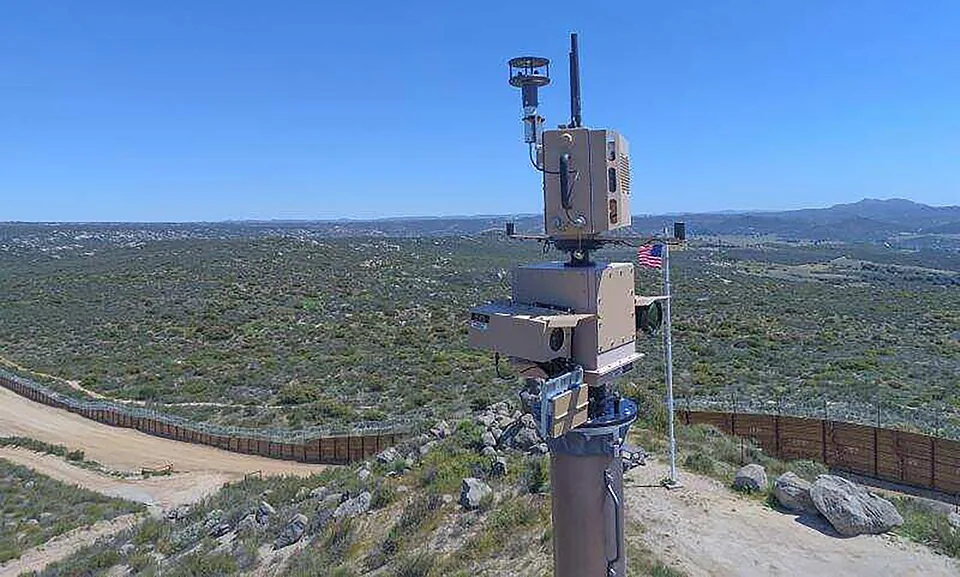
The United States Army is shooting down cartel surveillance drones with a laser weapon controlled by an Xbox controller, and each shot costs approximately three dollars. Three. Dollars. For context, the drones they're vaporizing are being used by Mexican drug cartels to scout smuggling routes past 8,000 American troops — and until recently, the best the military could do was politely send them home.
Eleven Drones Down, 75% Fewer Showing Up
CBS News was given exclusive access to a live test of the system near the border wall last Friday, and what they saw was almost disappointingly undramatic. A small quadcopter went up. Soldiers tracked it on an iPad-like screen using an Xbox controller. A beam fired. A brief flash. The drone fell out of the sky with a scorched propeller and a missing battery.
That's it. No explosion. No Hollywood laser. Just a very expensive piece of cartel hardware tumbling into a Texas field.
Since the laser made its operational debut on August 25th and 26th, military officials told CBS News there has been a roughly 75% drop in drone activity in the Rio Grande Valley. In the ten days following its debut, the system knocked down eleven drones. Since the start of 2025, the military has stopped 300 drones it says are linked to cartels, though the laser accounts for only the most recent handful of those.
The Xbox Controller Army
The system is called LOCUST, made by a defense company called AeroVironment, and this week the Army handed AeroVironment a $465 million contract — its first-ever contract for high-energy laser weapons. There are multiple units deployed along the border right now.
Army Lieutenant Owen Farquer, one of the operators, told CBS News that the Xbox controller interface has been intuitive for soldiers who grew up gaming. Which, sure. The U.S. military has been quietly absorbing gaming culture into its training pipelines for decades, but there is something genuinely surreal about the image: a soldier in a vehicle near the Rio Grande, thumbs on a controller, casually zapping drug cartel surveillance equipment at three dollars a pop.
For comparison, some air defense interceptors cost millions of dollars each. A single shot from this laser costs less than a Starbucks latte. Army Col. Robert Felicio, commander of the 130th Maneuver Enhancement Brigade deployed to the border, told CBS News the key distinction from jamming systems is permanence. Jamming sends a drone back. The laser makes sure that particular drone never comes back.
What the Cartels Are Actually Doing With These Drones
Here's the part that should get more attention. The cartels aren't flying drones for fun. According to military officials who spoke to CBS News, the drones are primarily used to track where U.S. service members and law enforcement are positioned so smugglers know exactly which corridors are clear for moving people and drugs across the border.
It's real-time intelligence gathering. Cheap, effective, and until recently, largely unanswered. The military had jamming tools that could spoof or redirect drones, but as Felicio put it, when you just send it back, it comes back up. Destroying the drone removes that tool from the cartel's arsenal entirely.
A recent report from the National Counterterrorism Innovation, Technology, and Education Center, funded by the Department of Homeland Security, found that cartels have also been deploying armed drones inside Mexico to attack rival groups. Between 2021 and 2025, there were 221 such incidents resulting in 77 fatalities. Military officials are now actively weighing what that armed drone threat could mean for the approximately 8,000 U.S. service members stationed along the border.
This Is Not a Perfect Weapon
Before we get too deep into the triumphalism, some caveats. The laser loses effectiveness in rain, fog, or atmospheric vapor conditions — which is to say, it struggles in weather. For a border region that includes everything from desert to humid Gulf Coast terrain, that's a meaningful limitation.
The FAA has concerns too. CBS News reported back in February that the agency initially raised alarms about operating a high-energy laser weapon near civilian aircraft, because a misfire into a plane would be catastrophic and instantaneous. Felicio told CBS News the military now coordinates with the FAA before and after each use, and that training mishaps earlier this year briefly forced a shutdown of El Paso's airport.
Admiral Daryl Caudle, the Navy's top officer, wrote an opinion piece in The Washington Post this week calling for more investment in high-energy laser weapons, framing them as a cost-effective complement to existing air defense systems rather than a replacement. That's the honest sell: not a silver bullet, but a useful tool that costs three dollars a trigger pull. Given that Air Force Gen. Gregory Guillot told lawmakers in 2024 that there are approximately 1,000 drone incursions at the southern border every single month, the math on that starts to look pretty compelling.
Cartels Are Already Adjusting
Military officials were careful to note to CBS News that the 75% reduction in drone activity may not be entirely attributable to the laser. Some of it might be cartels simply finding different routes or pulling back to assess what they're dealing with.
That's the nature of this kind of adversarial dynamic. You deploy a new tool. The other side watches. They adapt. Army Lt. Col. Ray Richards, head of the 211th Military Police Battalion from the Massachusetts National Guard, argued to CBS News that the financial disruption to cartels still matters regardless of cause. When you think of a 75% reduction of that capability and how that spreads based on the dollars tied to it, he said, that's a huge part of the story.
He's not wrong. Cartel drone operations aren't free. Operators cost money. Hardware costs money. Intelligence infrastructure costs money. Disrupting even a portion of that, repeatedly, at three dollars a shot, is a different kind of math than the cartels are used to dealing with.
The Dingo Take
You are supposed to believe that the southern border is an ungovernable catastrophe that can only be solved by mass deportations, emergency declarations, and whatever else gets floated on Truth Social this week. The actual military officials operating on that border are out here methodically zapping cartel drones with a laser that costs three dollars per shot and reporting a 75% drop in surveillance activity within two weeks. That's not nothing. That's not a talking point. That's a result.
None of this fits the preferred narrative that the border is pure chaos where nothing works and only strongman politics can save us. The reality, as it almost always is, is more complicated and more interesting. There are real threats — armed cartel drones killing people inside Mexico, surveillance operations that directly assist drug and human smuggling routes, and 8,000 service members whose safety is a legitimate concern. There are also real people working real solutions, at a cost-per-engagement that would make a Pentagon procurement officer cry with relief.
The cartels will adapt. They always do. The laser has limitations. All weapons do. But the idea that American institutions are incapable of developing effective, targeted, cost-conscious responses to real border threats is exactly as wrong as the idea that everything is fine and there's nothing to worry about. Both of those takes serve political agendas. Neither one is true. The drone just fell out of the sky for three dollars, and somewhere in a Rio Grande Valley field, a cartel's $800 surveillance quad is a pile of scorched plastic. That's a real thing that actually happened.





Comments