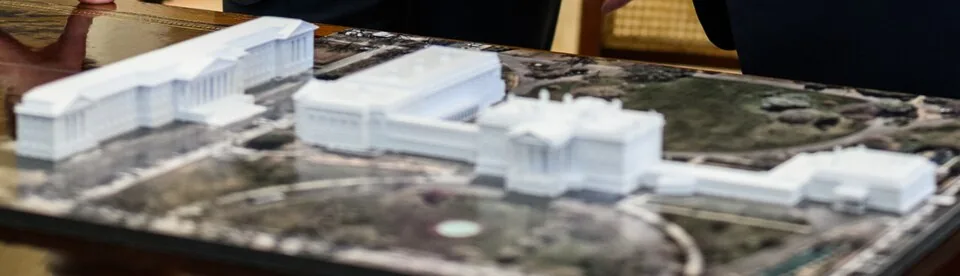
With two months until Election Day, public polling suggests Republicans may be on track to lose control of both chambers of Congress — in part because voters are furious about prices, a war in Iran, and the fact that the president appears preoccupied with remodeling the White House ballroom. That last part is not a joke. According to NPR, polls show voters see a direct disconnect between their top concerns and what Trump seems focused on, and "the White House ballroom construction project" is specifically cited as an example of that disconnect.
The Map Looks Bad and Republicans Know It
The basic math of midterm elections has always been simple: the party in power loses ground. Voters get tired, frustrated, and they take it out on whoever's holding the gavel. Republicans hold narrow majorities in both the House and Senate right now, which means they have very little room to absorb losses before the whole thing tips over.
According to NPR, polling averages heading into Labor Day weekend — the traditional kickoff of general election season — show the likeliest single outcome is Democrats taking the House. More voters say they want a Democrat representing them in Congress than a Republican. That's not a tied race. That's a preference.
At the start of 2026, the Senate looked like a different story. Democrats were staring down expensive tossup races in Georgia and North Carolina, and the map genuinely favored Republicans. But that was then. The expensive fights that will actually decide the Senate are now happening in Iowa, Texas, Ohio, and Alaska. Republican-friendly Iowa. Republican-friendly Texas. These are not supposed to be competitive states in a normal political environment. This is not a normal political environment.
What Moved the Numbers
Voters, per NPR's reporting, have serious concerns about the war in Iran, immigration, tariffs, gas prices, and the general affordability of daily life. Trump's approval ratings have hit record lows. The president's second-term agenda has proven deeply unpopular with the swing voters who, in theory, were supposed to be the beneficiaries of his promises to lower prices.
NPR also points to a separate piece of reporting on Pennsylvania swing voters who say Trump has simply not delivered on that core promise. People voted for cheaper groceries and cheaper gas. They did not get cheaper groceries and cheaper gas. They got a war and a tariff wall and, apparently, ballroom renovations.
Democrats, for their part, spent most of 2024 getting absolutely hammered up and down the ballot. What's happened since is a genuine rebound — not just with their base, but with independents. The 2025 Virginia and New Jersey governor's races both went Democratic with commanding margins, which was an early signal that the political winds had shifted hard.
The Money Fight Is Complicated
Here is where it gets genuinely interesting. Democratic candidates are outraising their Republican opponents in the key competitive races. That is real and it matters — candidate money is often the most effective money in a campaign because candidates can buy ads at cheaper rates than outside groups.
But Republican party committees and Trump's MAGA, Inc. super PAC are sitting on hundreds of millions of dollars in reserve. So Democrats have the fundraising momentum, and Republicans have the war chest. NPR reports that some Republicans have openly questioned whether MAGA, Inc. will actually spend that money to prop up vulnerable nominees — specifically naming Texas Senate candidate Ken Paxton as someone in need of outside support. Over the weekend, MAGA, Inc. announced a $10 million ad buy for Paxton's campaign, so apparently the answer is yes, but the fact that people inside the party were asking the question out loud tells you something about internal confidence levels.
Ten million dollars for a Texas Senate race that should not be competitive. Let that sit for a second.
Texas Republicans Are Holding a Convention to Convince Themselves They're Fine
This week, Republicans are holding what NPR describes as an "unprecedented midterm convention" in Dallas. Several battleground nominees and members of the Trump administration are attending. The stated goal is to rally a flagging base and send a message to independents that Republicans deserve two more years of Congressional control.
An unprecedented convention to reassure a flagging base is not the move of a party that thinks it's winning. You hold a victory lap after the win. You hold a pep rally when you're scared. The fact that Republicans felt the need to do something that has no real precedent in midterm politics suggests the internal numbers may look even worse than the public polling.
For Ken Paxton specifically, this is a genuinely remarkable situation. He is a Republican Senate nominee in Texas, which has not elected a Democrat to statewide office since 1994. He needs a $10 million emergency ad buy from a Trump super PAC and a special convention to generate enthusiasm. James Talarico, the Democratic challenger who NPR photographed at a campaign rally in Kerrville last week, is making this a real race.
Democrats Are Not Exactly Riding High Either
Look, this article is not a Democratic victory lap, because Democrats do not get to have one of those yet. NPR is careful to note that the party is dealing with record unpopularity driven by its own base voters' dissatisfaction with party leadership. The coalition is restless. Primary voters have kicked out several entrenched incumbents. Others have retired rather than face the voters.
Several Democratic nominees this cycle have built their campaigns, at least in part, around explicitly acknowledging that their own party has problems. That is a difficult needle to thread — "vote for us, we know we've been bad" — but it may be the honest message that actually works in this environment.
The third-party factor is also real. In some of these key Senate races, NPR reports that third-party candidates could pull enough votes from people who dislike both parties to swing the outcome. Whether that helps or hurts Democrats depends entirely on the race and who exactly is peeling off.
The Dingo Take
You are supposed to believe that a party controlling the White House, the Senate, and the House, with a popular mandate from a decisive 2024 election win, somehow turned "we're going to lower your prices" into a war, a tariff spiral, and a ballroom renovation in under two years. And you are supposed to believe the voters haven't noticed. They have noticed.
The thing about midterms is they are almost always a referendum on the president. Trump's approval is at record lows. The issues voters care about most — cost of living, the war in Iran, basic economic stability — are the issues where Trump's numbers are worst. Republicans are holding emergency conventions in their own safe states and begging a super PAC to rescue their Senate nominee in Texas. None of this is the behavior of a majority that feels secure.
Two months is a long time in politics, and polling averages are snapshots, not destiny. Republicans have more money in reserve and a history of closing strong with late ad spending. Democrats have their own messaging problems and a base that is impatient and suspicious of its own leadership. But if you're asking which party has the worse set of problems right now, at this specific moment, the answer is the one whose president is polling at record lows while his party scrambles to defend Iowa and Texas. November is going to be something.

Comments