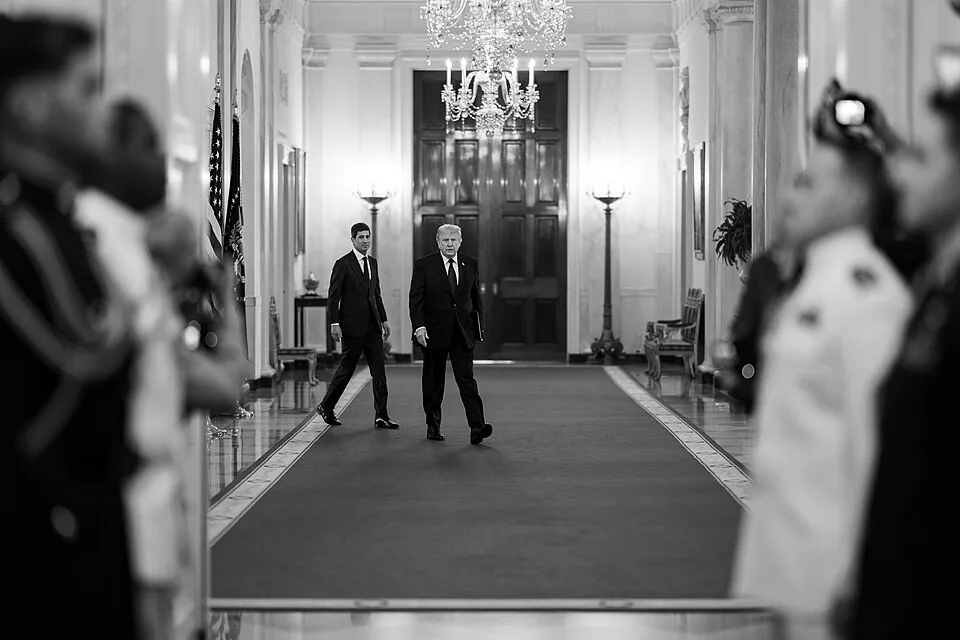
Donald Trump spent months demanding the Federal Reserve slash interest rates to the lowest of any country on Earth, then personally selected the man to run it. That man may raise them on Wednesday. This is what happens when you try to bully an institution whose entire credibility depends on not being bullied.
Trump Posted 'BE PATRIOTS' About Rate Cuts. His Guy Might Do the Opposite.
According to The Guardian, Trump posted on Truth Social this month that the US should have the "LOWEST RATE of any country in the World" and followed it up with a direct message to the Fed Board: "Be Patriots for a change." He was talking about Kevin Warsh, his handpicked Federal Reserve chair, a man Trump apparently believed would function as an interest rate remote control.
Warsh, however, has been talking like a central banker and not a MAGA content creator. In a speech this month, he said that without continued progress toward the Fed's 2% inflation target, policymakers would have "work to do." In central bank speak, "work to do" means rates are going up. Investors are watching Wednesday's decision like it's the last round of a heavyweight fight.
This is the core irony that the Trump White House seems constitutionally unable to process: the Fed's independence isn't a bureaucratic quirk, it's the entire mechanism that keeps the institution credible. You can yell "PATRIOTS" on social media all you want. The bond market doesn't care about your all-caps posts.
Why Rates Might Actually Have to Go Up
Here's the situation Warsh is actually walking into. The Guardian reports that US inflation is sitting at 3.4% annually, unchanged as of Friday's data, and has been above the Fed's 2% target for more than five years. Five years. That's not a blip. That's a structural problem.
The pressure isn't easing, either. Oil just blew past $100 a barrel last week for the first time since July, driven by the US-Iran conflict intensifying again. The Strait of Hormuz remains nearly shut to tanker traffic. Houthi rebels are advancing along the Red Sea coast, threatening Saudi oil supplies. Every barrel of crude that can't move through those waterways is another push on prices that the Fed has to either absorb or fight.
Oil prices backed off slightly Friday on hopes of talks to reopen the strait, The Guardian notes, but they remain well above summer levels. When energy costs surge, they bleed into everything. Groceries, manufacturing, shipping, heating. The Fed doesn't set oil prices, but it does set the cost of money, and right now money is one of the few levers anyone can actually pull.
The UK Is Trying to Hold Its Nerve, But Cracks Are Showing
Across the Atlantic, Bank of England Governor Andrew Bailey has been playing it cool. His argument, per The Guardian, is that rising mortgage rates have already done some of the tightening work for the Bank without requiring an official rate hike. Markets and economists broadly expect the Bank to hold rates at 3.75% when the Monetary Policy Committee meets Thursday.
But the committee isn't exactly unified. Three of the nine MPC members voted for a rate rise back in July, and Friday's stronger-than-expected UK economic growth data is the kind of thing that makes the hawks feel vindicated. Thomas Pugh, chief economist at consultancy RSM, told The Guardian the latest energy price surge had "materially increased the chance that the MPC will eventually follow other major central banks and raise rates."
Pugh is predicting what he calls a "hawkish hold" — rates stay put Thursday, but the minutes of the meeting will read like a warning shot. Financial markets, meanwhile, are now pricing in four UK rate rises over the next twelve months, up from the three they expected before oil spiked again. Four rate rises in a year is not a gentle glide path. That is a wall.
Japan Is About to Do Something It Hasn't Done in 30 Years
While Washington and London wrestle with whether to tighten, Tokyo is just going ahead and doing it. The Bank of Japan is widely expected to raise rates Friday, which would put its policy rate at 1.25%, a level Japan hasn't seen since it first started fighting deflation in the 1990s. That is not a short era. That is longer than TikTok, the iPhone, and the entire War on Terror combined.
The yen has been recovering on foreign exchange markets, and there's a reason. The Guardian reports that Treasury Secretary Scott Bessent has been remarkably candid about his position. At an event in Texas on Tuesday, Bessent said of the coordinated US-Japan currency intervention in July: "I have asymmetric information. I am the house now. You can bet against me if you want." The Treasury secretary of the United States, comparing himself to a casino. In public. At a university event. Completely normally.
The European Central Bank already moved. ECB President Christine Lagarde raised rates Thursday and said directly that Middle East conflict "continues to generate inflation pressures" and that inflation would "remain well above target for an extended period." At least one major Western central banker is speaking plainly about the problem.
Bessent Said He's 'The House.' The House Always Wins. Except When It Doesn't.
There's a broader pattern worth staring at here. Trump's economic worldview is essentially that lower interest rates are always good, inflation is someone else's fault, and the solution to every problem is for the institutions he controls to do what he says. This has never been how central banking works, and it especially cannot be how central banking works when a war in the Middle East is strangling global oil supply.
The Guardian notes that the US Treasury actually joined Japan in intervening in foreign exchange markets in July to prop up the yen. That is an extraordinary move, and Bessent's casino metaphor about it is an extraordinary thing to say out loud. "I am the house now" is not a phrase that has historically ended well for anyone who said it.
All three major decisions this week — the Fed on Wednesday, the Bank of England on Thursday, the Bank of Japan on Friday — are happening against the same backdrop: a war that isn't ending, oil that isn't getting cheaper, and inflation that won't die. The central bankers who raise rates will be called traitors by people on social media. The ones who don't will have to explain themselves to bond markets, which are considerably less forgiving than Truth Social.
The Dingo Take
Trump demanded the lowest interest rates on Earth. He called it patriotism. He picked his own guy to run the Fed. That guy is now staring at 3.4% inflation, $100 oil, and a closed shipping strait and doing the math that any first-year economics student would do. The math does not come out to rate cuts.
This is not a gotcha. This is cause and effect in its purest form. You cannot spend years flooding the economy, blow up a Middle East conflict that shuts down global energy shipping, and then scream at your central banker to make money cheaper. Those things are in direct contradiction. The Fed's job is to contain inflation. Right now inflation is winning. Warsh has to do something about that, or the dollar becomes a suggestion.
The real story this week isn't which central bank blinks first. It's that the entire global rate environment — from Washington to London to Tokyo — is being shaped in part by a war the Trump administration is prosecuting, an oil market it can't control, and bond markets that have stopped pretending any of this is fine. Markets betting on four UK rate hikes in the next year aren't making a political statement. They're just reading the room. The room is on fire.



Comments