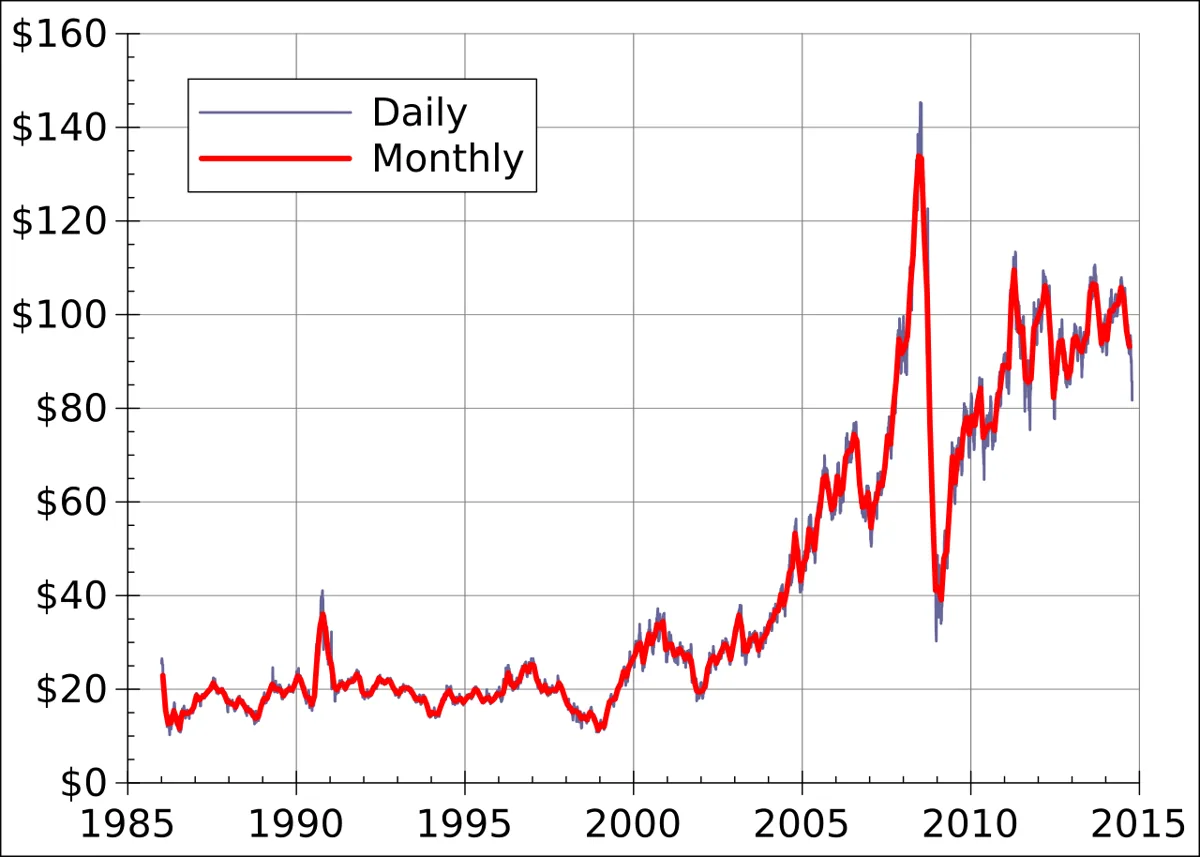
Saudi Arabia has roughly five to seven days of oil export stocks left after drone strikes from Iraqi territory knocked out its east-west pipeline, sending crude prices above $108 a barrel. The Houthis, meanwhile, just seized an island controlling one of the world's most critical shipping chokepoints. So, yes, Monday is going great.
How a Pipeline Attack Just Put 4% of Global Oil Supply on a Clock
The Guardian reports that Saudi Arabia has been heavily rerouting crude through its 745-mile east-west pipeline since the US-Israel war with Iran forced the closure of the Strait of Hormuz. About 4 million barrels a day were flowing that way, roughly 4% of everything the world burns. Then drone attacks, launched from Iraqi territory, forced the kingdom to shut the whole thing down.
With the pipeline offline, Saudi Arabia's Red Sea port of Yanbu is sitting on stocks that Saudi traders say will last five to seven days at current export rates. After that, Riyadh has a problem it cannot paper over. Energy prices have already surged throughout 2026 as the US-Israel conflict has systematically dismantled the Middle East's supply infrastructure, and this is the latest domino.
Iraq's government confirmed the attacks originated from its soil and announced an investigation, according to The Guardian. Baghdad has been under sustained pressure to rein in Iran-backed militant groups using Iraqi territory as a launching pad against Gulf states. How well that investigation goes is anyone's guess, given how that dynamic has played out for the past several years.
The Houthis Are Now Controlling Two Chokepoints at Once
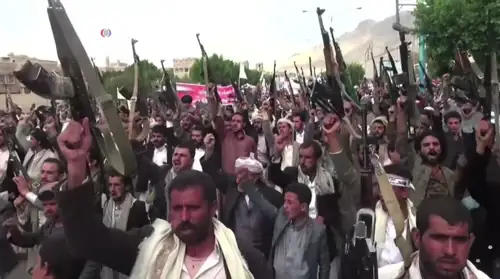
The pipeline attack did not happen in isolation. The Guardian also reports that Houthi forces launched multiple strikes against Saudi Arabia over the weekend and captured the island of Perim, a small but strategically enormous piece of land sitting inside the Bab al-Mandab strait.
The Bab al-Mandab is the narrow passage between Yemen and the Horn of Africa that connects the Red Sea to the Gulf of Aden. A significant chunk of global trade flows through it. With Hormuz already disrupted and now Houthi forces expanding their grip on Bab al-Mandab, the world's two most important oil shipping chokepoints are simultaneously compromised. That is not a coincidence. That is a strategy.
Trump, per The Guardian, said he believes Tehran is responsible for the broader escalation. Iran, for its part, maintains its usual posture of plausible deniability. The Houthis are Iran-aligned but technically independent. This is the part where international law gets very slippery and oil traders get very nervous.
What $108 Oil Means for Everyone Who Drives a Car or Eats Food
The Guardian reports that gas prices climbed alongside crude. That's the part that reaches past the geopolitical abstract and lands directly in people's wallets, grocery bills, and heating costs. Oil prices touching $108 a barrel is not a number that stays in the commodity markets. It bleeds into everything.
This is already a year of elevated energy prices. The US-Israel war with Iran has been rerouting supply chains, closing waterways, and disrupting production since it began. Each new incident adds another layer of price pressure that does not disappear when the crisis cools. Supply disruption scars tend to linger in energy markets long after the incident itself.
Five to seven days. That is how much runway Saudi Arabia has before the world's largest oil exporter faces a genuine export crisis, unless the pipeline reopens or alternative arrangements materialize fast. The clock is ticking in a very literal sense.
The Tech Meltdown Nobody Saw Coming: Altman and Musk Say Slow Down AI
In a development that would have seemed like satire eighteen months ago, The Guardian reports that the CEOs of Anthropic, OpenAI, and SpaceX have all called for a slowdown in AI development, citing fears the technology is approaching a point where it cannot be controlled. Anthropic's Dario Amodei led the charge, appealing publicly for the industry to pump the brakes. Sam Altman and Elon Musk backed him.
AI-linked stocks took a hit in response. Amodei's specific proposal, as The Guardian outlines, involves three components: US AI companies submit to third-party safety evaluators, democratic nations establish shared safety standards, and democratic AI powers then coordinate with autocracies, including China, to prevent a runaway arms race on development.
Former President Barack Obama separately appealed to Democrats to coalesce around a unified AI safety policy, arguing that waiting for voluntary compliance from tech companies was, in his framing, a governance failure waiting to happen. A former Anthropic employee last week warned AI could precipitate human extinction by 2030. Trump, visiting his golf course in Ireland, said the warnings came from "very negative forces" and that the feared outcomes "won't happen." Great. Sorted then.
Israel Accused of Systematically Eliminating Palestinian Life in West Bank
Israeli human rights organization B'Tselem published a report, covered by The Guardian, accusing Israel of working toward the systematic "elimination" of the conditions that sustain Palestinian collective life in the occupied West Bank. The report describes an "accelerating process of ethnic cleansing" and documents intensifying attacks on Palestinian communities, institutions, land, culture, and social ties.
The language B'Tselem uses is deliberate and specific. "Elimination in this context means sustained harm to the conditions that enable Palestinians to exist as a people," the report states. This is an Israeli human rights organization, not a foreign government or advocacy group with an obvious geopolitical stake. Its findings are about what is happening inside the occupied territory, documented by people who live there.
Israel has not softened its West Bank operations. It has expanded them. The report lands at a moment when global attention is already stretched thin by the Iran conflict, oil shocks, and a cascade of other crises. That is, as B'Tselem's findings make clear, very much part of the problem.
The Dingo Take
Five to seven days. That is the number that should be dominating every financial news ticker and every government briefing room right now. Saudi Arabia, the country that backstops global oil supply when everything else goes sideways, is sitting on a week's worth of export stocks because a pipeline got knocked out and nobody has a clean fix. The Houthis control an island in one of the world's critical maritime chokepoints. The Strait of Hormuz is already closed. And the sitting US president is on a golf course in Ireland telling everyone that the people warning about problems are just being negative.
It is almost impressive how many load-bearing pillars of the global order are cracking simultaneously. Oil at $108 and rising. Two major shipping chokepoints under pressure. The CEOs of the three most powerful AI companies on earth publicly saying the technology they built might be getting away from them. An Israeli human rights group documenting what it calls ethnic cleansing in the West Bank. Any one of these is a front-page crisis. All of them together, in the same week, is something else entirely.
The phrase "supply fears" in every oil headline right now is doing a lot of polite work. These are not fears. The pipeline is down. The stocks have a number attached to them. The Houthis have a flag planted on Perim Island. At some point the euphemism has to give way to the plain fact: the systems that keep modern life running are under simultaneous, coordinated strain, and the people nominally in charge are either playing golf or arguing about who to blame.


Comments