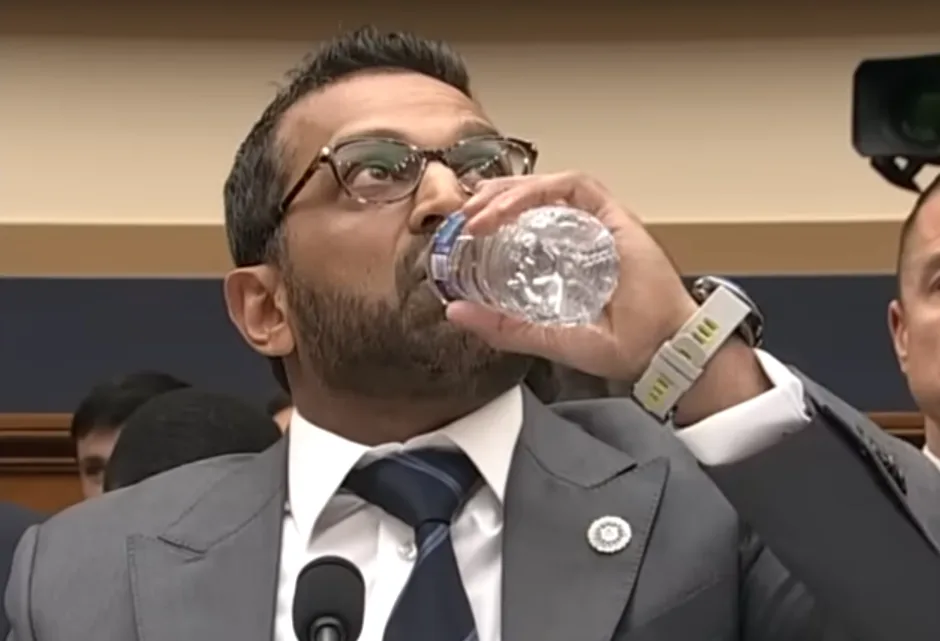
The FBI, the federal agency responsible for maintaining law and order in the United States, has quietly decided that applicants who stole from their employers, paid for sex, or committed acts of bestiality before the age of 18 are now, potentially, fine. Kash Patel's FBI made this call. And on Tuesday, Patel had to sit in front of the Senate Judiciary Committee and explain himself.
What Actually Changed, and Why
CBS News reported last month that the FBI has shifted its background check standards for job applicants to allow, in some cases, histories of hiring sex workers, stealing from an employer, animal cruelty, and bestiality committed prior to the applicant turning 18. An FBI spokesperson told CBS News the changes apply to a narrow set of circumstances. Cool. Great. Very reassuring.
When confronted about the change directly at Tuesday's hearing, Patel offered his own reasoning: he insisted, per CBS News, that "we did not want to punish victims of bestiality, victims who were trafficked." That is, at minimum, a specific thing to say out loud in a Senate hearing.
The reason this happened is not complicated. Over 1,100 FBI special agents left in 2025 alone, according to Justice Connection, a nonprofit that tracks former Justice Department and FBI personnel who resigned or were pushed out. The bureau fired analysts who raised concerns about the Georgia 2020 election investigation. It fired agents who worked counterintelligence cases involving Iran. It fired staffers who worked on the Mar-a-Lago classified documents case against Trump. Fire enough experienced people, and apparently the pool of replacement candidates gets a little more... eclectic.
The FBI has also relaxed its college degree requirements for certain agent positions, accepting candidates with prior law enforcement experience in lieu of a diploma. To be fair, a degree requirement waiver is not the same as a bestiality waiver. But the fact that we are now distinguishing between these two categories of standards is its own kind of achievement.
Democrats Put It in Writing
Ahead of Tuesday's hearing, Democrats on the Senate Judiciary Committee sent Patel a letter that deserves to be read in full, or at least the part where they wrote: "Having dangerously thinned the FBI's experienced workforce for reasons that had nothing to do with performance, you are now asking the American people to accept, without explanation, that the resulting shortfall justifies admitting applicants with histories of employee theft, paying for sex, or bestiality."
That is a sentence that exists in an official Senate letter. About the FBI. In 2026. Take a moment.
Ranking member Dick Durbin of Illinois pledged that Democrats would "hold Director Patel accountable for his failed leadership" at the hearing, and accused the FBI under Patel of spending enormous resources protecting Trump and delivering "retribution to his enemies" while pulling resources away from protecting ordinary Americans. That is a sharp accusation. It is also the kind of accusation that lands differently when the agency in question has simultaneously loosened its standards on who gets to carry a federal badge.
Patel's Other Problems Waiting in Line
The hiring standards mess is not even the only item on the Senate's agenda. CBS News reports that Democrats also plan to question Patel about the departure of hundreds of staff from the bureau, the Justice Department's investigations into Trump's political opponents, immigration enforcement, the Epstein files, and Patel's personal use of FBI resources, including his use of an FBI jet and his presence at the Winter Olympics.
In May, Democratic senators raised allegations of excessive drinking. Patel has strongly denied those. He now gets to relitigate that in addition to everything else. By any measure, this is a man with a full calendar.
Patel, for his part, has pointed to the FBI's crime statistics as evidence that things are going well. The bureau's 2025 annual crime report shows the U.S. murder rate fell 18.1% to a 20-year low and that violent crime overall recorded the biggest one-year drop on record. Trump called them "the best numbers anybody's ever seen on crime" at a Long Island event last month. Some experts, as CBS News notes, point out that crime rates have been on a multi-year downward slide since the COVID-era spike, and the causes are hard to attribute to any single administration or policy.
The Bigger Picture Nobody Should Miss
Here is the through-line that connects all of this. The FBI fired experienced agents for political reasons: cases that touched Trump, investigations that embarrassed the administration, analysts who asked the wrong questions. Those firings created a staffing hole. That hole now needs to be filled. And filling it apparently required revisiting what, exactly, we consider disqualifying behavior.
This is not a bureaucratic accident. It is a consequence. You gut an agency for loyalty reasons, and you get a gutted agency. Then you lower the bar to fill it back up. Then you stand in front of the Senate and hope nobody notices the chain of events you just set in motion.
They noticed.
The Dingo Take
You are supposed to look at an 18% drop in the murder rate and conclude that Kash Patel's FBI is working. You are supposed to treat the crime statistics as a verdict on the administration's approach and move along. What you are not supposed to do is ask what happened to the experienced counterintelligence agents, the election security analysts, and the Mar-a-Lago case staffers who were shown the door so those numbers could be someone else's problem. And you are definitely not supposed to ask who is replacing them.
The FBI fired people for doing their jobs. It is now considering applicants who stole from their bosses and committed acts against animals. Those two facts sit in the same timeline, in the same institution, under the same director. That is not a coincidence. That is a policy.
Kash Patel will say the changes are narrow, limited, and no big deal. He will point to the crime numbers. He will probably get through the hearing without losing his job, because that is how these things go. But somewhere out there, a future federal agent with a very unusual adolescence just got a little bit closer to a badge. Sleep well.




Comments