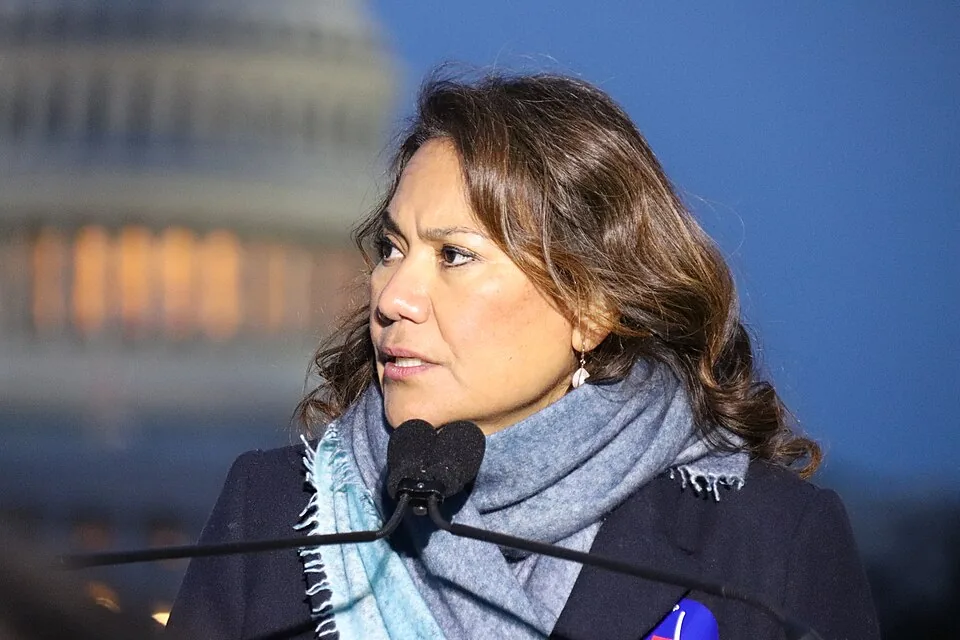
A sitting member of Congress showed up to inspect a detention camp where a man was beaten to death by guards, two separate disturbances had just happened, and the administration's response was: no, you cannot talk to anyone here. Rep. Veronica Escobar visited Camp East Montana at Fort Bliss last month, and ICE wouldn't let her speak with a single detainee. She also asked for surveillance footage of the incidents. She hasn't gotten that either.
The Biggest ICE Detention Camp in America Is a Tent City With a Body Count
Camp East Montana is not a facility you stumble across in a government brochure. It is a sprawling soft-sided tent camp hastily thrown up last summer on a military base in El Paso, capable of holding up to 5,000 people. No walls, no permanent structures, just thousands of people living in tents on an army installation. It is the largest ICE detention center in the country.
Since it opened, according to the Guardian, the facility has been hit with accusations of physical abuse, sexual harassment, inedible food, and medical neglect. ICE was sued over conditions there earlier this year. Three people have died in ICE custody at the site. One of them, a 55-year-old man, died in January after security guards beat him. His death was ruled a homicide.
An internal ICE inspection found deficiencies in use-of-force practices. A Government Accountability Office report found problems with the facility's contract, its construction, and its conditions, and issued four recommendations to DHS, ICE, and the Army. The Guardian reports all four of those recommendations remain "open," meaning not one has been resolved.
Two "Disturbances" in One Week, and Congress Still Can't Get Answers
In early September, the Department of Homeland Security reported two separate incidents at Camp East Montana within a single week. On September 1, detainees allegedly assaulted security staff. On September 7, a group of around 130 detainees allegedly threw items, flipped furniture, disabled security cameras, and knocked down partitions between living quarters.
That second incident got bad enough that an ICE official called 911, according to reporting by the El Paso Times. That detail matters, because, as Escobar told the Guardian, ICE officials apparently failed to mention that call when they briefed her during her visit. So either they forgot, or they didn't want her to know.
"While there absolutely have been serious issues and mismanagement, fraud, deaths, and a homicide, there had never been a riot," Escobar told the Guardian. "There had never been, especially in two weeks in a row, situations where the contractor lost control of the population in their custody." The contractor losing control. At the country's largest immigration detention facility. On a U.S. military base.
The Administration's Explanation: Venezuelans Are Just Difficult
When Escobar pressed ICE officials for an explanation of what caused the disturbances, the Guardian reports the deputy was quick with an answer: it's the Venezuelans. "The deputy was very quick to blame the nationality of the detainees, saying that the Venezuelans are a difficult population," Escobar said.
That's the official read from inside a facility where guards beat someone to death, where a GAO report found widespread problems, where four corrective recommendations sit unresolved, and where two separate incidents in one week required a 911 call. The problem, according to the people running it, is the detainees' nationality. Got it.
What Escobar could not get was any actual information. She was denied access to detainees. She has not received the surveillance footage she requested. The administration, in her words, "obviously has attempted to block congressional oversight."
Congress Sued Over This. Won. And It Didn't Matter.
Members of Congress have the legal authority to conduct unannounced oversight visits to ICE detention facilities and speak with detainees directly. This is not a gray area. It is settled law and long-standing practice. The Trump administration has been trying to hollow it out anyway.
Escobar and other lawmakers sued the Trump administration last year for blocking these visits. A federal judge ruled in their favor in December. According to the Guardian, ICE officials have continued to limit or turn away members of Congress during oversight visits since that ruling. Winning in court, it turns out, only matters if the other side acknowledges the court exists.
The DHS pushed back in a statement to the Guardian, claiming that any member of Congress can request to speak with detainees, and that if both parties agree to meet, ICE will facilitate it. What they did not explain is why Escobar was not allowed to speak with anyone when she showed up. The statement also referred to detainees as "illegal aliens, including many with criminal histories," which is the kind of framing that tells you everything about how seriously DHS takes the oversight function of a coequal branch of government.
Escobar's Verdict: Shut the Whole Thing Down
Escobar did not mince words in her interview with the Guardian. "That facility, from my perspective, should not be operational," she said. "It should have been shut down a long time ago."
She represents El Paso. This camp is in El Paso, on a military base, in her district. She has been trying to exercise the oversight her job legally requires. And the administration has made that as difficult as possible at every turn, even after losing in federal court over the same question.
"Oversight, during the second Trump administration, has certainly been significantly more challenging than during the first Trump administration," Escobar told the Guardian. That is a remarkable sentence when you consider how the first Trump administration handled oversight. Whatever floor existed then, this one has gone through it.
The Dingo Take
A man was beaten to death by guards at this facility. That is not an allegation. That is what the coroner ruled. And the administration's response to a member of Congress showing up to ask questions about it is to make sure she cannot talk to anyone, withhold the surveillance footage, and have a deputy explain that the real issue is that Venezuelans are a difficult population. This is the posture of people who are not concerned about accountability because they have decided accountability does not apply to them.
The lawsuit is the part that should make your head spin. Congress sued. Congress won. A federal judge said yes, you have the right to conduct these oversight visits. ICE kept blocking visits anyway. There is no mystery about what this is. When an administration loses in court and continues doing what the court told it to stop doing, that is not a bureaucratic miscommunication. That is a decision. Someone made it, and someone continues to enforce it every time a lawmaker shows up at a facility gate and gets turned away.
Four GAO recommendations at Camp East Montana. All four unresolved. A homicide. Two incidents requiring 911 calls. An ongoing lawsuit over conditions. And Congress still cannot get in the door to talk to anyone. Escobar is right that this place should be shut down. But the more immediate problem is that the administration has made itself immune to the mechanisms that are supposed to force that kind of accountability. When you can ignore a court order, a congressional subpoena, and a body count without consequence, you will keep doing all three.



Comments