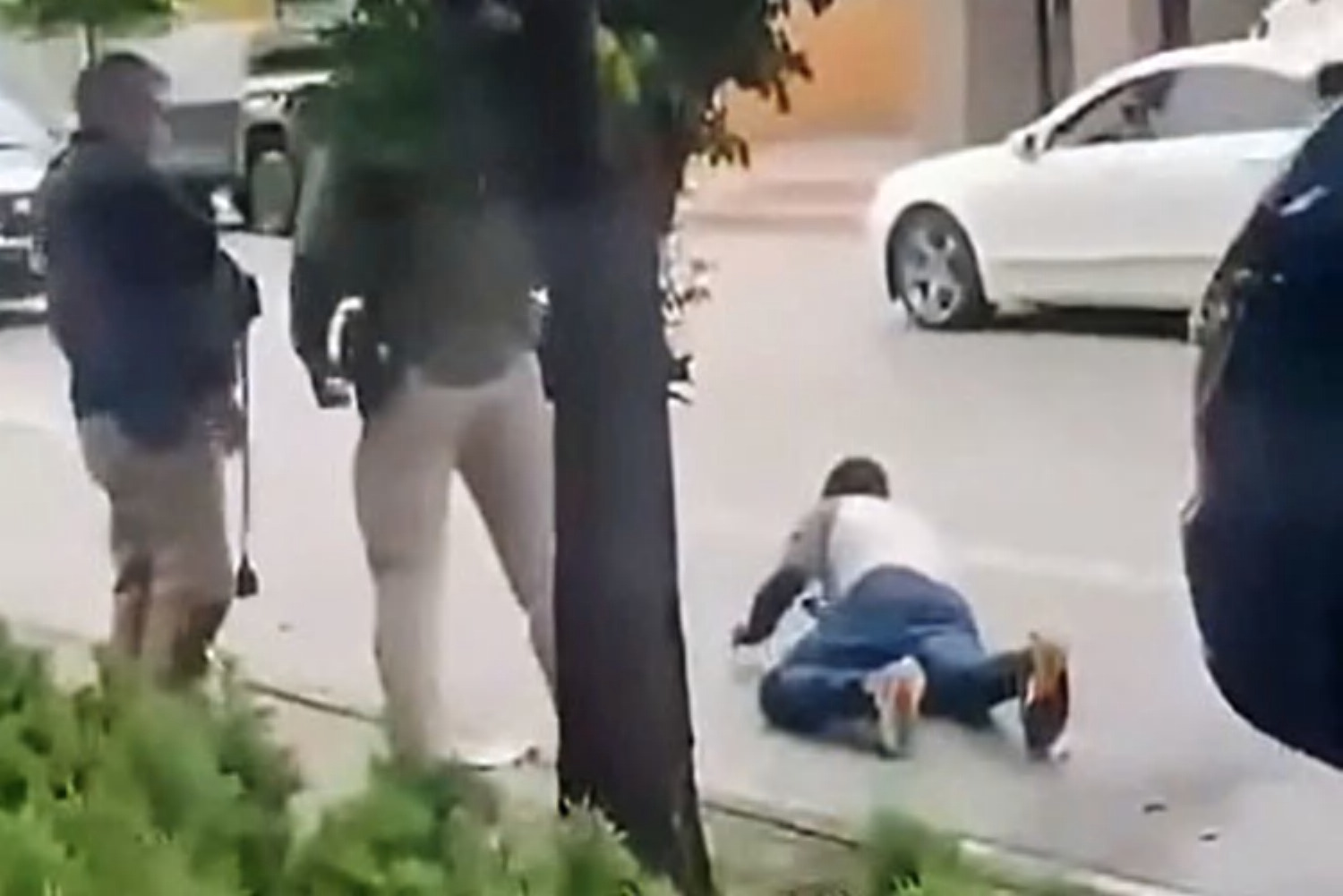
Two ICE agents in Evanston, Illinois tackled a Black man, pinned him to the pavement, and injured him badly enough that bystanders had to call 911. Then they got in their SUV and drove away. The man was screaming that he was a U.S. citizen. He was right.
What the Video Actually Shows
NBC News verified the footage. A Black man is sprawled on the street near a curb, behind a black SUV. Two agents in ICE-style vests are standing over him. One has his face covered. One is pinning the man down. The man is shouting, "I'm a f------ U.S. citizen."
According to Evanston police, the man reported injuries to his head, neck, and teeth. Officers requested an ambulance. Witness Miguel Angel Olivares told NBC Chicago that when he approached, the man's jaw was visibly swollen and there was blood on his shirt. "They were using very rough force on him, and it looked like they really did hurt him because we had to call 911," Olivares said.
After the agents were done, they got in the black SUV and left. They did not call for help. They did not stay to check on the man they had just put on the ground. Bystanders made the 911 call. Bystanders stayed with him until help arrived.
ICE's Explanation, Such As It Is
In a statement to NBC News, a Department of Homeland Security spokesperson confirmed the basic facts and then proceeded to explain why none of it was actually a problem. The man "resembled" someone they were targeting. ICE identified themselves as law enforcement. The man "was not cooperative and refused to identify himself."
"DHS enforcement operations are highly targeted, and officers do their due diligence," the statement reads. That is a direct quote. "Highly targeted" is the phrase they chose after their agents beat up a man they had the wrong identity for.
The Evanston police news release fills in the framing ICE preferred to leave out: agents "detained" the man for fingerprinting after he refused to show ID, and he "resisted detention." An Evanston officer noted blood on the agent's hands. The agent said he was injured during the handcuffing attempt and declined medical treatment. The man the agents actually injured was taken to a hospital.
The Part DHS Didn't Address
NBC News specifically pointed out that DHS's statement said nothing about the injuries the man sustained or why ICE officers did not appear to render any aid after the encounter. DHS had no comment on either of those things.
Evanston police said they spoke with the man at a local hospital Sunday and photographed and documented his injuries as part of their ongoing investigation. Neither Evanston police nor DHS has publicly identified the man. The investigation is continuing.
You Don't Have to Show ID, But Try Telling That to ICE
Here is a fact worth sitting with: in the United States, you are generally not legally required to identify yourself to law enforcement unless you are being lawfully arrested or in a state with a specific "stop and identify" statute. Illinois is not one of those states. A person on a public street declining to hand over ID to federal agents is not, by itself, grounds for physical detention.
ICE's own statement frames the man's refusal to identify himself as the inciting problem. A man walking down the street in Evanston declined to show papers to agents who approached him. For that, he ended up on the pavement with injuries to his head, neck, and teeth. Then the agents left.
The question of whether ICE had any legal basis to physically detain someone who "resembled" a target and declined to produce ID on command does not appear anywhere in DHS's statement. It is a significant question.
This Is Not a One-Off
Cases of ICE detaining or injuring U.S. citizens during enforcement operations are not new, but they have accelerated sharply as the agency has expanded its operations under the current administration's immigration crackdown. The pattern is consistent: agents approach someone based on appearance or a resemblance to a target, the encounter turns physical, and the agency later confirms a mistake was made while describing the officers' conduct as procedurally sound.
What makes this case harder to dismiss than usual is the video. Bystanders filmed it. The man's words are on camera. The agents walking away are on camera. Olivares and others stayed on scene and talked to press. The physical evidence was documented at a hospital. Usually these incidents exist only as an agency statement and a detained person's word against federal officers. This one has receipts.
The Dingo Take
DHS said their operations are "highly targeted." A Black man with injuries to his head, neck, and teeth, lying on a street in Evanston while ICE agents drove away, is what "highly targeted" looks like in practice. That is the whole story.
The agency's statement is a masterpiece of saying words that mean nothing. "Officers relied on their training." Their training produced a bleeding U.S. citizen on the pavement and a federal vehicle departing the scene without rendering aid. If that is the training, the training is the problem. DHS did not address the injuries. DHS did not address the failure to render aid. DHS said the encounter ended "without further incident" once the man finally identified himself. The man was in a hospital. That is the incident.
Evanston police are investigating, which is something. But let's not pretend that a local department investigating federal agents produces accountability in any meaningful historical sense. The man's name has not been released. He has not been compensated. The agents have not been identified. DHS issued a statement calling it a targeted, professional operation. The video is still out there if you want to decide for yourself.



Comments