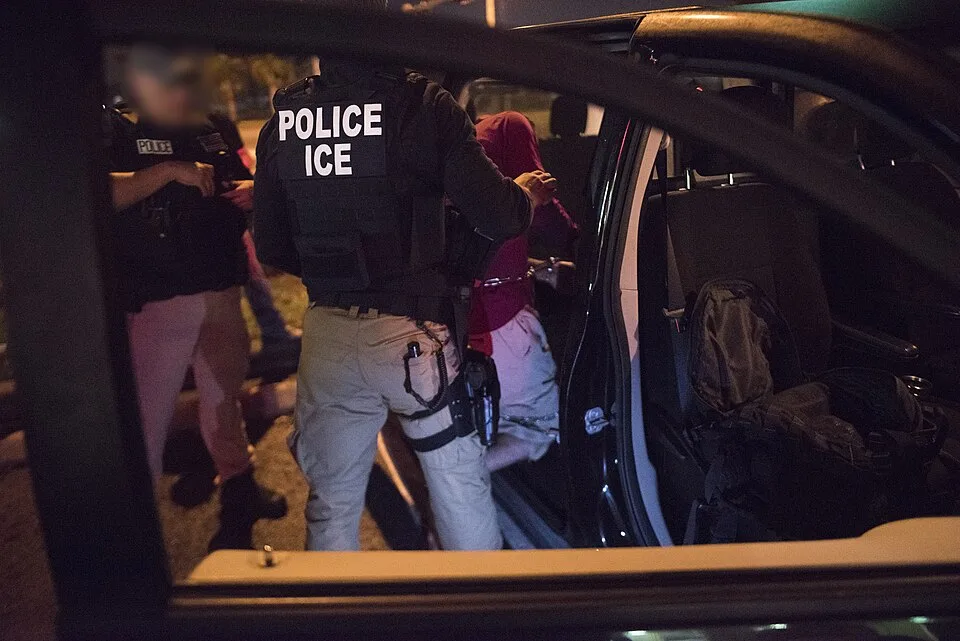
Immigration and Customs Enforcement is planning to roll out "mobile detention facilities" in Pennsylvania — which, stripped of the bureaucratic language, means vans that follow officers into the field, fill up with human beings, and drive away. The documents describing this program, first obtained by watchdog group Project Salt Box, contain essentially no standards for how long someone can be held inside, whether they get food, or how they use the bathroom. The one rule that did make it into the paperwork: women can't stay in the vans for more than ten hours.
What the Documents Actually Say
According to NPR, the mobile detention plan is buried in Department of Homeland Security paperwork related to ICE's broader detention expansion in Pennsylvania. The facilities would be run by GTI, the transportation subsidiary of private prison giant GEO Group. The document describes a network of vans that shadow officers during arrest operations, holding detainees "until full" or until the operation wraps up.
That's it. That's the whole operational description. No word on meals. No word on bathroom access. No standards for how long a person can be locked in a van before the situation becomes something a war crimes tribunal might want to hear about. Michael Wriston, a co-founder of Project Salt Box and a former military intelligence analyst, told NPR the absence of those details wasn't an oversight. It was conspicuous.
"Very conspicuously missing from this description was: What are the standards? How long a person can be kept in a van. How are people using the bathroom? How are they feeding them?" Wriston said. Neither ICE nor GEO Group responded to NPR's request for comment.
Amazon Prime, But With Human Beings
To understand how ICE got here, you need to understand the money. The One Big Beautiful Bill Act handed ICE a $75 billion supplement, turning it into the highest-funded law enforcement agency in the United States. That is not a typo. Seventy-five billion dollars. Acting ICE Director Todd Lyons, apparently inspired by this windfall, described his vision to NPR as wanting the deportation process to run like "[Amazon] Prime, but with human beings."
With that budget, ICE went on a warehouse buying spree, scooping up large facilities across the country to convert into what the agency called mega detention centers. Communities near those warehouses staged protests. Several states, including Maryland, filed lawsuits. According to data gathered by Project Salt Box, ICE has since backed off that plan and is selling most of those warehouses. The mega detention center project, by any honest measure, flopped.
So now they're trying vans.
The Scope of What's Actually Happening
The warehouse failure did not slow the broader expansion. Not even close. NPR reports that on Sunday, the Department of Homeland Security signed construction contracts worth over $7 billion to expand immigration detention in New York, Texas, Arizona, Florida, California, Colorado, Washington, and Pennsylvania. During an August earnings call, GEO Group CEO George Zoley told investors that ICE currently has 68,000 detention beds and is aiming for around 100,000. "So they have another 30,000 or so more beds to go," he said, as casually as if he were discussing quarterly projections for a mattress company.
Meanwhile, NPR reports that the Trump administration has arrested roughly 100,000 immigrants in just the last two months. Of the tens of thousands currently in ICE detention, around 70% have no criminal record. That last number matters, because the White House has repeatedly framed this as going after dangerous criminals. It is not, primarily, going after dangerous criminals.
Wriston put it plainly to NPR: "If this were targeted immigration enforcement, if this were truly 'worst of the worst'-type enforcement, it stands to reason that ICE would have a list of a couple of names, and then an officer or a team of officers would go out and make an arrest. This describes sweeps, immigration sweeps."
Why Pennsylvania, Specifically
Wriston told NPR he believes the focus on Pennsylvania comes down to a practical enforcement problem. Pennsylvania is a large state where many local police departments are prohibited from cooperating with ICE. That means when agents make arrests, they can't just drop detainees at the nearest county jail while they wait for processing. They need somewhere to put people. Hence: vans.
The solution to "we can't use local jails" being "we will invent mobile holding cells with no minimum standards" is the kind of logic that sounds reasonable inside an enforcement bureaucracy and absolutely unhinged the moment you say it out loud to another human being.
The Pushback That Already Worked Once
That flop had a face. "I don't understand. What do we need this for?" Linda Powell, a resident of Williamsport, Maryland, told NPR back in March, after ICE bought a warehouse near her home to convert into one of those mega detention centers. "We don't need it here." Powell was one of the ordinary residents whose objections, multiplied across enough towns, are the actual reason the warehouse plan is now being sold off piece by piece.
The vans, in other words, are ICE's plan B — proof that plan A already failed once under public pressure. Whether that same pressure can be organized against a program with far less visibility than a warehouse next door is the open question.
The Dingo Take
Seventy percent of the people currently sitting in ICE detention have no criminal record. Let that land for a second. The administration that sold this entire crackdown as a heroic campaign against dangerous criminals is now designing vans with no bathroom standards to sweep up people who, by its own data, committed no crime. The rhetoric and the reality are not in the same zip code.
Wriston is right that the mobile detention plan reveals the true scale of what's being attempted here. You don't need a van that fills up "until full" if you're hunting specific individuals. You need that van when you're doing sweeps. When the goal is volume. When the point is to arrest as many people as possible as fast as possible, due process be damned, and figure out the logistics of human dignity somewhere down the line, maybe, if there's time.
The warehouse plan failed because communities pushed back, states sued, and the public actually showed up. The same playbook is available now. Project Salt Box is tracking these contracts in real time. The lawsuits are already being filed. The 12-point Democratic lead in the polls suggests that voters are, in fact, paying attention. None of that makes the vans less real, or the 100,000 arrests in two months less staggering. But the lesson from the warehouse collapse is that this administration's ambitions are not inevitable. They buckle under pressure. Apply pressure.




Comments