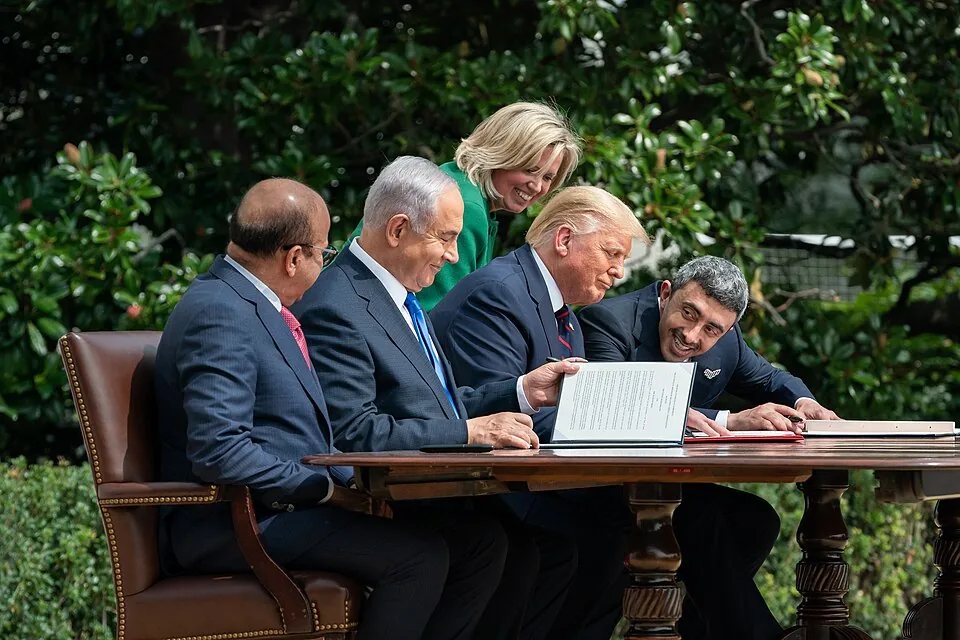
Nearly three years after Hamas's October 7 attacks froze one of Trump's signature foreign policy achievements in place, U.S. diplomats quietly reassembled the Abraham Accords countries on the 43rd floor of a midtown Manhattan office tower — ten blocks from the UN General Assembly they apparently didn't want to be seen at. The meeting, reported by CBS News, was the first official gathering of the Accords nations since the attacks derailed what had been a genuinely expanding coalition. And for the first time, Kazakhstan pulled up a chair.
What Actually Happened in That Manhattan Office Tower
Thursday morning, State Department Under Secretary of Political Affairs Allison Hooker led the U.S. delegation into a meeting hosted by the N7 Foundation, a U.S.-based organization that has been convening these multilateral gatherings since 2021. Around the table: the United States, Israel, the UAE, Bahrain, Morocco, and Kazakhstan, attending its first official Accords meeting after signaling interest in joining last year.
According to CBS News, the session focused on next steps to formalize cooperation among member countries. Jeffrey Talpins, founder of the N7 Foundation and chair of the meeting, kept the framing optimistic: 'The next phase is about deepening the relationships that already exist and identifying practical opportunities for countries to work together.' That's diplomat-speak for 'we have a lot of work to do,' but the fact that they're in the same room again is itself the story.
How We Got Here, Briefly
The Abraham Accords were brokered during Trump's first term, with the first agreements signed in 2020. The UAE and Bahrain became the first Gulf Arab nations to formally recognize Israel. Morocco followed. It was a genuine diplomatic achievement, and momentum was building toward Saudi Arabia and others joining before October 7 blew the whole project apart.
The Hamas attacks on Israel, and the wars in Gaza, Lebanon, and with Iran that followed, made it politically impossible for Muslim-majority countries to be seen cozying up to Israel. The Accords didn't collapse — they just froze, suspended in amber while the region burned around them. That three-year pause is what Thursday's meeting was quietly trying to end.
Kazakhstan Is an Interesting Addition Here
Kazakhstan is not an Arab country, not a Middle Eastern one, and not historically part of the conversation around Israeli normalization. It is, however, a large, strategically located Central Asian nation with a Muslim-majority population and serious ambitions in tech and transport infrastructure — which is exactly what a Kazakhstan embassy official cited to CBS News when explaining the appeal. 'We are interested in collaborations in technology and transport,' he said. 'Together we can do more than each individual country could do alone.'
Trump announced Kazakhstan's intent to join the Accords during an Oval Office meeting with President Kassym-Jomart Tokayev back in November 2025, posting on Truth Social that 'there are many more Countries trying to join this club of STRENGTH.' The all-caps STRENGTH is doing a lot of work in that sentence, but the underlying point — that the Accords framework is being pitched as an economic and security coalition, not just an Israel normalization project — matters. It's a deliberate rebranding, and Kazakhstan's inclusion is the clearest signal yet of that shift.
Who's Running This for the Administration
Hooker led the U.S. delegation, but CBS News reports that a senior administration official — speaking without authorization to do so publicly, which is Washington's favorite way to say something official — confirmed that Secretary of State Marco Rubio's team and Steve Witkoff, the White House Special Envoy for Peace Missions, 'are clearly prioritizing this effort.'
Also in the room: Aryeh Lightstone, special adviser to the Board of Peace, an international coalition focused on peace and reconstruction in Gaza, along with Ryan Arant, Hooker's chief of staff, and Oren Eisner, president of the N7 Foundation. The attendance list matters. These aren't junior staffers sent to check a box. This was a deliberate, senior-level signal that the administration wants this project alive and moving.
The Saudi Question Looms Over All of This
The original grand prize of Accords expansion was always Saudi Arabia. A Saudi-Israel normalization deal would have been a genuine reshaping of the Middle East's political architecture, and it was tantalizingly close before October 7 made the whole conversation radioactive inside the Kingdom.
CBS News doesn't report any Saudi presence or direct Saudi engagement coming out of Thursday's meeting. That silence is loud. The Gaza war has not ended cleanly enough, and the political cost inside Saudi Arabia of being seen normalizing with Israel while Palestinian civilians are dying remains enormous. The Accords can expand to Kazakhstan and beyond, but without Saudi Arabia, the project is still missing its most consequential piece.
The Dingo Take
You are supposed to look at this meeting and see a carefully staged diplomatic revival. A quiet room on the 43rd floor, away from the cameras and speeches at the UN General Assembly down the street. Senior officials. A new country. A show of momentum. And fine — on its own terms, getting these countries back in the same room after three years of war is not nothing. Diplomacy requires presence, and presence requires someone actually showing up.
But let's not pretend the hard part is behind them. The Abraham Accords have always been more symbolically powerful than operationally transformative, and the one deal that would actually change the region — Saudi Arabia recognizing Israel — is no closer than it was in October 2023. Kazakhstan joining a trade and tech cooperation framework is a fine thing. It is not a peace deal. It is not normalization between historic adversaries. It is a Central Asian country signing on to an economic coalition that happens to include Israel, which is a very different thing than the original promise of the Accords.
The Trump administration will call this a win, and they will be somewhat right, which is the most annoying possible outcome. Reviving a stalled diplomatic process is legitimately useful. But the gap between 'countries met in a Manhattan office building' and 'durable Middle East peace framework' remains one of the largest gaps in geopolitics. Hooker said the Accords are 'moving forward again.' Moving forward toward what, exactly, is the question nobody in that room answered out loud.


Comments