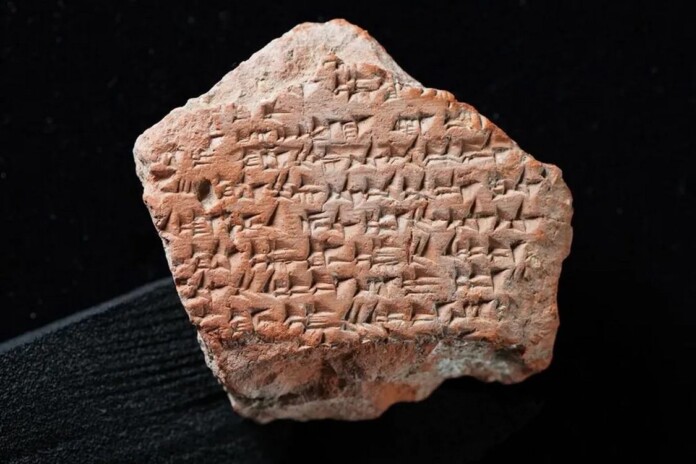
Archaeologists digging through the ruins of the ancient Hittite capital in Turkiye have pulled a clay tablet fragment out of the ground that contains part of the world's oldest known peace treaty, a 3,300-year-old document that, among other things, guaranteed extradition rights without having your tongue cut out. We have set the bar extremely high for ourselves as a civilization and we are failing to clear it.
The Battle That Ended in a Draw and Then Somehow Produced Diplomacy
Around 1,300 BCE, Pharaoh Ramses II and Hittite King Muwatallis II sent tens of thousands of soldiers at each other in what may have been the largest chariot battle in recorded history. According to Good News Network, nobody actually won. The armies fought to a stalemate, both sides went home, and eventually Muwatallis' successor sat down with Ramses and hammered out a deal.
The result was the Peace of Kadesh, a treaty covering eternal friendship, lasting peace, territorial integrity, nonaggression, extradition, and mutual defense against both foreign invasions and domestic insurrections. In 1300 BCE. Written in cuneiform on clay tablets. These people had not invented paper yet and they were still writing more sophisticated foreign policy than most modern governments manage to produce in a full legislative session.
What's Actually on the Tablet
The newly uncovered fragment contains articles 12 through 20 of the treaty, according to Good News Network. Article 14, translated from Akkadian through Turkish into English, reads: "Look, the order fixed for eternity which the Sun God and the God of the Tempest have created for the country of Egypt and the country of Hatti, that is peace and fraternity without leaving place among them to any enmity."
Peace and fraternity without leaving place for enmity. Fixed for eternity. By the Sun God and the God of the Tempest. Look, the theological framework is different, but the aspiration is not. These two civilizations fought a catastrophic war, called it a draw, and then wrote down a binding commitment to stop doing that. The fragment was found during excavations at the Hittite royal palace at Buyukkale, in Hattusa, in the Corum province of Turkiye.
Turkey's culture and tourism minister Mehmet Nuri Ersoy confirmed the discovery on social media after archaeologists spent roughly a year studying the artifact's inscription before going public with it. That is called due diligence. Science doing science correctly.
The Extradition Clause That Should Embarrass Us All
The Peace of Kadesh had an extradition process. If someone fled Egypt into Hittite territory, or vice versa, they'd be detained and returned. Standard enough. But here is the part that is worth reading twice: the treaty specifically guaranteed that returned individuals would not face punishment. No property destruction. No seizure of family members. No cutting out of tongues.
Three thousand three hundred years ago. Bronze Age. No international courts, no human rights organizations, no Geneva Conventions. Two kings wrote amnesty protections into their peace agreement because they understood that an extradition deal nobody trusts is not actually an extradition deal. The UN received a copper replica of one of the original tablets as a gift from Turkiye in 1970, and currently displays it. Which means the world's foremost international body keeps a copy of this thing on the premises and we are still out here doing what we are doing.
What Survives and What They're Still Looking For
The Peace of Kadesh is uniquely well-documented for an ancient treaty. As Good News Network reports, three cuneiform copies survive along with an Egyptian hieroglyphic version inscribed on the walls of the Temple of Karnak. It is the only ancient Near Eastern treaty where both sides' versions survived long enough to be directly compared, which tells historians something important: both civilizations considered this document worth preserving.
The tablet fragment uncovered at Buyukkale represents a previously unknown physical copy. Archaeologists are hoping continued excavation at the site will turn up the remaining sections of this version, since only three complete copies currently exist. The dig is ongoing. There may be more clay out there in the dirt with 3,300-year-old promises written into it, waiting to make modern diplomacy look even worse by comparison.
The Dingo Take
You are supposed to look at a clay tablet dug out of the ground in central Turkiye and feel good about humanity's capacity for reason. And sure, fine, the Peace of Kadesh is genuinely remarkable. Two civilizations on opposite ends of the ancient Near East fought a massive war, agreed it solved nothing, and then wrote a binding peace agreement with extradition rights and amnesty protections that held for generations. That is extraordinary. It is also approximately 3,300 years old, which is the uncomfortable part of this story.
We have had that long. We have had that blueprint, literally preserved in stone, displayed at the United Nations, studied by historians for over a century. The foundational architecture of what international cooperation could look like has been sitting there the whole time. And what have we built on top of it? Because from where most of us are sitting in 2026, watching governments around the world lurch toward nationalism, blow up alliances, and treat 'no tongue-cutting' as an aspirational policy position rather than a baseline assumption, the honest answer is: not enough.
The archaeologists in Hattusa are doing the right thing, carefully, patiently, spending a year verifying what they found before saying a word about it. More of that energy, please. Everywhere. From everyone. The Hittites and Egyptians figured out how to stop fighting each other and write it down in a way that survived millennia. The bar is not that high. We are just choosing not to clear it.


Comments