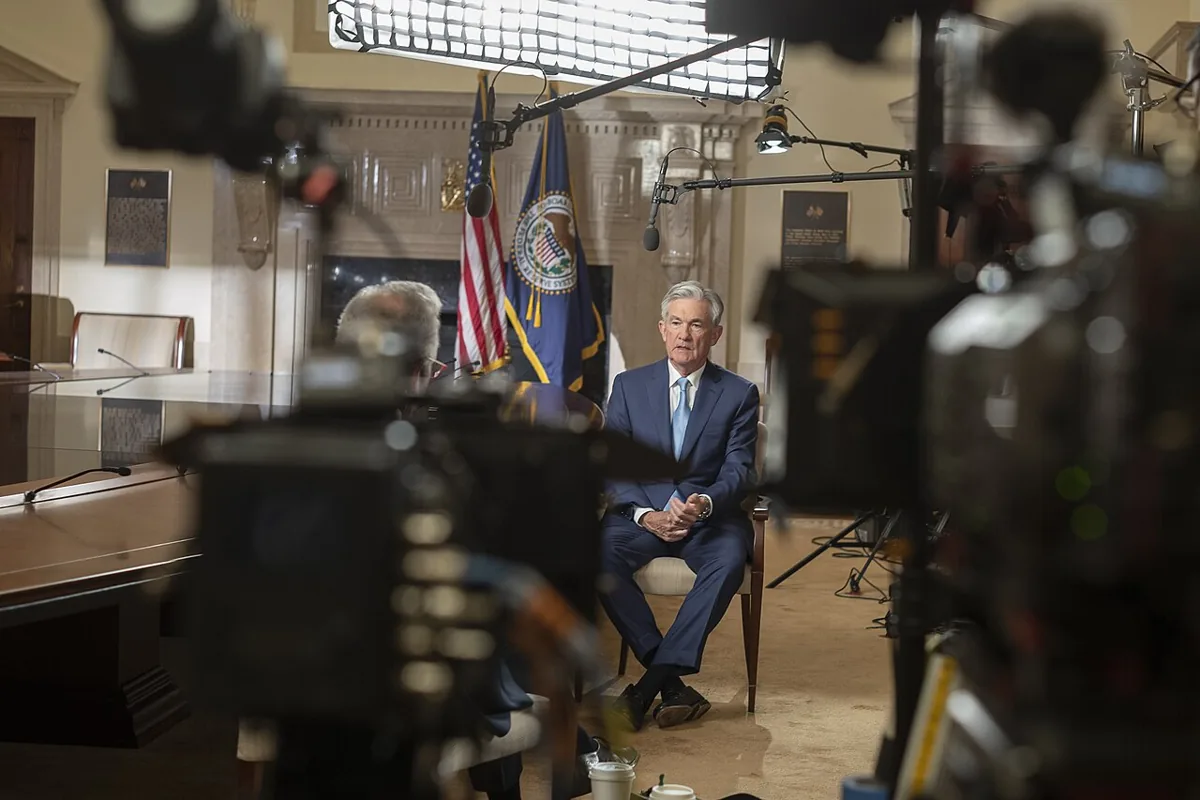
The Federal Reserve's inspector general just released a 121-page report concluding that Jerome Powell committed no crimes, which would be a boring administrative footnote except for one thing: the Justice Department opened an unprecedented criminal investigation into a sitting Fed chair over this exact building project, grand jury subpoenas and all. That probe was launched by Jeanine Pirro. A federal court later quashed her subpoenas, finding they were a pretext to pressure Powell into cutting interest rates. The watchdog has now confirmed what most people already suspected: there was nothing there.
What the Report Actually Found
The Office of the Inspector General for the Board of Governors of the Federal Reserve System dropped its findings Wednesday after more than a year of investigation. The conclusion, per the 121-page report: "At no point during our evaluation did we find reasonable grounds to believe that a violation of federal criminal law had occurred requiring a referral to the U.S. Attorney General." The IG also did not identify administrative misconduct.
The report did find genuine management problems. According to CBS News, the Fed never obtained a guaranteed maximum price from its general contractor, even after four years of construction and over $2 billion in awarded construction costs. Internal project governance was "insufficient" to manage a project of such scale. The renovation's estimated cost has risen from $1.9 billion to nearly $2.5 billion, with completion targeted for 2027.
Cost overruns, the IG found, resulted from inflation, limited subcontractor bidding, substantial design changes after construction began, and challenging site conditions including more asbestos than anticipated and soil contamination. The IG acknowledged inflation was "clearly a factor" but noted the overruns surpassed the general inflation rate. The Fed, notably, did not provide the IG with a detailed analysis of exactly how much inflation contributed.
The Marble, the Water Features, and Tim Scott's Fairy Tale
Remember the Senate hearing that started all of this? In June 2025, Sen. Tim Scott grilled Powell about what he called "lavish renovations" featuring "rooftop terraces, custom elevators that open into VIP dining rooms, white marble finishes and even a private art collection." Powell flatly denied every single element of that list. As NBC News recounts, Powell told the committee: "There's no dining room. There's no new marble. We took down the old marble, we're putting it back up. There are no new water features. There's no beehives, and there's no roof terrace gardens."
The inspector general backed Powell up. According to NBC News, the report found that the design elements that drew so much political fury, including the marble, water features, and garden terrace, "did not materially contribute to subsequent cost increases." One official told the watchdog that removing four water features from the plans wouldn't even produce significant savings, because landscaping and other costs would be needed to replace the fountains anyway.
Scott responded to the report Wednesday by welcoming its findings and pivoting immediately to a statement about fiscal responsibility. That takes a certain kind of nerve.
How a Building Project Became a Political Weapon
The renovation was first approved in 2017 by the Fed's entire seven-member Board of Governors. Powell became Fed chair in 2018. The project predates his tenure as chair. None of that mattered once the Trump administration decided it needed a cudgel.
Russell Vought, Trump's OMB director, wrote Powell a letter claiming the renovation cost "many orders of magnitude" more than comparable federal buildings and called it "a palace built on the taxpayer's dime." There is one significant problem with that framing, which NBC News flags clearly: the Federal Reserve is not funded by taxpayer money. It is self-funded through fees and the interest it earns on its bond portfolio. Vought either did not know this or did not care.
Trump himself made a surprise visit to the construction site on July 24, 2025, touring alongside Powell and Scott. During the visit, Trump suggested the cost had ballooned even higher than reported. Powell pushed back in real time. According to NBC News, when handed a piece of paper by Trump containing the inflated figure, Powell told the president he was including costs from a previously completed building project in the new estimate.
The Pirro Investigation and Its Convenient Timing
In January 2026, Powell revealed that the Fed had received grand jury subpoenas as part of a criminal investigation. This was not a small thing. No sitting or former Fed chair had ever faced a criminal probe. The subpoenas were issued by Jeanine Pirro, the U.S. Attorney for Washington, D.C., who was appointed by Trump.
A federal court in Washington ultimately quashed those subpoenas, finding they were issued as a pretext to pressure Powell into voting to cut interest rates or resigning, per CBS News. That is an extraordinary finding. A court concluded that federal prosecutorial power was being used not to enforce the law but to coerce an independent central banker into monetary policy decisions.
The criminal investigation had one immediate practical consequence beyond terrorizing Powell: it held up Kevin Warsh's confirmation as his successor. Republican Sen. Thom Tillis said he would not vote to confirm any Fed nominee until Pirro dropped the probe. Pirro announced in April that prosecutors had ended the investigation, clearing the path for Warsh's confirmation. Pirro told CBS News on Wednesday she would review the IG report. CBS News has asked whether she plans to reopen the criminal investigation. One hopes that answer is no, though hope has not been a reliable guide lately.
Where Things Stand Now
Kevin Warsh, who replaced Powell as Fed chair in May and had himself been a critic of the renovation, wrote to IG Michael Horowitz on Tuesday confirming that the General Services Administration would now oversee the project rather than the Fed itself. Warsh also said the Board would initiate a full audit to determine whether the Fed paid for work that was not performed, and would seek reimbursement or credit accordingly.
The GSA taking over management of the project is one of the IG's seven recommendations. Whether that produces better outcomes depends entirely on whether the GSA is actually equipped and empowered to do the job, which in the current federal environment is not a given. The renovation is expected to be completed in 2027.
Powell himself is gone, the criminal investigation is closed, and the IG has delivered its verdict. What remains is a building that costs more than it should have, a series of management failures the IG documented in 120 pages, and a political episode that caused genuine institutional damage to the Fed's independence, whether anyone in power wants to admit that or not.
The Dingo Take
The Trump administration used the Justice Department to criminally investigate the Federal Reserve chair because he wouldn't cut interest rates fast enough, and a federal court said so out loud. That is the story. The marble and the water features and the rooftop terrace that didn't exist were never the point. They were the pretext, and not even a convincing one, which is why the inspector general spent 121 pages confirming that every specific allegation Tim Scott, Russell Vought, and Donald Trump made about the renovation was either wrong or wildly exaggerated.
The management failures are real. The Fed ran a multibillion-dollar construction project for four years without ever locking in a guaranteed maximum price. That is genuinely bad. It is the kind of thing that should generate a sharp internal review, some fired contractors, and a round of process reforms. It is not a crime. It is not a scandal worthy of grand jury subpoenas from a U.S. attorney whose boss openly wanted the central bank chair fired for disagreeing with him about interest rates.
Jeanine Pirro is now "reviewing" the IG report that found nothing. The same report her office said, on the record, it was "confident" would resolve the questions that led to the subpoenas. Those questions have been resolved. The answer is no. The question now is whether any of the people who spent a year treating the Federal Reserve's independence as an obstacle to be destroyed will face any consequence whatsoever for doing it. History suggests the answer, but history has been wrong before.

Comments