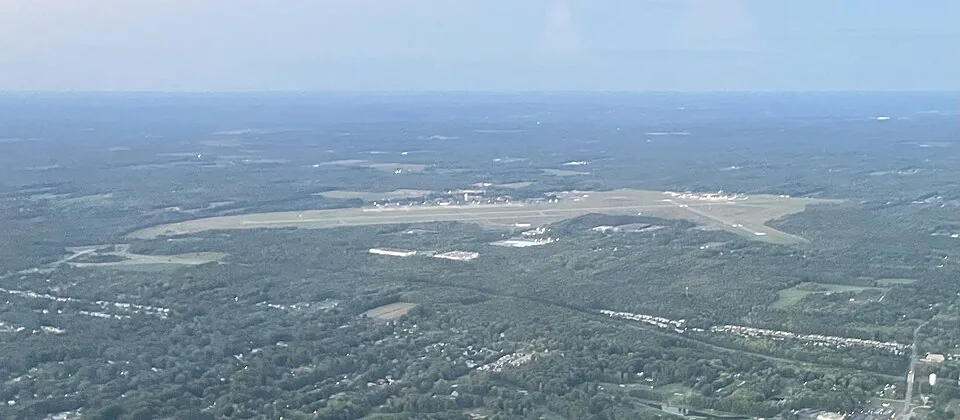
A tiny airport near the Ohio-Pennsylvania line with zero commercial flights has become one of the busiest hubs in America's deportation machine. According to The Guardian, Youngstown-Warren and Akron-Canton together have seen more ICE shuffle flights this year than all but seven other US airports, and the whole operation is built on the premise that nobody is looking.
The Busiest Airport Nobody Has Heard Of
Picture a 50-seat Bombardier CRJ200 touching down at Youngstown-Warren regional airport just after 10:30 on a weekday morning. It parks next to another Air Wisconsin plane and a Boeing 737 that flew in the night before from Alexandria, Louisiana. Together those aircraft can move about 300 people at a time.
This airport handles no commercial flights. None. Last year it logged 398 ICE-contracted flights, a mix of "shuffle" hops between US airports and direct deportation runs. Between Youngstown-Warren and its neighbor Akron-Canton, ICE Flights Monitor has counted roughly 300 flights apiece so far this year.
That puts two sleepy regional airfields ahead of nearly every big metro area in the country for deportation shuffle flights. Only seven other airports have more than the two of them combined.
How the Shuffle Actually Works
The routine is mundane, which is the whole point. Immigrants held in jails across the region get bused to the airport, usually in late morning, and loaded onto contracted planes. The planes ferry them between Wisconsin, Michigan, Ohio, and Massachusetts, and then typically on to Alexandria, Louisiana.
Alexandria is where ICE runs a swathe of detention facilities that have been pilloried for human rights abuses. From there, people get flown overseas. Sometimes the Ohio flights skip the middleman and go straight to a tiny airport outside the Mexican town of Tapachula, close to the Guatemalan border.
Hundreds of people move through this network every single day. Few of them will ever appear in a local news story, because the geography was chosen to make that unlikely.
Hiding in Plain Sight on Purpose
Erin Bracken-Sanchez, a military veteran from Massillon, Ohio, drives to the Youngstown-Warren airport to watch the planes come and go. She has a theory about why ICE likes it here, and it isn't complicated. "They're [using these regional airports] to be more obscure, to be under the radar. Who's here? No one's here; no one knows."
She also has a warning that deserves more attention than it gets. "We have to fight for the rights of others because if they're going to come for them, you know who's next; they could knock on our doors next."
Look, you don't need a conspiracy theory here. A massive government operation moved to the places with the fewest cameras, the fewest reporters, and the fewest neighbors. Draw your own conclusions about what that says about how confident the administration feels in its own program.
The Airline With the Drug Testing Problem
Now for the part where it gets worse. On September 28, an Eastern Air Express plane struck the left horizontal stabilizer of a parked Eastern Air Express aircraft at Akron-Canton. Yes, the company ran one of its planes into another one of its planes. No injuries were reported, and the Ohio state highway patrol is handling the investigation.
Eastern Air Express is one of ICE's main contracting airlines, and its safety record is already under a microscope. In July, the FAA proposed a $65,000 fine for letting 26 employees, pilots included, perform safety-sensitive functions without being subject to required random drug and alcohol testing. The FAA says the process remains open.
The Guardian emailed the company asking whether it plans its own investigation of the collision. Nobody answered. Airlines are supposed to report wing collisions to the NTSB, yet there is no record of this one on the agency's website. An NTSB spokesperson said it is "not investigating that event" because there was no substantial damage or serious injuries, even though the agency did investigate a commercial airliner incident in San Francisco on October 6.
Nobody in Charge Will Say a Word
The Department of Homeland Security and ICE did not directly respond to questions about whether they will review safety requirements for contracting airlines after the Akron-Canton incident. Silence is the house style.
Savi Arvey of ICE Flight Monitor said the group has been "very concerned on the safety of detained passengers on charter flights" and followed the Ohio incident closely. People shackled in a seat on a plane do not get to pick their carrier or read its FAA file.
Massachusetts Governor Maura Healey demanded back in January that Eastern Air Express and GlobalX, another contracted airline, end the flights. As recently as last week, an Air Wisconsin plane contracted by ICE took off from Youngstown and landed at Hanscom Field in Massachusetts anyway. A governor's demand, it turns out, has the stopping power of a strongly worded Post-it.
Small Airports Eat the Bill
These Ohio airports have struggled financially for years, and the deportation flights are not helping. Airlines normally pay landing fees to the airports they use. That is how small fields keep the lights on.
Since last February, those fees have been waived for the airports ICE uses around the country. The policy was extended in February 2026 so that the waivers for government operations also cover contractors working on the government's behalf. The result is that dozens of airports, these two included, are potentially out millions of dollars.
So the pitch to a struggling regional airport is simple. Host hundreds of flights, absorb the wear and the security burden, and collect nothing. Thanks for your service.
The Dingo Take
The administration found the least-watched runways in America and built a deportation hub on them. That's the story.
Everything else follows from that choice. The out-of-the-way airports, the contractor with the drug-testing violations, the plane that hit another plane while the feds shrugged, the landing fees nobody collects. This is what an operation looks like when it assumes the public will never show up to ask questions, and so far a few volunteers with binoculars are doing the oversight the government won't.
Here's the thing about hiding something in a small place: it only works until someone points at it. Ohio has a veteran standing at a fence line writing down tail numbers, and a lot of other people are better at counting than the people running this program would like. If the plan requires that no one is here and no one knows, then knowing is the whole job.





Comments