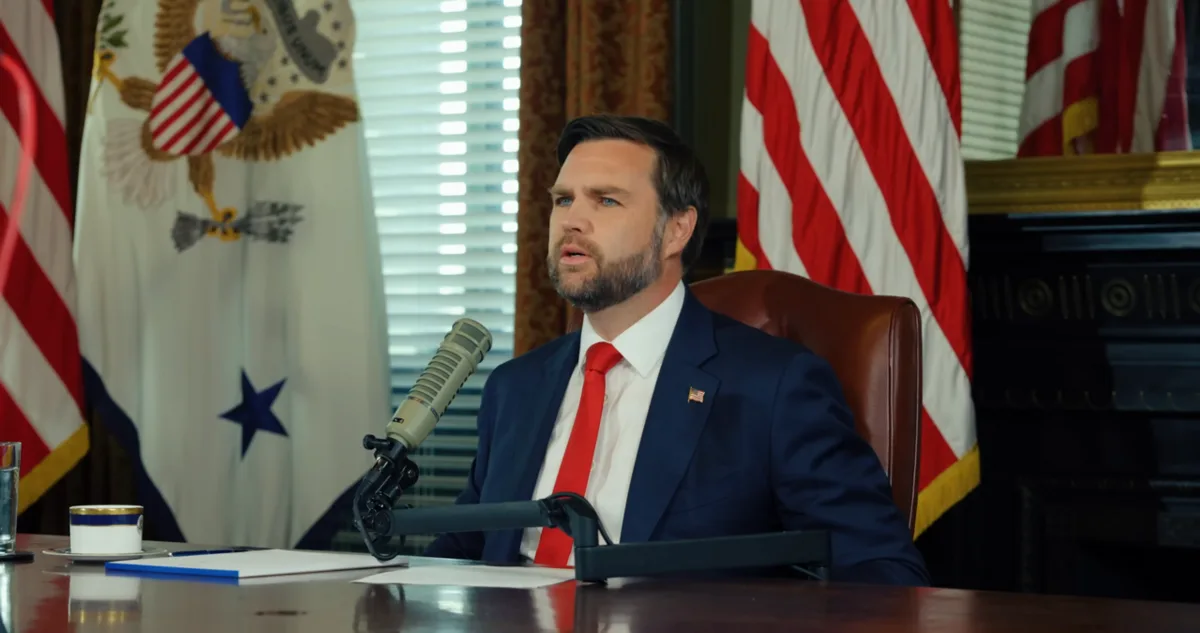
Master Sgt. Nicole Amor was one of six Americans killed in an Iranian drone attack on a Kuwaiti outpost, and her husband says leadership failures helped put her there. When he asked Vice President JD Vance on live TV how the administration would hold those leaders accountable, Vance said it was literally the first time he'd heard about it. Then he explained that sometimes information doesn't filter up because the vice president lives in a bubble.
A Widower Asks the Question Washington Won't
At a CBS News town hall hosted by Tony Dokoupil in Michigan, Joey Amor took the microphone with a question nobody in the administration had apparently bothered to answer. His wife, Nicole Amor, a member of the U.S. Army Reserve from Minnesota, died on March 1 at an outpost at Kuwait's Port of Shuaiba. It was one day after the U.S. began striking Iran. Six people were killed. It remains the deadliest attack on American forces in the entire war.
"Though the Iranian drone was the weapon that killed my wife, there were a lot of mistakes and a lot of fundamental failures that led up to that," Amor said. He added that his wife had told him things before she died. Then he asked the vice president how this administration plans to "start holding those leaders accountable for the actions and the deaths of the soldiers that we honor and that we love."
That is not a gotcha. That is a grieving husband asking whether anyone will answer for his wife's death.
"The First Time I've Heard of This"
Vance called Nicole Amor "a precious human being who served her country honorably." Fine. Then came the part that should make everyone's stomach drop. "If there were failures, and I don't doubt there were, I just … literally the first time I've heard of this is this conversation," he said.
The first time. In a war that has dragged on for months. Vance even took part in negotiations with Iran over the summer. And the deadliest attack on U.S. troops, the one families have been publicly asking questions about for months, had somehow never crossed his desk.
His explanation was that as vice president, "you live in a bubble" and "sometimes information doesn't filter up to me." Sir, you are the second most powerful person in the executive branch. The bubble is not a defense. The bubble is the problem.
What the Families Have Been Asking All Along
Vance's surprise would be more believable if this were an obscure story. It is not. Since the attack, families of the people affected have raised questions about whether the military did enough to protect Americans stationed at Shuaiba. CBS News has reported on concerns that the facility wasn't adequately fortified and lacked the capability to shoot down incoming drones.
The reporting goes further. The Army reportedly chose not to rebase troops farther from Iran. It also ignored a request to bulk up medical support. Those are not vague gripes about the fog of war. Those are specific decisions, made by specific people, that families believe cost lives.
Accountability for those decisions is exactly what Joey Amor asked about. The vice president's answer was a promise to look into it.
The Admission Buried in the Answer
Here is where it gets interesting. Vance said "there are issues with … where troops were located that we realized was a huge mistake, and that we could do better on. And we have changed that."
Read that again. The same man who says he's hearing about the failures for the first time also says the administration realized the troop placement was a huge mistake and already fixed it. Both things can't be fully true. Either he knew something, or he didn't, or he knew just enough to sound reassuring while claiming total ignorance.
He declined to give details, citing the risk of tipping off Iran. That is a reasonable argument for operational specifics. It is a much weaker argument for saying whether anyone will be held responsible. He promised, "I want to talk to those soldiers, and I want to talk to you." No names, no timeline, no mention of a single leader facing consequences.
Meanwhile, Back in the Gas Station
The rest of the town hall was a tour of everything going wrong that the administration would like you to blame on someone else. Sandy Johnson, who owns a family entertainment center, said she's "barely making ends meet" and asked when ordinary Americans will have money to spend. Vance's answer was that it will take more than 18 months to fix a "bipartisan, multi-generational failure." So the economy is Biden's fault, and also everyone's fault, and also not fixable on this timeline.
A Detroit barber named Keshon Wheatley, who voted for Trump in 2020 and 2024 partly because of low gas prices, said he now plans to vote for Democrat Abdul El-Sayed over Republican Mike Rogers. Vance blamed Iran for choking off energy supply and admitted gas prices are "too high right now." The Iran war, remember, is the thing driving oil prices up.
Asked why the U.S. hasn't decisively won, Vance said "in some ways we have won decisively," but "the enemy gets a vote." Inflation stays stubbornly above the Fed's 2 percent target and manufacturing jobs are roughly flat, but the ship, we are told, is turning.
The 2028 Question He's Too Busy to Think About
Dokoupil also asked whether there is any chance Vance won't run for president in 2028. "Of course there's a chance," he said, describing himself as a procrastinator who hates thinking about big life decisions. He noted that he and Usha Vance have four young children.
This is the widely viewed frontrunner and Trump's self-described "most likely" successor, claiming he hasn't given the question much thought. Sure. Meanwhile he's campaigning in a swing state with a tight Senate race ahead of the midterms. Nobody who procrastinates that hard ends up in Michigan on a Saturday night.
The Dingo Take
How many more families have to ask before somebody in this administration already knows the answer? Joey Amor did not need a seat in the Situation Room to learn that his wife's outpost may have been poorly protected. He learned it because he listened to his wife and to the other families who have been asking questions for months. The vice president learned it on a television set in Michigan.
Vance deserves some credit. He didn't dodge Amor, he didn't sneer, and he said he wanted to fix it. That is more than most of his colleagues would manage. But a promise to "figure out what exactly happened" is what officials say right before nothing happens. The test is simple. Does anyone who made the call to leave those troops exposed lose their job? Does anyone even get named?
Six Americans died on the second day of a war the administration chose to start. The least a government owes the people it sends is to find out why they died, and to find out before a widower has to ask on live TV. Living in a bubble is not an excuse. It is a confession.



Comments