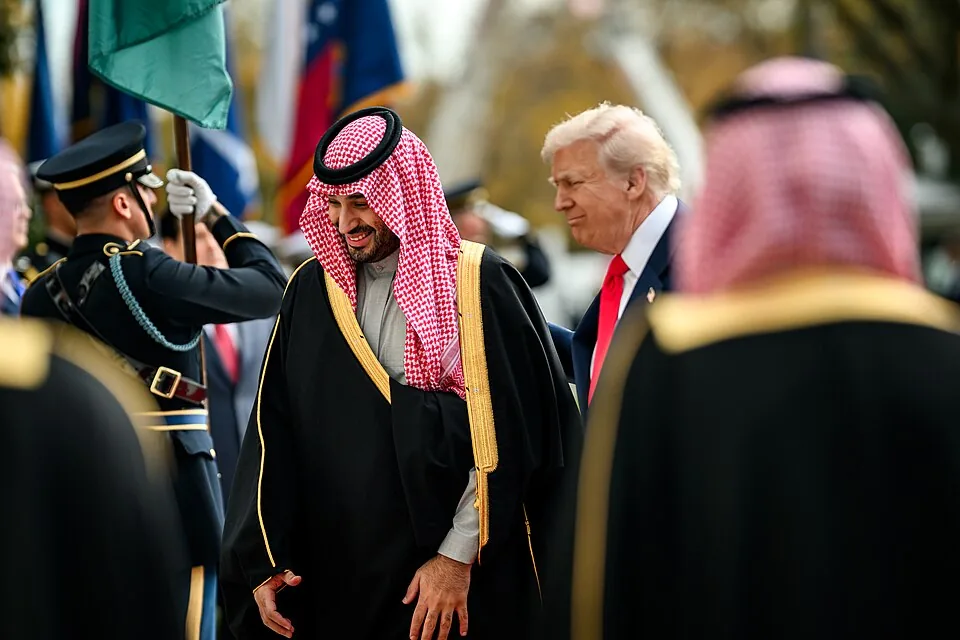
Mohammed bin Salman spent years stuffing billions into Jared Kushner's private equity firm and the Trump Organization, signed a deal for dozens of F-35s, and pledged enough investment to rival his own country's GDP. Then the Houthis put a cruise missile into Riyadh's airport, and the president he'd been bankrolling said, "We may. We're going to look at it."
The Most Expensive Voicemail in Saudi History
Here's the setup, laid out in a Guardian opinion piece by Mohamad Bazzi. In January 2025, days after Trump returned to the White House, the crown prince pledged $600 billion in investment and trade with the US over four years. He later bumped that to nearly a trillion dollars, a number so large it approaches the kingdom's entire annual economic output. Nobody was entirely sure how he planned to pay it.
Then came last November's Washington visit. A defense cooperation agreement. A deal for dozens of F-35 stealth fighters, the most advanced warplane America makes. The prince flew home believing he had bought what Gulf monarchs have always thought they were buying: the guarantee that if someone attacks, Washington shows up.
He did not buy that. He bought a very nice jet and a friendly phone call.
A War Trump Started Comes Home to Roost
Over the summer, Trump's war against Iran reignited the years-long fight between Saudi Arabia and the Houthi militia in Yemen, who are allied with Tehran. This was exactly what Middle East experts and some US intelligence officials warned would happen. You attack Iran, and the fire spreads to everyone standing nearby.
In September the Houthis stepped up their strikes on Saudi territory and on the kingdom's Yemeni allies. Prince Mohammed called Trump multiple times, asking for US airstrikes on the Houthis. Multiple times. The man who just wired billions across the ocean was reduced to leaving the president repeated pleas for help.
The response was nothing. Then, on October 10, the Houthis fired a cruise missile at Riyadh's international airport. At least 13 people died and more than 300 were wounded.
"We May. We're Going to Look at It."
That's the full quote. Asked by reporters whether the airport attack made him more willing to order strikes, Trump said: "We may. We're going to look at it. We just found out about the recent attack. So we'll make a decision."
Thirteen dead, more than 300 injured, and the commander in chief of the country that sold the victim its fighter jets sounds like a man deciding whether to return an Amazon package. We just found out. We'll make a decision.
And look, the inaction itself is arguably the one sane call in this whole mess. Bazzi calls it one of the best foreign policy decisions of an otherwise disastrous second term, and it's hard to argue. Dragging American forces into a Saudi-Houthi slugfest would be catastrophic. But the reason matters, and it isn't strategy.
Why Trump Is Suddenly Allergic to War
Trump isn't holding back out of wisdom. He's holding back because of the midterms. The Iran conflict has pushed up gasoline and energy prices, and US inflation hit 3.7 percent in September. The war is deeply unpopular, including with chunks of his own MAGA base who believed his repeated promises not to start new wars.
Republicans are staring down widespread anger over the cost of living, and nothing says "vote for us" like another front in a war that's already making your groceries more expensive. So the Saudis wait.
After next month's elections, the math changes. If Democrats take both chambers of Congress, Trump gets less constrained by electoral fear, and more pressure from the Saudis and hawkish Republicans to intervene. The Saudis may simply be waiting out the calendar.
The Corruption Is the Whole Point
Now consider the leverage cutting the other way. Prince Mohammed is reeling from the war's damage to Saudi oil exports, and he has a very obvious pressure point. Billions of Saudi dollars have flowed into Kushner's private equity firm and the Trump Organization. He can threaten to turn off the tap.
That's the danger Bazzi flags. When a president runs foreign policy like a family business, foreign autocrats stop lobbying the United States and start lobbying the Trump brand. American interests get subsumed by whoever has the deepest pockets and the best access to the president's relatives.
The real US interest here is boring and obvious: promote diplomacy and de-escalate the Houthi-Saudi conflict. That doesn't generate a single dollar for anyone's private equity fund.
The Khashoggi Receipts
None of this should be mistaken for sympathy for the prince. This is the man US intelligence agencies concluded ordered the 2018 killing of Jamal Khashoggi, a dissident journalist murdered inside the Saudi consulate in Istanbul by a 15-member hit team that dismembered his body with a bone saw. He launched the destructive 2015 invasion of Yemen and blockaded neighboring Qatar.
Trump and Kushner shielded him through all of it. Trump flew to Riyadh for his first overseas trip in 2017, broke with tradition to do it, and soaked up the gilded banquets and the kingdom's highest civilian honor. The Saudis figured out early that this president runs on flattery and cash.
So they supplied both, generously, for years. That's the transaction. What they're learning is that Trump's side of it was never a promise.
The Dingo Take
Who benefits? Right now, the Trump family business does. Billions in Saudi money sit in Kushner's fund and the Trump Organization, and the arrangement keeps paying out whether or not a single American plane ever takes off for Yemen. The prince got a handshake. The Trumps got the capital. Everyone else gets the war that was started to begin with.
The grim joke is that the Saudis made the same mistake every Trump partner eventually makes: they confused being useful with being protected. Trump has never once treated a deal as a bond. A deal is a thing that happens, you collect, and then you look at the next one. Ask the Kurds. Ask Ukraine. Now ask a man with a trillion-dollar pledge and a smoking airport.
Here's the part that should keep you up at night, though. The same corruption that left MBS holding the bag is also what makes this all so dangerous for the rest of us. When American foreign policy has a price tag and a family-owned cashier, the next crisis gets decided by whoever writes the biggest check or threatens to pull it. That isn't strategy. That's a protection racket where the protected party keeps getting hit, and everyone is shocked, shocked, that it turns out nobody was ever really being protected.

Comments