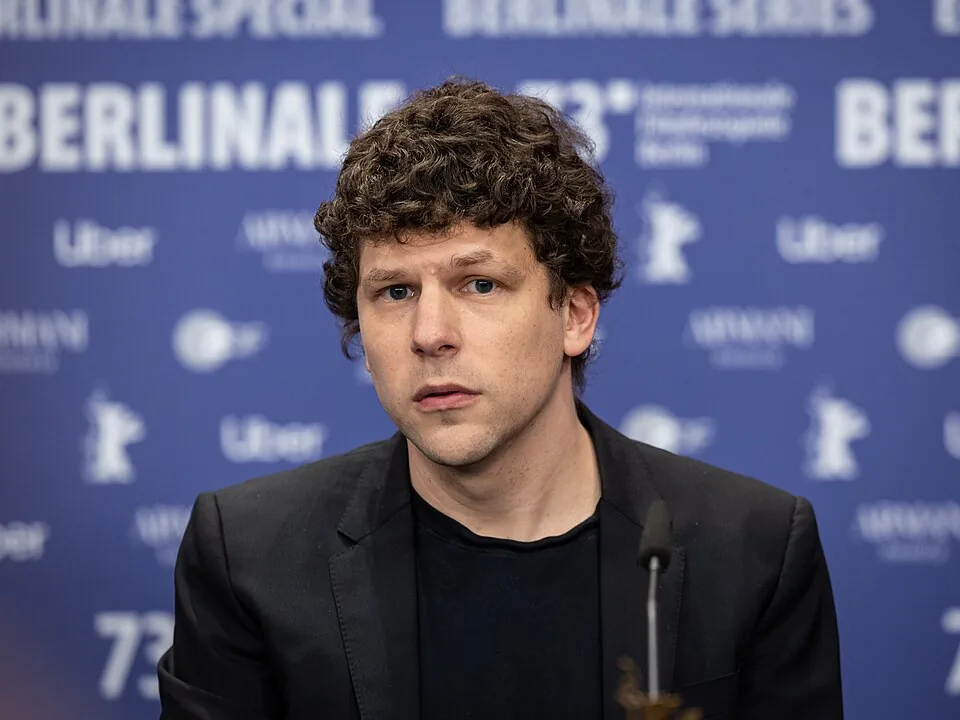
Jesse Eisenberg says a Razzie for playing Lex Luthor in Batman v Superman terrified him so badly he started writing and directing movies just to stay employed. Nine years later he has an Oscar nomination for a screenplay he wrote, which means the Golden Raspberry Awards may have accidentally launched the most successful second act in superhero-movie-adjacent history.
The Fear Talking, By His Own Admission
Speaking at the BFI London Film Festival on Sunday, the 43-year-old actor told the crowd that his pivot to directing was driven by panic, as reported by the New York Post, which cited Variety. "Listen, a lot of it just came from fear," he said. "I couldn't get into movie studio parts anymore because I had won a Raspberry Award from [being in the] 'Batman' movie … and I saw the trajectory."
He won the Razzie for worst supporting actor in 2017 for playing Lex Luthor in the 2016 Zack Snyder film. Ben Affleck was Batman. Henry Cavill was Superman. Eisenberg was the guy who played a tech billionaire like a caffeinated squirrel doing a TED Talk, and the Razzies noticed.
The Whole Film Got Dragged, Not Just Him
In fairness to Eisenberg, he had company at the Razzie podium, or at least in the nominations list. Batman v Superman led the 2017 Razzie nominations and went on to win worst screenplay, worst sequel and worst screen combo. That last one means Affleck and Cavill got to share a trophy for being bad together. Romantic, almost.
The movie was a critical punching bag across the board, so it's not like Eisenberg was singled out from an otherwise beloved masterpiece. He just happened to be the one who took the statuette home and, apparently, let it live rent-free in his head for the better part of a decade.
Acting Is a Treadmill, and Nobody Gets a Plateau
Eisenberg described the actor's existence as a permanent state of dread. Actors, he said, are "constantly panicked about, am I on an upslope or a downslope?"
"Because there's no plateau," he continued. "Acting is just this unstable, awful industry where you are either on the treadmill and you're doing OK and you're running up, or you are yesterday's news, and it's awful. And if you're a paranoid person like me, you see it way in advance."
He's not wrong about the industry. He's also describing a man who watches himself on the treadmill's readout display and sees the number drop by a tenth of a mile per hour. "So I was like, I've got to direct movies," he said. "That's why I started writing them, just to kind of keep my career afloat, really."
The Industry Told Him Something, and He Listened
Here's where it gets interesting. Eisenberg treated the Razzies as a message from Hollywood, a formal notice that studios did not want him in superhero movies. "The industry tells you what they want from you," he said. "And if you're smart and self-aware, you learn that quickly."
Then he took a swing at the actors who don't get the memo. "It's the unsuccessful actor that goes, 'No, I want to be in more of those,'" he said. "It's not going to happen, and they don't want you there. And they wouldn't have given you a Raspberry Award if they wanted you there. That's an award for bad acting."
He wrapped it up with a line that sounds like a fortune cookie written by a career counselor: "The industry tells you what it wants, and if you want a career in the arts, you have to follow the things that you're being told are liked."
The Career That Allegedly Died Keeps Showing Up to Work
Now for the part where the premise gets a little shaky. Eisenberg went on to appear in Now You See Me 2 and Zombieland: Double Tap. Then came the real kicker: Zack Snyder's Justice League. That's right. The guy who says the Razzie made him unwelcome in superhero movies came back for another round with the exact same director.
He also made his directorial debut with When You Finish Saving the World, followed by 2024's A Real Pain, which he co-starred in alongside Kieran Culkin. That one earned him an Oscar nomination for best original screenplay. He's currently promoting his latest film as a director, A24's musical comedy The Debut, starring Julianne Moore and Paul Giamatti.
He previously told Page Six that he felt like a "hack" after Culkin, 44, questioned his direction on A Real Pain. "I felt immediately embarrassed," he said in part. "I always just kind of try to consider the behavior that I can change, which is my own, and I was thinking, yeah, I'm probably in the wrong here." Even his Oscar-nominated peak comes with a side of self-flagellation.
The Dingo Take
"I saw the trajectory." Sure you did, Jesse. The trajectory you saw led straight to an Oscar nomination, a second collaboration with the same director who gave you the Razzie, and an A24 musical comedy with Julianne Moore and Paul Giamatti. If that's what a ruined career looks like, the rest of us would like to be ruined too.
There's something both sincere and very funny about a man describing Hollywood as a treadmill of doom while standing on the stage of a major film festival promoting his own movie. Eisenberg's anxiety is real, and his read on the industry's brutality is not wrong. But the story he's telling about the Razzie as a career-ending verdict doesn't match the filmography he's built since. The Razzies are a joke award run by people who hand out trophies for fun. Hollywood doesn't take them seriously. Eisenberg, apparently, did, and it pushed him into the best work of his life.
So here's the lesson, if you want one: sometimes the thing you're sure has killed you is just a very annoying redirect. The Razzie didn't end Eisenberg's career. It gave him a reason to stop waiting for studios to hand him parts and start writing his own. If that's what fear gets you, maybe more of us should be a little more afraid of the Golden Raspberries.

Comments