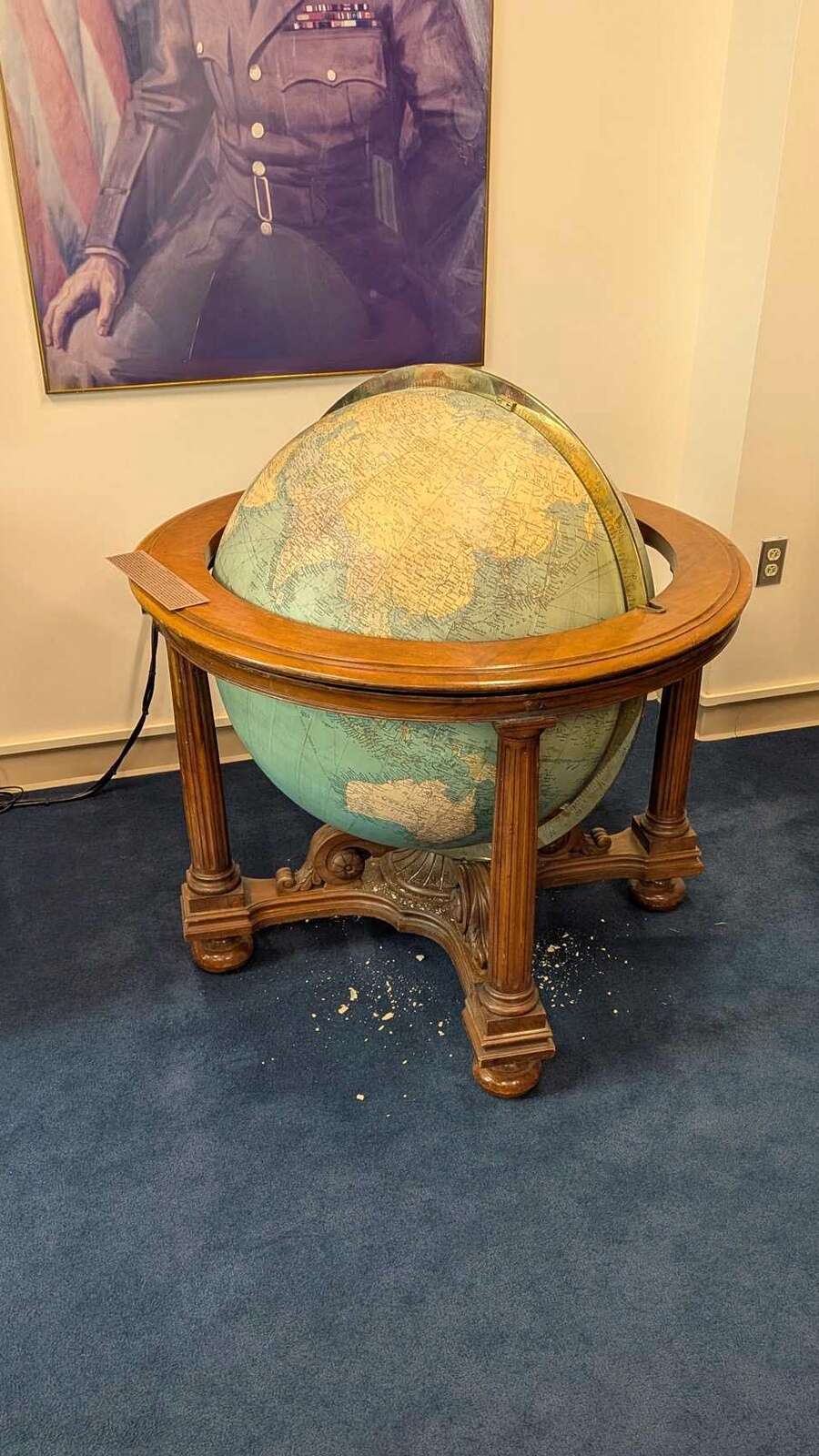
A 30-inch globe that Dwight Eisenhower reportedly used to plot the D-Day landings is now in pieces, because Pete Hegseth's aides decided they didn't need professional movers and dropped it on the way to his office. One source says the shell was impaled "near Antarctica." The Pentagon's explanation is that it was a replica, and also that you're a jerk for asking.
A Priceless Artifact Meets Unpriced Impatience
Photographs published by the Washington Post show the wreckage: fragments of the globe on a blue hallway carpet below its wooden frame, and an inches-wide gash in the bottom of the sphere with the base punched through. The 30-inch globe dates to before World War II and is said to have been used by Eisenhower as allied supreme commander while he planned the D-Day invasion.
There are two similar globes from the 1930s housed in the Pentagon. Hegseth reportedly took a liking to one of them and asked for it to be placed in his office. Honestly, fair. If you're going to cosplay as a warrior, you want the good props.
The incident happened in February, which means this thing has been sitting in the Pentagon's repair queue for roughly eight months while the building said nothing.
Why Hire Experts When You Have Aides?
Here is the part that makes the whole thing sing. Specialist movers exist for exactly this situation. According to the Post's sources, Hegseth's aides were in such a hurry that they skipped the pros and sent their own team instead. One source blamed an "apparent lack of patience."
Then they lost control of it. "They lost control of the artifact and dropped it, sending the globe crashing on to its base and impaling the fragile shell near Antarctica," a source said. The sphere detached from the metal mounting that lets it rotate, which is a sentence you never want to read about a historical object.
It did not even work. The globe never made it to Hegseth's office. All that urgency, all that haste, and the only thing relocated was the damage, from "priceless" to "insurance question."
The Army Admits It, The War Department Does Not
A US Army spokesperson told the Post that the damage occurred during "an attempted move" and confirmed that the spherical portion was detached from its mount. That is the sound of an institution trying very hard to describe a fumble in the calmest possible language.
Then came the statement to the Guardian from the Pentagon, which now calls itself the "war department" because the administration rebranded it during Donald Trump's second term. The official said an accident occurred while staff were transporting "a replica of the Eisenhower globe." Accidents happen, the statement continued, everyone is fine, and the globe is being repaired.
A replica. Sure. Except the Army spokesperson was already on the record describing damage to the actual globe's spherical portion and mounting, and the globe is described as undergoing repair. You do not repair a replica in a specialist restoration process. You order another one.
The Professionals Were One Phone Call Away
Want to know what doing this right looks like? Specialist movers Craters & Freighters moved an Eisenhower globe between two Army facilities in Alabama in 2022 and wrote about it on their website. They designed and precision-built protective crating for the job. Their own account says the globe was considered priceless and that its value was "much greater than financial."
That is the standard. A custom crate, a trained crew, and a plan. The Hegseth method was a few staffers, a hallway, and vibes.
The contrast is the entire story. One group understood that a fragile piece of history requires patience. The other group worked for a man who has boasted about instilling a "warrior ethos" in the military since his January 2025 confirmation, and apparently the ethos includes not waiting for the guy with the foam padding.
Inconsequential Non-Story, Says Department of Non-Stories
The statement's last line deserves its own frame. The official said it was "unsurprising that the Washington Post is once again dedicating time to another inconsequential non-story."
A non-story is a story nobody has to deny. This one got a statement, a clarification about replicas, and a swipe at the press, all delivered with the energy of a man standing in a pile of broken glass insisting the window was always like that.
And look, nobody is claiming the globe's destruction ended the republic. The point is what it shows. The people running the Pentagon grabbed a historic object because they wanted it, refused to wait for people who knew how to handle it, broke it, and then said nothing for months.
The Dingo Take
"Accidents happen, we are grateful no one was harmed." Sure, and that's a lovely sentiment, but it cuts both ways. Accidents also happen to people who skip the expert crate, ignore the professionals, and decide patience is for suckers. This wasn't weather. It was a choice, made in a hurry, by people who couldn't be bothered to wait for competent help. The Eisenhower globe was fine for roughly 90 years. Then Hegseth's staff touched it.
The replica claim is the part that should stick in your throat. The Army itself said the globe was damaged and detached from its mount. The globe is undergoing repair. And the department's answer to a documented screwup is to wave it off as fake and then insult the paper that published the photos. That is not damage control. That is a man holding a smoking fire extinguisher and complaining about the smoke detector.
Here's the thing about "warrior ethos." Real military culture, the kind Eisenhower came out of, is obsessed with planning, logistics, and doing the boring work correctly so the dramatic work doesn't fail. D-Day did not happen because someone was impatient. It happened because thousands of people sweated every dull detail. The man who wants that globe in his office apparently could not manage to get it down a hallway. Make of that what you will, and then ask yourself who else is carrying things this fragile.





Comments