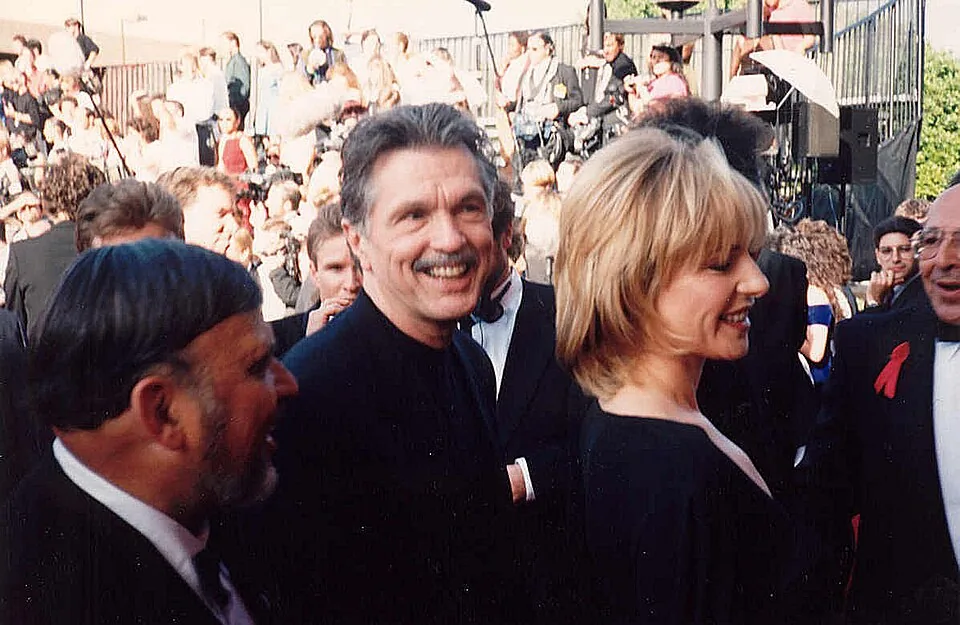
Tom Skerritt died Wednesday of natural causes at 93, which is a better exit than he got in Alien, where he was dragged into a duct and removed from the movie by a creature with acid for blood. The actor who spent six decades playing the guy you wanted in charge, whether as a commanding officer, a sheriff, or a stern dad with a fishing rod, leaves behind a filmography that quietly holds up half of American pop culture.
The Man Behind the Mustache
Skerritt's death was confirmed by his family and his representative on Thursday, according to NPR and CBS News. He was born August 25, 1933, in Detroit, the son of a small businessman and a housewife. He had two brothers, and a sister who died as a child.
He served four years in the Air Force, studied at Wayne State, and then moved to UCLA to study filmmaking after seeing Citizen Kane. Directing was the dream. Acting, as it turned out, was where the work kept showing up.
That is the most relatable career arc in Hollywood. He wanted to be behind the camera, the roles kept coming, and then there were five kids to feed. He told The Ottawa Citizen in 1992 that the years flew by and he had no regrets.
He Beat Out Robert Redford for Nothing, and Then Got Paid Back
Skerritt's first film role was a supporting turn as a sergeant in War Hunt, a scrappy 1962 independent Korean War movie made for about $250,000. It marked the debuts of Skerritt, Robert Redford, Sydney Pollack and Francis Ford Coppola. Read that list again. A $250,000 movie accidentally minted four people who would shape the next half century of American film.
Skerritt and Redford were reportedly up for the same lead. Redford got it. Decades later, with Redford directing A River Runs Through It, he handed Skerritt the plum part of the stern Reverend John Maclean, a minister whose governing passions were his faith and fly-fishing. Redford called it paying him back with interest, and the two became lifelong friends. Redford died last year.
"His values were close to mine, and he kept his integrity," Redford told the Seattle Times in 2007. That is about as good a eulogy as an actor can ask for, and Skerritt got it while he was still alive.
Captain Dallas, Viper, and the Art of Being Memorable in Small Doses
The early years were lean. He had a small part in MAS*H as Captain Duke Forrest, a role that NBC calls his breakthrough, and which NPR notes was one of the few characters who did not make the jump to the TV series. He did bit work for Robert Altman in Thieves Like Us. He played a motorcycle cop in Harold and Maude for Hal Ashby, because of course he did.
Then came Alien in 1979. Skerritt played Captain Dallas of the Nostromo, the beleaguered boss who crawls into the ventilation system with a sputtering flamethrower and does not crawl back out. What he liked about the script, he told the Seattle Times, was that the lead actor disappears and the woman becomes the hero. "I really like that idea," he said.
That is a remarkably generous thing for a lead to say about being killed off to make room for Sigourney Weaver. It is also why the movie works.
In 1986 he showed up as Viper, Tom Cruise's no-nonsense flight instructor in Top Gun. "There are no points for second place," he told the room. You have heard that line in a thousand offices since. Most of the people quoting it have never once been as cool as the man who said it.
An Emmy for the Sheriff of Frog Town
Skerritt's best notices came from Picket Fences, David E. Kelley's strange and brilliant drama that ran from 1992 to 1996. He played Sheriff Jimmy Brock in Rome, Wisconsin, a town where a robber leaves a trail of frogs and the pope becomes the star witness in a murder trial. Kathy Baker played his doctor wife.
The show won 14 Emmys and a Golden Globe. Skerritt took home the Emmy for outstanding lead actor in a drama series in 1993 and was nominated twice, both times for the show. He credited the writing. "It was written by the best writer on television," he told the A.V. Club in 2019, adding that he had not been trying to do a series until he heard Baker was in.
He was also, in the same stretch, the patient husband in The Turning Point, Sally Field's husband in Steel Magnolias, and the scheming opportunist standing in Jodie Foster's way in Contact. He played Evan Drake on Cheers, Jimmy Ford on Leverage, and William Walker on Brothers and Sisters. He even modeled for Guess jeans. Range.
The Part That Wasn't on Screen
Skerritt lived in the Pacific Northwest and put his weight behind independent film and theater there. NPR reports he co-founded The Red Badge Project, a program that lets veterans take storytelling courses and share their experiences. He made his Broadway debut in 2013 in an adaptation of John Grisham's A Time to Kill, and in 2004 he was the narrator in Our Town at Seattle's Intiman Theatre.
In 2016, at 84, he started Heyou Media, a digital entertainment and content-aggregation company in Seattle. "This is a new era," he told The Seattle Times. At an age when most people are fighting with their cable provider, he was founding a media company.
His family said in a statement that the world knew Tom through his acting, but they knew him for "his humor, curiosity, wisdom, generosity, and the love he brought into our lives." They added that he cared deeply about storytelling, service, veterans, and the natural world. He is survived by his wife Julie Tokashiki, five children, five grandchildren, and two great-grandchildren.
The Dingo Take
"A writer once described me as a character actor locked in a leading man's body, and I've always loved that." Skerritt said it in 1997, and he was right on both counts. He never needed to be the biggest name on the poster. He needed to be the guy who made the poster believable.
Think about the job description. Somebody has to play the commander who tells Tom Cruise there are no points for second place. Somebody has to play the sheriff who keeps a town with frog-trailing bandits and a papal witness from sliding into complete nonsense. That is real craft, and it is mostly invisible until the person doing it is gone.
He wanted to direct. He made one TV movie, Divided by Hate, and spent the rest of his life becoming a face that three generations of moviegoers trust on sight. Not a bad consolation prize. Ninety-three years, a lifelong friendship with Robert Redford, and a Xenomorph that finished him off in the best-loved horror movie in the history of the genre.




Comments