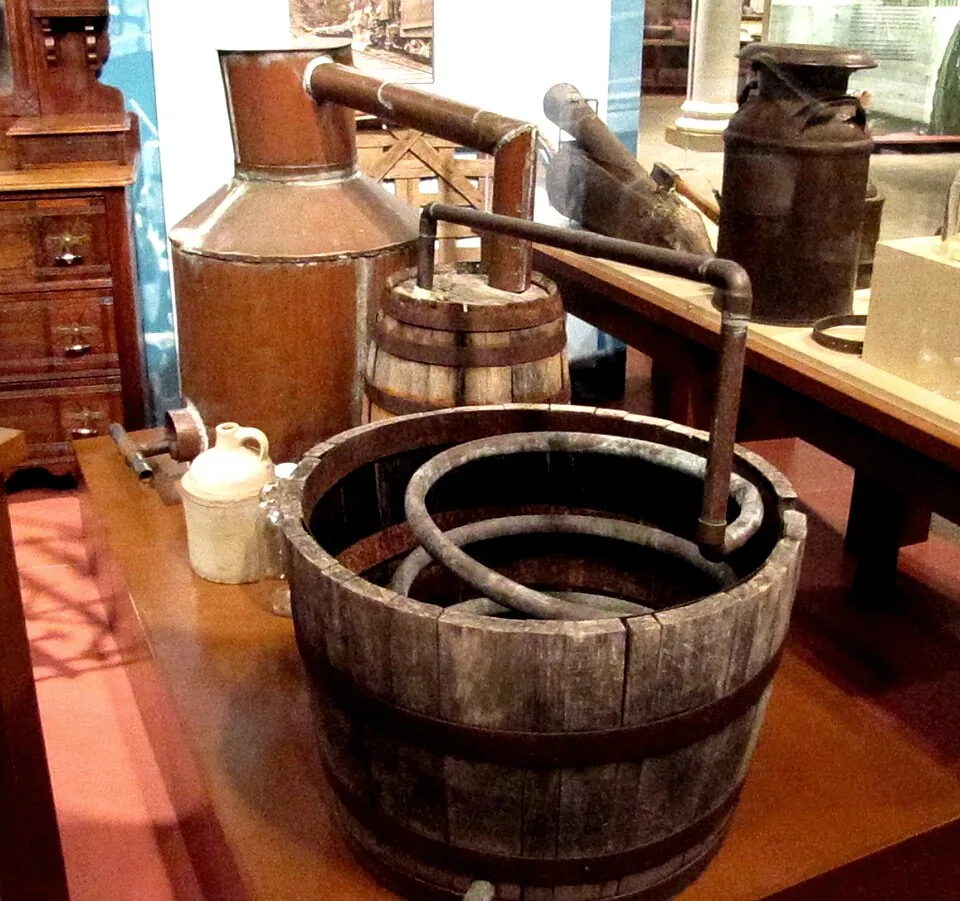
The Supreme Court has agreed to decide whether the federal government can send you to prison for five years for turning your dining room into a distillery. The law in question dates to 1868, and the man who made it a punchline in the first place, George Washington, ran a whiskey operation at Mount Vernon. Somewhere, a 66-year-old Wyoming mechanic is mixing coffee-flavored shine with a power drill and a bowl, waiting to find out if he's a felon.
The Shining Room
Geno Stecks of Wyoming has done what any dedicated hobbyist does. He modified his home. "I turned my dining room into my shining room," the bearded 66-year-old told the BBC, which first reported on the case this week. He spends his free time tinkering with recipes, and his signature product is a coffee-flavored moonshine he shares with friends and neighbors.
It is also a federal crime. Distilling alcohol in a private home carries up to five years in prison, a $10,000 fine, or both. Stecks knows this, which is why his own advice on the subject is the most American sentence of the week: "Keep quiet. Don't make commercials or nothing."
That is the current legal status of one of the country's oldest hobbies. A man with a drill and a mixing bowl has to operate like a guy running a speakeasy, except the speakeasy is his house and the product is coffee liquor.
A Reconstruction-Era Tax Grab
The law the Court will examine goes back to 1868, when Congress restricted distilling for tax purposes during Reconstruction. Anyone making spirits had to pay a tax. Historian Daniel Pierce told the BBC that large distillers could afford it, but for most people the cost was out of the question.
Small farmers who made a little liquor on the side to earn extra money or barter were suddenly stuck. When federal agents started enforcing the rules, those farmers had few options. The ban has outlived the problem it was written to solve by roughly a century and a half.
Then Prohibition arrived from 1930 to 1933 and handed illegal distillers a booming new market. Moonshiners got rich. Bootleggers modified their cars to outrun the law, and those souped-up getaway vehicles gave birth to NASCAR. Let that sink in. An entire professional sport exists because the government made it illegal to make a drink.
Beer and Wine Are Fine, Brandy Is a Felony
Here's the part that makes the whole thing feel like a bit. Home brewing beer and wine is legal across the country. Home distilling is not. The legal line sits exactly where a hobbyist tries to take the next step.
Rick Morris, president of the Hobby Distillers Association, hit that wall himself. He and his wife were home brewers who wanted to go further. "It didn't make sense," he said. "I could make beer, I could make wine, both perfectly legally, and it was frustrating that I couldn't take what I had already legally made and do one more step to it, to start to try to make a bourbon or a brandy."
Ohio challenger John Ream, an aerospace engineer, has a similar story. His wife gave him a home-brewing kit about 17 years ago. He made enough messes in the kitchen to get exiled to the garage. He stayed away from distilling once he learned it was illegal, then decided to join the legal fight instead. These are the dangerous criminals the federal government is protecting us from: an aerospace engineer and a guy who used to service soda machines.
The Circuit Split
The Supreme Court usually steps in when lower courts can't agree, and they can't agree here. One lower court found the almost 160-year-old ban unconstitutional. In a separate and similar case, another lower court reached the opposite conclusion.
The plaintiffs argue Congress overstepped its powers when it restricted distilling for tax reasons. Lawyers for the government say the measure was lawful and necessary to stop producers from dodging taxes. Robert Alt, who represents the plaintiffs, called the law "both absurd and unconstitutional" and noted that the hobby is "as American as apple pie, and certainly a lot older."
The Court will hear the case early next year. A ruling could come in the summer of 2027. Alt says the heart of it is state versus federal authority, since alcohol has traditionally been regulated by the states. Missouri and New Hampshire have already passed laws allowing limited home production for personal use.
The Safety Argument Has Teeth
Not everyone wants the ban gone, and the opposition deserves a fair hearing. Courtney Armour, chief legal officer at The Distilled Spirits Council of the US, warned about real dangers. "The distillation process can be quite dangerous, including risk of explosion, burns, fires, and more," she said. Even in the careful, regulated setting of the industry, accidents, injuries and fatalities still happen.
She also pointed to the health risks of improperly produced alcohol, and noted the danger wouldn't stop at the person doing the distilling. Neighbors could be affected too. A man running a still in a two-bedroom house is not just risking himself.
That is a legitimate concern, and it is a different argument from the one the government has to win. Safety is a reason to regulate. It is not obviously a reason to threaten five years in prison over a tax law from the Andrew Johnson era.
The Dingo Take
The government's position is that a tax law from 1868 justifies a prison sentence for a man mixing coffee liquor with a drill. The government's defense is that it needs the ban to stop people from dodging taxes on alcohol they make for themselves and give to their neighbors. That is the entire legal edifice. It has stood since Reconstruction.
Look, the safety concerns are real. Stills can explode. Bad batches can hurt people. But we regulate dangerous hobbies all the time. We don't throw people in federal prison for owning a deep fryer, and we let people build their own gas-powered contraptions in garages across America without a five-year sentence hanging over them. If the worry is safety, write safety rules. If the worry is revenue, collect it. A felony for a dining room hobby is a strange answer to either problem.
Here's the delicious irony. The nation's founding father made whiskey, the nation's biggest motorsport grew out of fleeing the cops over whiskey, and the nation's highest court is now deciding whether a retired mechanic in Wyoming can keep doing what Washington did for fun. Whatever the Justices rule next summer, Geno Stecks will probably keep quiet and keep stirring. He's been doing it for two years. The law has been out of step for about 158 of them.


Comments