
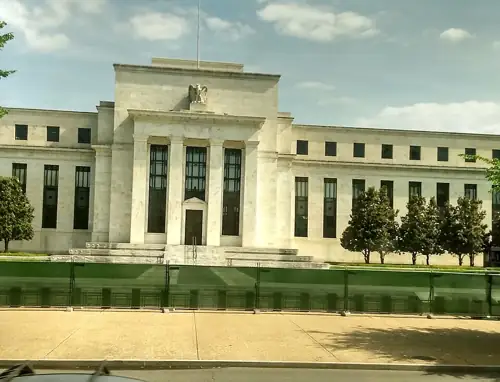
The Federal Reserve voted Wednesday to hold interest rates steady at 3.75% to 4%, less than a week before the midterm elections, while inflation climbed from 3.4% to 3.7% and gas prices kept soaring thanks to a war the president started. The central bank swears the timing is a coincidence, and an economist quoted by NPR admitted a hike right before the vote would have looked "suspicious." Cute word choice for a decision that happens to spare the party in power one more bad headline.
The Fed Blinks, Then Promises It Didn't
Here are the facts. The rate-setting committee left its benchmark rate unchanged on Wednesday, a month after raising it for the first time in more than three years. The vote was not unanimous. Ten members voted to hold, and two voted to raise by a quarter point: governor Lisa Cook and Cleveland Fed President Beth Hammack. September's hike, by contrast, passed 12 to 0, so someone clearly changed their mind in a hurry.
The statement was blunt about the problem. "Inflation remains elevated," the committee wrote, adding that more information will help it figure out how to ensure "a timely return of inflation to the Committee's 2 percent goal." That is central bank for "we know, we know, give us a minute."
Wall Street saw it coming. Investors shrugged, and the major indexes barely moved after the announcement. The only real drama was the two dissents, which is a bigger sign than anything in the statement.
Inflation Is Heading the Wrong Direction
Consumer prices in September were up 3.7% from a year ago, a faster annual pace than August's 3.4%. Core inflation, which strips out food and energy, ran at 2.6%. Both numbers came in above what economists expected. The Fed's preferred gauge, the personal consumption expenditures index, lands Thursday and is also expected to hit 3.7%.
"It's 'wrong way,'" said Dan North, a senior economist at Allianz Trade. "That inflation line is going up, not down." Fed Chairman Kevin Warsh admitted as much, saying inflation has run above the committee's target for close to six years. Six years. That is a long time to be "transitory."
The biggest driver is energy. The U.S. war with Iran has kept gas, diesel and crude oil prices elevated, and economists say the spillover is now showing up across the broader economy. Warsh said the Fed's job is to make sure those price jumps in some sectors do not broaden out. Translation: they already are, and he is hoping to catch it before it gets worse.
The Timing Is Convenient, and Everyone Knows It
The decision came less than a week before votes are tallied. North put it plainly: "It would be suspicious if there were a hike before the midterm." That is an economist saying out loud what the whole market was thinking. A rate hike makes credit cards, car loans and mortgages more expensive for the exact voters who are already furious about prices.
Those voters are furious, and the polling is ugly. NBC News found Trump's approval at 27% on the cost of living and 29% on the Iran war. Two-thirds of Americans said the soaring gas prices triggered by the war were a problem for them. When both of your signature issues poll like a root canal, you do not need the central bank adding a fresh round of financial pain on the Wednesday before Election Day.
To be fair, the president has spent years demanding lower rates, and the Fed just did the opposite of what he wants by hiking in September. Nobody here is accusing Warsh of doing Trump a favor on purpose. But the dissenters wanted a hike now, and the majority wanted to wait. Draw your own conclusions about why the majority felt so patient.
December Is Coming and It Brought Friends
The pause looks temporary. Economists widely expect a hike at the Dec. 8-9 meeting, and Oxford Economics' Michael Pearce said the dissents, the statement's wording and prior comments from officials all point that way. Samuel Tombs at Pantheon Macroeconomics said markets are pricing in another 0.75 percentage points of tightening over the next year. Morgan Stanley's economists said the Fed "might not be done tightening."
Warsh refused to confirm anything. Asked about December, he said, "A lot of things can happen, so I'm not going to be able to share with you my musings about what happens when this group gets together six weeks from now." He also described the internal debate as "a heck of a family fight, a serious, sober discussion." That is the most entertaining sentence the Federal Reserve has produced in years.
For regular people, the math is grim. Credit card rates, auto loans and holiday debt could all get pricier before the year ends. Mortgage rates already hit a three-year high of 7.4% earlier this month before easing slightly, and the housing market has been in a slump for four years.
Rich People Are Fine, Everyone Else Is Not
The economy is not collapsing, which is part of the problem. Consumer spending has stayed resilient, fueled in part by upper-income shoppers riding a rising stock market. The AI boom shows no sign of slowing either. "The A.I. companies don't care what interest rate they have to pay," North said. The frenzied push to build data centers is even pushing up prices for construction materials and electronic equipment, so the boom is feeding the inflation the Fed is trying to kill.
Meanwhile, average wages rose just 3% over the 12 months ending in September, well behind prices. Mark Zandi, chief economist at Moody's Analytics, said lower and middle-income Americans are "having a real struggle," and that their purchasing power is actually declining. "That's a pretty uncomfortable place to be," he said. It also explains why people tell pollsters they feel terrible about an economy that looks fine on a spreadsheet.
So you have a stock market that loves the AI gold rush, a wage gap that keeps widening, and a central bank that cannot cool prices without hammering the people who are already getting hammered. Fun system.
Warsh Also Wants to Vote Less Often
In the one genuinely surprising move of the day, Warsh announced changes to the Fed's meeting schedule. The central bank will keep meeting eight times a year, but starting in 2027, one meeting will be reserved for strategy discussion, with no rate vote and no policy statement. By 2028, two meetings would be discussion-only, leaving six for actual rate decisions.
Warsh said the change will improve the "quality" of decisions and give the group time for "strategic deliberations." It fits his broader push for less communication from Fed officials, which he argues preserves their flexibility.
Think about the optics here. The Fed is losing a fight with inflation that has dragged on for nearly six years, and its chairman used this particular Wednesday to announce that it will make fewer decisions. Maybe that is smart. It is also exactly the kind of announcement that makes a nervous public wonder who is steering this thing.
The Dingo Take
The Fed picked patience over pain six days before the election, and nobody should pretend that is an accident.
Maybe the data really did justify waiting. Maybe two dissents out of twelve is just healthy debate. But when an economist tells NPR that a hike right now "would be suspicious," he is describing a central bank that knows how this looks and went ahead anyway. The people paying for that caution are the ones already watching wages trail prices while the AI crowd throws money at data centers and doesn't care what borrowing costs.
Here is the part that should keep people up at night. Inflation is running at 3.7% because of a war the administration launched, gas prices are the number one voter complaint, and the one institution with the power to cool things off is waiting until the ballots are counted. December is coming, the hikes are coming, and the bill for the Iran war is landing on regular Americans no matter who wins on Tuesday.



Comments